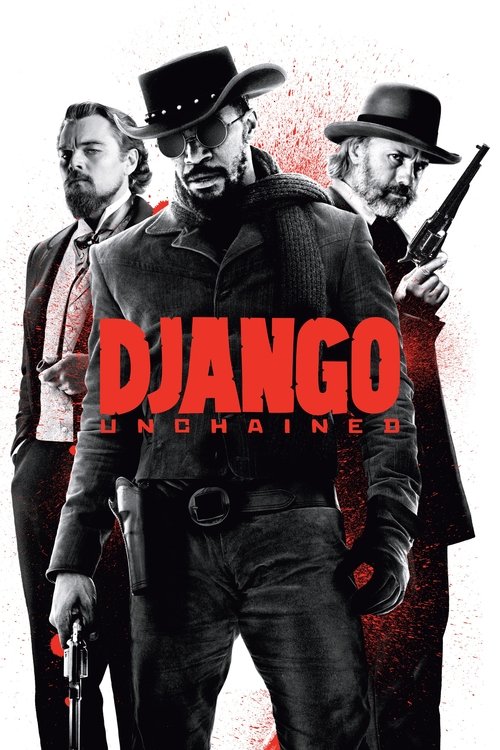
Django Unchained
A blood-soaked yet darkly comedic odyssey through the antebellum South, where a hero forged in chains carves a path of righteous vengeance, painting the snow-covered landscapes red with the price of freedom.
Django Unchained
Django Unchained

"Life, liberty, and the pursuit of vengeance."

25 December 2012 United States of America 165 min ⭐ 8.2 (27,108)
Director: Quentin Tarantino
Cast: Jamie Foxx, Christoph Waltz, Leonardo DiCaprio, Kerry Washington, Samuel L. Jackson
Drama Western
Revenge and Justice Freedom and Slavery Racism and Dehumanization Mythology and Storytelling
Budget: $100,000,000
Box Office: $425,368,238

Django Unchained - Ending Explained

⚠️ Spoiler Analysis

The plot of "Django Unchained" follows a clear path of escalating conflict towards a dramatic confrontation. After Django is freed by Dr. King Schultz, they form a partnership to hunt bounties. Schultz agrees to help Django rescue his wife, Broomhilda, leading them to the Mississippi plantation Candyland, owned by the sadistic Calvin Candie. Their elaborate ruse is to pretend to be interested in buying one of Candie's "Mandingo" fighters for an exorbitant price, planning to purchase Broomhilda on the side.

The plan unravels when Candie's cunning house slave, Stephen, realizes that Django and Broomhilda know each other. Cornered, Candie drops his facade of civility and forces them to buy Broomhilda for the outrageous price of $12,000. Schultz agrees, but as the deal is being finalized, Candie insists on shaking Schultz's hand to seal it. Revolted by Candie's barbarism, Schultz refuses, instead shooting and killing Candie with a hidden pistol. In the ensuing chaos, Schultz is killed, and Django is captured after a massive gunfight.

Instead of being killed, Django is sold to a mining company. However, during transport, he uses the handbill from his first kill to convince his Australian captors that he is a bounty hunter and that a large reward awaits them back at Candyland. Once they free him and give him a pistol, he kills them, steals their dynamite, and returns to the plantation. He rescues Broomhilda and exacts his final revenge, killing all of Candie's remaining henchmen and his sister. His final confrontation is with Stephen. Django shoots him in the kneecaps, leaving him helpless inside the main house as he lights a fuse to the dynamite he planted. Django and Broomhilda watch from a distance as the Candyland mansion, a symbol of slavery and oppression, explodes spectacularly. They then ride off together, free at last.

Alternative Interpretations

One significant alternative interpretation focuses on the character of Dr. King Schultz, arguing that the film is as much, if not more, his story as it is Django's. This reading suggests the film is a dual hero's journey. Schultz begins as a morally ambiguous killer-for-hire who uses Django for his own ends. His journey, however, leads him to a profound moral reckoning. His disgust with Candie's depravity forces him to evolve from a pragmatic capitalist into a man who sacrifices his life for a principle—the refusal to dignify evil by shaking Candie's hand. In this view, Schultz's final act is the film's moral climax, and Django's subsequent rampage is the explosive, cathartic epilogue.

Another interpretation challenges the film's label as a simple "revenge fantasy." Some analysts argue that Django's primary goal is not revenge but rescue. His mission is centered on love and reunification with Broomhilda. While he certainly enacts vengeance upon those who wronged him, these acts are secondary to his core objective. The destruction of his oppressors is a necessary consequence of his quest for liberation, not the quest itself. This perspective reframes the narrative from one of pure retribution to a heroic love story set against the brutal backdrop of slavery.