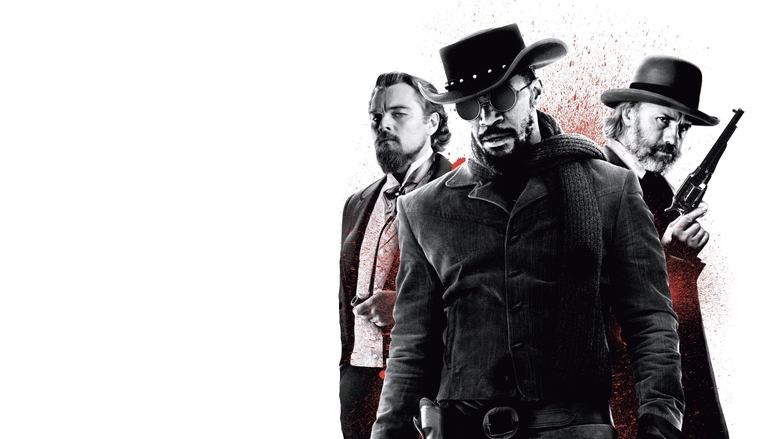
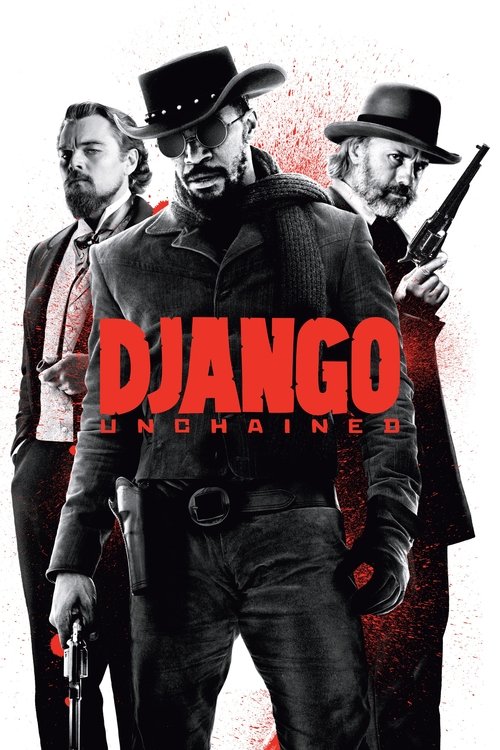
"Life, liberty, and the pursuit of vengeance."
Django Unchained - Symbolism & Philosophy
Symbols & Motifs
Broomhilda and the Siegfried Legend
Broomhilda's name directly references the German legend of Siegfried and Brünnhilde (Broomhilda), in which the hero must overcome great obstacles, including a mountain and a dragon, to rescue his love. This allegory frames Django's quest as a heroic, mythical endeavor. Candyland becomes the mountain, and Calvin Candie the dragon that Django must slay to save his princess.
Dr. Schultz, being German, is the one who explains the legend to Django after learning his wife's name. This knowledge gives Django's personal mission a grander, epic significance and solidifies his resolve, as he tells Schultz, "I know how he feel."
The Blue Suit
Django's flamboyant blue suit, which he chooses for himself, symbolizes his transformation from a slave into a free man with agency and a distinct identity. It is an allusion to Thomas Gainsborough's 1770 painting "The Blue Boy." The act of a Black man choosing such an aristocratic and conspicuous outfit is a bold act of defiance against the subservient role forced upon him by society.
Django wears this outfit when he acts as Schultz's valet at "Big Daddy" Bennett's plantation. The sight of a Black man in such attire, treated as an equal, is shocking to the plantation owners and underscores the reversal of power dynamics as Django proceeds to whip one of the overseers who had previously abused him.
Dr. Schultz's Tooth Wagon
The large, wobbling tooth on top of Dr. Schultz's carriage serves as a symbol of his cover profession as a dentist. It represents his methodology: just as a dentist extracts rotten teeth, Schultz extracts evil and corruption (wanted criminals) from society. The symbolism is further extended by the fact that his main adversary is named "Candie," whose plantation is "Candyland"—sweets that cause the decay Schultz is equipped to remove.
The tooth wagon is a prominent visual in the film's first act. It's the vehicle in which Schultz, a man of intellect and principle, travels through a barbaric land, bringing his unique form of justice. It establishes his character as both quirky and dangerous.
The Bounty Hunter's Handbill
The handbill from Django's first solo bounty kill, which he keeps, represents his official entry into the world of bounty hunting and his new identity as a free man. It is a tangible document proving his skill, his worth, and his right to kill white men under the sanction of the law, a complete inversion of the power dynamics of slavery.
After successfully collecting his first bounty, Schultz gives Django the handbill and the money. Django keeps the paper, and it later becomes crucial for his survival. When he is captured and being sent to a mining camp, he uses the handbill to prove he is a bounty hunter and trick his captors into freeing him, promising them a share of a non-existent bounty back at Candyland.
Philosophical Questions
Is extreme violence a justifiable response to systemic evil?
The film poses this question by presenting a world where law and morality are inverted; the legal system protects the monstrous institution of slavery. Django and Schultz operate as bounty hunters, sanctioned by the law to kill, but their most significant acts of violence are directed against the 'legal' slave owners. The film's stylized, often cathartic violence against oppressive figures suggests that when systems of justice are corrupt, personal, violent retribution becomes a valid, and perhaps the only, form of moral action. It forces the audience to consider whether turning the tools of oppression back on the oppressor is a righteous act of liberation or a descent into the same brutality.
What is the nature of freedom?
"Django Unchained" explores freedom as more than just the absence of shackles. Initially, Django is legally freed by Schultz, given papers, and paid for his work. However, he is not truly 'unchained' until he reclaims his identity, asserts his agency, and liberates his wife, the repository of his past and future. The film suggests that true freedom requires self-definition, the ability to protect one's loved ones, and the power to dismantle the very structures of one's oppression. Django's final act of blowing up the Candyland plantation is the ultimate expression of this idea—he doesn't just escape the system, he destroys it.
Can one maintain morality in an utterly immoral world?
Dr. King Schultz embodies this struggle. He is a man of culture, education, and principle who works as a killer-for-hire. He navigates the brutal world of the antebellum South with a detached, ironic civility. However, the sheer depravity of Calvin Candie forces him to a breaking point. His refusal to shake Candie's hand, a seemingly minor social gesture, becomes an absolute moral stand. He cannot abide the pretense of civility with such a monster and chooses death over compromising his conscience. His journey questions whether it's possible to engage with evil, even to fight it, without being corrupted, and suggests that at a certain point, a moral line must be drawn, regardless of the consequences.
Core Meaning
"Django Unchained" is a revisionist Western that uses the conventions of the genre to confront the brutal legacy of slavery in America. Director Quentin Tarantino crafts a narrative of empowerment and revenge, transforming a brutal historical reality into a stylized, cinematic fantasy. The core message is one of liberation, not just from physical chains but from the psychological and systemic oppression of slavery. By placing a Black hero at the center of a Western, a genre that has historically marginalized non-white characters, the film reclaims and reshapes American mythology. It posits that in the face of absolute inhumanity, violent retribution is not just a cathartic fantasy but a justified path to reclaiming one's identity and achieving a form of justice where none is legally available.