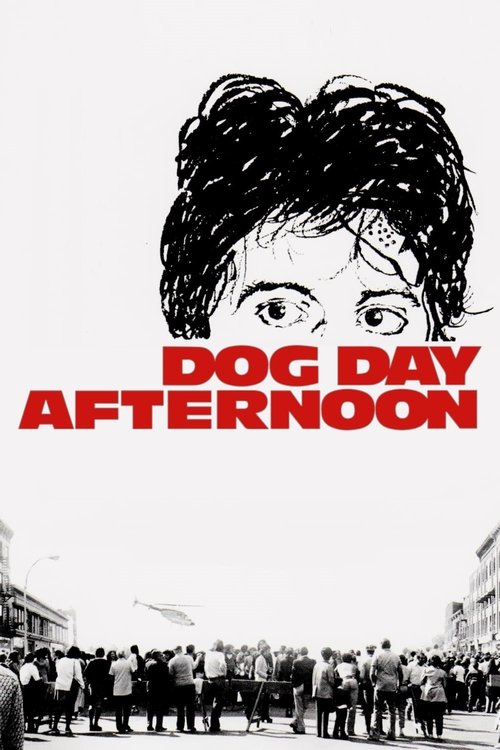
"Anything can happen during the dog days of summer. On August 22nd, 1972, everything did."
Dog Day Afternoon - Ending Explained
⚠️ Spoiler Analysis
The narrative of "Dog Day Afternoon" is a slow-motion tragedy, where every decision Sonny makes digs him deeper into a hole from which there is no escape. The central twist, revealed midway through the film, is the true motivation for the robbery: Sonny needs money to pay for his lover Leon's gender-affirming surgery. This re-contextualizes the entire film, shifting it from a standard heist movie into a desperate love story. The poignant phone call between Sonny and Leon, where Leon reveals he is in a psychiatric hospital after a suicide attempt, adds another layer of tragedy, showing that Sonny's grand, reckless gesture is unwanted and is only causing more pain.
The development of a quasi-Stockholm Syndrome between Sonny and the hostages is a key element. He never intends to hurt them, and his genuine concern for their welfare (like letting one employee go to the bathroom) fosters an unusual bond. They cease to see him purely as a monster, and instead as a complicated, overwhelmed man. This humanization makes the film's violent climax all the more shocking.
The ending is brutally swift and inevitable. Despite all the negotiations and Sonny's elaborate performance for the media, the authorities are simply waiting for their moment. At the airport, as Sonny believes he is on the verge of escape, FBI Agent Murphy shoots Sal in the head, killing him instantly. Sonny is immediately arrested. There is no glorious escape or final standoff. The system he railed against extinguishes the threat with cold efficiency. The final shots of Sonny's devastated face as he watches Sal's body being taken away reveal the complete and utter failure of his plan. The closing text reveals that Sonny was sentenced to 20 years, and that Leon eventually had her surgery, a bittersweet and hollow victory that cost Sal his life and Sonny his freedom.
Alternative Interpretations
While the film is largely seen as a sympathetic portrait of a desperate man, some interpretations offer a more critical view of Sonny. One perspective is that Sonny is not a noble anti-hero, but a deeply selfish and destructive individual who uses his love for Leon as a justification for his own chaotic impulses and desire for attention. This reading suggests that the robbery is less about helping Leon and more about Sonny's own narcissism and need to be the center of a grand drama. His manipulation of the media and the crowd can be seen as evidence of a man who thrives on spectacle, regardless of the danger it poses to others, including Sal and the hostages.
Another interpretation focuses on the film as an allegory for the Vietnam War experience. Sonny is a veteran, and his erratic behavior, his feeling of being under siege, and his lashing out against authority can be read as a manifestation of post-traumatic stress. In this view, the bank is a stand-in for a battlefield, and the chaotic, unwinnable situation reflects the absurdity and trauma of the war itself. His rebellion is not just against the police in front of him, but against the entire system that sent him to war and then abandoned him.
Finally, a more cynical interpretation suggests the film is a critique of the very idea of rebellion in a media-saturated age. By turning his standoff into "entertainment," Sonny's protest is ultimately co-opted and neutralized by the system he's fighting. He becomes a temporary celebrity, a fleeting image on a TV screen, but nothing actually changes. The system wins, Sal is killed, and Sonny is imprisoned. This reading suggests that authentic rebellion is impossible when the media can instantly turn any act of defiance into a consumable product for the masses.