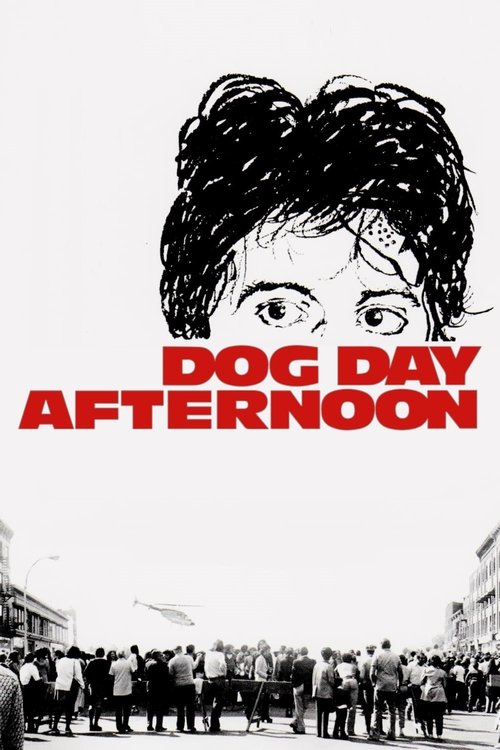
Dog Day Afternoon
"Anything can happen during the dog days of summer. On August 22nd, 1972, everything did."
Overview
Based on a true story, "Dog Day Afternoon" chronicles a sweltering August day in Brooklyn when first-time crook Sonny Wortzik (Al Pacino) and his accomplice Sal Naturile (John Cazale) attempt to rob a bank. The plan immediately falls apart when they discover the bank has already sent out most of its cash, leaving them with just over a thousand dollars. The situation quickly escalates as the police surround the building, turning a simple robbery into a tense, fourteen-hour hostage standoff.
As the day wears on, the bank becomes the epicenter of a media circus, with crowds gathering on the street to both cheer and jeer the robbers. Sonny, an erratic but strangely sympathetic Vietnam veteran, becomes an unlikely folk hero, railing against the police and the establishment. The film delves deep into Sonny's personal life, revealing the desperate and unconventional motive behind the robbery: to pay for his lover Leon Shermer's (Chris Sarandon) gender-affirming surgery. The narrative masterfully balances the intense hostage negotiations with moments of dark humor and profound human drama, exploring the complex relationships that form between the captors and their hostages under extreme pressure.
Core Meaning
At its heart, "Dog Day Afternoon" is a powerful statement about the desperation of the marginalized and the creation of spectacle by the mass media. Director Sidney Lumet wanted to explore the human story behind a bizarre headline, focusing on an anti-hero pushed to extremes by a society that has no place for him. The film is a raw and scathing critique of institutional power, from the police to the media, and a deeply empathetic portrait of a man's flawed attempt to care for someone he loves in the only way he knows how. It carries a message about how society's outcasts can become unwilling celebrities in a world hungry for entertainment, and the tragic consequences of that fleeting fame. The core idea is not about the crime itself, but about the deeply human, albeit misguided, motivations behind it and the societal failures that lead to such desperate acts.
Thematic DNA
Anti-Establishment and Rebellion
The film channels the anti-authoritarian sentiment of the 1970s. Sonny's defiance of the police and the FBI transforms him into a counter-cultural hero for the onlooking crowd. His famous chant of "Attica! Attica!" directly invokes the deadly 1971 prison riot, positioning his personal struggle as part of a larger fight against oppressive state power. The film portrays law enforcement not as protectors, but as a hostile, overwhelming force, turning the botched robbery into a symbol of the individual versus the system.
Media Spectacle and the Nature of Celebrity
"Dog Day Afternoon" is a prescient examination of how the media turns real-life tragedy into mass entertainment. The hostage crisis quickly becomes a live television event, a "circus sideshow." Sonny understands and manipulates this, declaring, "We're entertainment." The film explores the symbiotic relationship between Sonny and the media; they give him a platform and a sense of power, and he provides them with a sensational story. This theme is highlighted when even a pizza delivery boy involved in the scene declares, "I'm a star!", showcasing the pervasive desire for fame in the television age.
LGBTQ+ Identity and Marginalization
For its time, the film was groundbreaking in its portrayal of a queer protagonist. The revelation that Sonny is robbing the bank for his partner Leon's gender-affirming surgery is the story's emotional core. The film treats their relationship with sensitivity and realism, a stark contrast to the often stereotypical or villainous portrayals of queer characters in that era. It explores the desperation born from societal intolerance and the lengths one might go to for love and identity, making it a landmark film in queer cinema.
Desperation and Flawed Masculinity
Sonny Wortzik is a portrait of fractured masculinity. He's a Vietnam veteran, a husband to two women (one cis, one trans), a father, and a failed provider. His frantic energy and emotional volatility stem from a profound sense of powerlessness. The bank robbery is his desperate, last-ditch attempt to assert control and fulfill what he sees as his responsibility to the person he loves. The film deconstructs traditional notions of a male protagonist, presenting a main character who is vulnerable, confused, and driven by love rather than greed.
Character Analysis
Sonny Wortzik
Al Pacino
Motivation
Sonny's primary motivation is love and a misguided sense of responsibility. He is robbing the bank to get enough money for his partner, Leon, to have gender-affirming surgery. This act is born of desperation, a last resort after being failed by legitimate societal systems. He is driven by a desire to provide for and protect the person he loves, even if it means resorting to crime.
Character Arc
Sonny begins the film as a determined, if inept, bank robber. As the heist fails and becomes a protracted standoff, his character arc is one of rapid unraveling and transformation. He evolves from a criminal into a reluctant public figure, a mouthpiece for the disenfranchised, and a deeply vulnerable man forced to confront his personal failures on a public stage. His initial confidence devolves into desperation and finally, devastating acceptance of his fate as he loses everything he was fighting for.
Salvatore 'Sal' Naturile
John Cazale
Motivation
Sal's motivations are less clear than Sonny's, which makes him more frightening. He seems to be motivated by loyalty to Sonny and a fatalistic acceptance of a criminal path. He is repeatedly shown to be ready to kill if necessary, viewing it as the only way to maintain control and survive the situation. His most explicit desire is to escape to a place like Wyoming, a naive and impossible dream that highlights his disconnect from reality.
Character Arc
Sal's arc is tragically static. He enters the bank as a nervous but committed accomplice and remains a quiet, menacing, and unpredictable presence throughout. He does not evolve but rather disintegrates under the pressure. His anxiety and fear manifest as a stony, dangerous resolve. His journey is a descent into inevitable doom, a man who knows he is a "dead man walking" and can see no way out but through violence or death.
Detective Sergeant Eugene Moretti
Charles Durning
Motivation
Moretti is motivated by a professional duty to end the standoff without any casualties. He is a pragmatist, willing to negotiate and make concessions to keep the hostages safe. He is focused on resolving the crisis with the least amount of violence possible, putting him in direct conflict with both Sonny's erratic demands and the FBI's more aggressive tactics.
Character Arc
Moretti's arc is one of diminishing control. He starts as the primary negotiator, a seasoned, street-smart cop trying to de-escalate a dangerous situation through dialogue and psychological maneuvering. He builds a rapport with Sonny, however strained. His arc concludes as he is sidelined by the FBI, representing the replacement of street-level, human-to-human policing with a colder, more clinical federal approach.
Leon Shermer
Chris Sarandon
Motivation
Leon is motivated by a desire for survival and authenticity. While he is the reason for the robbery, he never asked for it and is horrified by Sonny's actions. His main goal is to get through his own personal and medical crisis. He seeks peace and the ability to live as himself, something that Sonny's violent, public spectacle actively undermines.
Character Arc
Leon appears only briefly but is central to the film's emotional core. His arc is revealed through a poignant and largely improvised phone call with Sonny. He has moved from a place of love and dependence on Sonny to a state of emotional exhaustion and self-preservation, having been institutionalized after a suicide attempt. He represents the real-world emotional fallout of Sonny's chaotic life and ultimately rejects Sonny's criminal means of 'helping' him, choosing his own well-being over the fraught relationship.
Symbols & Motifs
The Oppressive Heat
The film is set on a scorching hot "dog day afternoon," which symbolizes the mounting pressure, tension, and claustrophobia of the situation. The heat is a palpable, oppressive force that mirrors the characters' frayed nerves and the inescapable nature of their predicament. It contributes to the feeling that everything is about to boil over.
The film's title itself emphasizes the heat. Characters are constantly shown sweating and looking exhausted. The oppressive atmosphere of the bank is amplified by the unrelenting summer weather, visually reinforcing the high-stakes, pressure-cooker environment both inside and outside the bank.
The Bank
The bank symbolizes the institutions of power and capitalism that have failed Sonny. It is a place of money, yet there is none for him when he needs it, reflecting his economic disenfranchisement. Trapped inside, the bank becomes a microcosm of society—a confined space where societal rules break down and new, temporary power structures are formed.
Almost the entire film is set within the confines of the First Brooklyn Savings Bank. The initial plan to quickly rob it fails, turning the building from a target into a prison. The interactions between Sonny, Sal, and the hostages within this space highlight themes of Stockholm syndrome and the breakdown of traditional authority.
The Crowd
The crowd that gathers outside the bank symbolizes the fickle nature of public opinion and the audience's role in the media spectacle. They are a volatile, unpredictable force, at times cheering for Sonny as an anti-hero and at other times simply hungry for a dramatic event. They represent a society that is both alienated from and fascinated by acts of rebellion.
The crowd is a constant presence, reacting to Sonny's every move. Their cheers fuel his performance, most notably when he chants "Attica! Attica!". They transform the crime scene into a public stage, blurring the line between a real crisis and a piece of theater.
Memorable Quotes
Attica! Attica!
— Sonny Wortzik
Context:
Sonny screams this chant at the police and the growing crowd outside the bank after realizing the police are moving in on him. He feels cornered and betrayed, and his outburst electrifies the onlookers, turning the tense standoff into a public rally against the authorities.
Meaning:
This is the film's most iconic line, an improvised cry that connects Sonny's personal rebellion to the larger struggle against state oppression. By invoking the 1971 Attica Prison riot, a brutal and deadly event, Sonny frames himself as a victim of a violent system, instantly gaining the sympathy of the crowd and cementing his status as an anti-establishment folk hero.
Is there any special country you wanna go to?
— Sonny Wortzik to Sal Naturile
Context:
During a moment of negotiation, Sonny asks Sal where he'd like to be flown to once they get a plane. The conversation happens inside the bank as they discuss their demands with the police, revealing the fantastical and ultimately doomed nature of their aspirations.
Meaning:
This exchange reveals the tragic naivety at the heart of their plan. Sal's quiet, deadpan response, "Wyoming," underscores how unprepared and out of his depth he is. Wyoming not being a country is a moment of dark, pathetic humor that highlights Sal's simple-mindedness and the utter hopelessness of their dream of escape. The line, ad-libbed by John Cazale, perfectly encapsulates his character.
Kiss me. When I'm being fucked, I like to get kissed a lot.
— Sonny Wortzik
Context:
Sonny says this during his emotionally charged phone conversation with Leon, who has been brought to the scene by the police from a psychiatric hospital. The call is a raw, painful negotiation of their broken relationship, and this line is Sonny's desperate attempt to reconnect on an intimate level.
Meaning:
This raw, vulnerable line spoken to Leon over the phone encapsulates Sonny's desperation and the complex dynamic of his and Leon's relationship. It's a plea for intimacy and affection in a moment of utter humiliation and defeat. The line powerfully conveys his feeling of being metaphorically (and soon, literally) 'fucked' by the situation and his need for a human connection amidst the chaos.
I'm a Catholic, and I don't want to hurt anybody.
— Sonny Wortzik
Context:
Sonny says this to the bank manager, Mulvaney, at the very beginning of the robbery when he suspects the manager is trying to trigger a silent alarm. It's an attempt to assert control while simultaneously reassuring his victim (and himself) that he is not a killer.
Meaning:
This line, spoken early in the robbery, establishes Sonny's fundamental internal conflict. Despite committing a violent felony, he sees himself as a moral person who is being forced into this situation. It highlights his self-perception as a good person doing a bad thing for the right reasons, a theme that runs through the entire film as he consistently shows concern for the hostages' well-being.
Philosophical Questions
Can an immoral act be justified by a moral or loving intention?
The entire film hinges on this question. Sonny commits a dangerous crime—armed robbery and kidnapping—which is unequivocally wrong. However, his motivation is to help someone he loves achieve self-actualization. The film forces the audience to grapple with this conflict, creating sympathy for a man whose actions are illegal and reckless but whose intentions are rooted in love and desperation. It explores the gray area between right and wrong, asking whether the 'why' can ever excuse the 'what'.
Where is the line between news and entertainment?
"Dog Day Afternoon" meticulously documents the media's role in transforming a violent crime into a public spectacle. The news crews, the live reports, and the cheering crowds all blur the distinction between a real-life crisis and a television show. The film questions the ethics of media coverage, suggesting that the drive for ratings and a sensational story can overshadow the human tragedy at its center. Sonny's own awareness and manipulation of the cameras further complicates this, as he becomes both a subject of the news and a performer for it.
What is the nature of power and authority?
The film constantly interrogates power dynamics. Inside the bank, Sonny, an outcast, wields absolute power over his hostages, yet he is powerless against the police force surrounding him. The police have the power of the state, but are constrained by public opinion and the media. The crowd, individually powerless, wields collective power by turning Sonny into a folk hero. The film suggests that power is fluid, performative, and often illusory, shifting dramatically based on context and perception.
Alternative Interpretations
While the film is largely seen as a sympathetic portrait of a desperate man, some interpretations offer a more critical view of Sonny. One perspective is that Sonny is not a noble anti-hero, but a deeply selfish and destructive individual who uses his love for Leon as a justification for his own chaotic impulses and desire for attention. This reading suggests that the robbery is less about helping Leon and more about Sonny's own narcissism and need to be the center of a grand drama. His manipulation of the media and the crowd can be seen as evidence of a man who thrives on spectacle, regardless of the danger it poses to others, including Sal and the hostages.
Another interpretation focuses on the film as an allegory for the Vietnam War experience. Sonny is a veteran, and his erratic behavior, his feeling of being under siege, and his lashing out against authority can be read as a manifestation of post-traumatic stress. In this view, the bank is a stand-in for a battlefield, and the chaotic, unwinnable situation reflects the absurdity and trauma of the war itself. His rebellion is not just against the police in front of him, but against the entire system that sent him to war and then abandoned him.
Finally, a more cynical interpretation suggests the film is a critique of the very idea of rebellion in a media-saturated age. By turning his standoff into "entertainment," Sonny's protest is ultimately co-opted and neutralized by the system he's fighting. He becomes a temporary celebrity, a fleeting image on a TV screen, but nothing actually changes. The system wins, Sal is killed, and Sonny is imprisoned. This reading suggests that authentic rebellion is impossible when the media can instantly turn any act of defiance into a consumable product for the masses.
Cultural Impact
"Dog Day Afternoon" was a critical and commercial success that left a significant mark on 1970s American cinema. Released in a post-Watergate, post-Vietnam era of widespread cynicism towards government and authority, the film perfectly captured the zeitgeist. Sonny Wortzik became an iconic anti-hero, a symbol of the common man raging against an oppressive system, resonating deeply with audiences.
Its most profound and lasting impact was in the realm of LGBTQ+ representation in mainstream film. At a time when queer characters were rare, and often depicted as caricatures or villains, "Dog Day Afternoon" presented a complex, sympathetic bisexual protagonist and made his love for a transgender woman the central motivation of the plot. It was a groundbreaking moment, with a major star like Al Pacino playing an openly queer character in a way that was treated with emotional sincerity rather than as a joke. This helped to humanize queer experiences for a mass audience in an unprecedented way.
The film's realistic, documentary-like style, influenced by the New Hollywood movement, was highly influential. Its raw energy, use of improvisation, and on-location shooting became hallmarks of the era's gritty filmmaking. The film's themes of media sensationalism were also remarkably prescient, anticipating the rise of 24-hour news cycles and reality television. It won the Academy Award for Best Original Screenplay and remains a celebrated classic, studied for its powerful performances, taut direction, and daring social commentary.
Audience Reception
Upon its release, "Dog Day Afternoon" was met with widespread critical acclaim and was a box office success. Audiences were captivated by the film's raw intensity and, in particular, Al Pacino's electrifying performance as Sonny Wortzik, which was universally praised as one of his best. Viewers were drawn to the film's blend of high-stakes tension, dark humor, and unexpected pathos. The humanistic portrayal of the characters, including the bank tellers who develop a complex rapport with their captors, was frequently highlighted as a strength.
The film's progressive and sensitive handling of its queer themes was noted by many, though it was also a point of discussion and, for some, controversy in 1975. The central motivation of the robbery being for a sex-change operation was a bold and challenging element for mainstream audiences of the time.
Points of criticism are sparse, but some viewers found the chaotic, almost documentary-style pacing to be jarring or felt the film's focus on Sonny left other characters, particularly Sal, somewhat underdeveloped. However, the overwhelming verdict from audiences then and now is that "Dog Day Afternoon" is a masterclass in acting, directing, and screenwriting—a powerful, funny, and tragic snapshot of 1970s America that remains compelling and relevant decades later.
Interesting Facts
- The film is based on the real-life story of John Wojtowicz and Salvatore Naturile, which was documented in a Life magazine article titled "The Boys in the Bank".
- Much of the dialogue was improvised by the actors after weeks of rehearsal, which director Sidney Lumet encouraged to create a more naturalistic feel.
- The iconic "Attica! Attica!" chant was improvised by Al Pacino.
- Director Sidney Lumet used no artificial lighting for much of the filming, relying on the bank's actual fluorescent lights to enhance the documentary-style realism.
- The film has no musical score, apart from Elton John's "Amoreena" playing from a car radio in the opening scene, to avoid sensationalizing the events and maintain a sense of reality.
- Al Pacino was so exhausted by the emotional and physical intensity of the role that he collapsed after filming and was briefly hospitalized.
- John Cazale, who played Sal, was 39 years old at the time, whereas the real Salvatore Naturile was only 18. Pacino insisted on his casting.
- Chris Sarandon and Al Pacino's lengthy, emotional phone call was largely improvised.
- The film was shot mostly in chronological sequence to help the actors maintain the escalating emotional tension of the day-long ordeal.
⚠️ Spoiler Analysis
Click to reveal detailed analysis with spoilers
Frequently Asked Questions
Explore More About This Movie
Dive deeper into specific aspects of the movie with our detailed analysis pages
Comments (0)
No comments yet. Be the first to share your thoughts!