
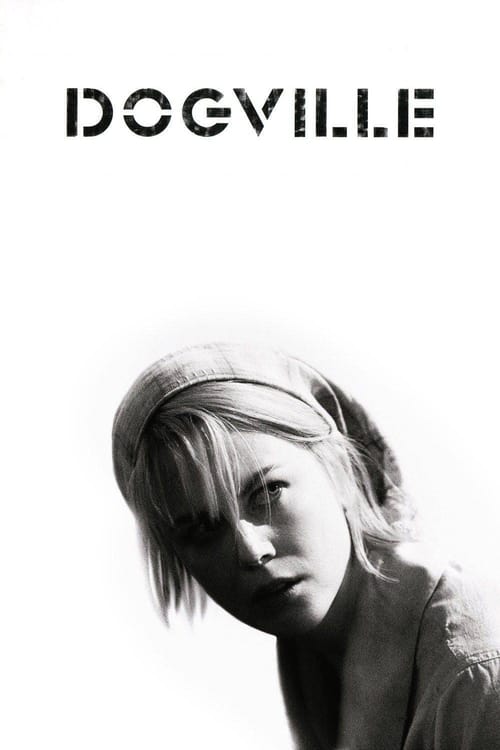
"A quiet little town not far from here."
Dogville - Symbolism & Philosophy
Symbols & Motifs
The Chalk Lines
They symbolize the fragility of civilization and the artificiality of social boundaries. They force the audience to see the "invisible" truth—that privacy is an illusion and that the town's moral decay is happening in plain sight.
The entire set consists of white lines drawn on a black floor to designate houses and streets. Actors mime opening doors, emphasizing that the barriers between them are mental, not physical.
The Porcelain Figurines
These represent Grace's fragile ideals, her dignity, and the only tangible possessions she has. Their destruction symbolizes the town's complete domination over her spirit.
Grace buys seven figurines from the local shop. Later, in a scene of cruel coercion, Vera smashes them one by one to force Grace to suppress her emotions, mirroring the town's crushing of her humanity.
Moses (The Dog)
Moses represents honest nature. Unlike the humans who lie to themselves, the dog acts according to its nature (biting when his bone is stolen). He is the only resident spared because he never pretended to be anything other than a dog.
For most of the film, the dog is just a chalk outline labeled "DOG." In the final shot, he becomes real flesh and blood, barking at the burning town.
Light and Changing Seasons
Light represents the harsh truth that exposes the town's sins. As the seasons change, the "merciful" light that once hid their flaws becomes a penetrating glare that reveals every imperfection.
The narrator explicitly describes how the light changes, signaling the shift from the town's acceptance of Grace to their exposure as monsters.
Philosophical Questions
Is unconditional forgiveness actually a vice?
The film suggests that forgiving everyone for everything removes their agency and dignity. If we don't hold people to ethical standards, we treat them like animals, which is the ultimate form of arrogance.
Does environment determine morality?
Von Trier explores whether the townspeople are evil by nature or if their poverty and isolation force them into evil. Grace initially excuses them based on their circumstances, but ultimately rejects this, holding them personally accountable.
What is the nature of justice?
Is justice about rehabilitation and mercy, or is it about retribution and elimination? The film ends with a terrifying endorsement of retributive justice as the only way to "make the world a better place."
Core Meaning
The Arrogance of Unconditional Forgiveness. Lars von Trier uses Dogville to challenge the traditional Christian notion of turning the other cheek. The film argues that infinite forgiveness is not a virtue but a form of moral arrogance—by refusing to judge others for their actions, one denies their humanity and responsibility.
Through the character of Grace, the director demonstrates that allowing oneself to be a victim without seeking justice ultimately breeds evil in the oppressors. The film serves as a cynical critique of communal hypocrisy and suggests that true morality requires the fortitude to hold others accountable, even if it means delivering ruthless judgment.