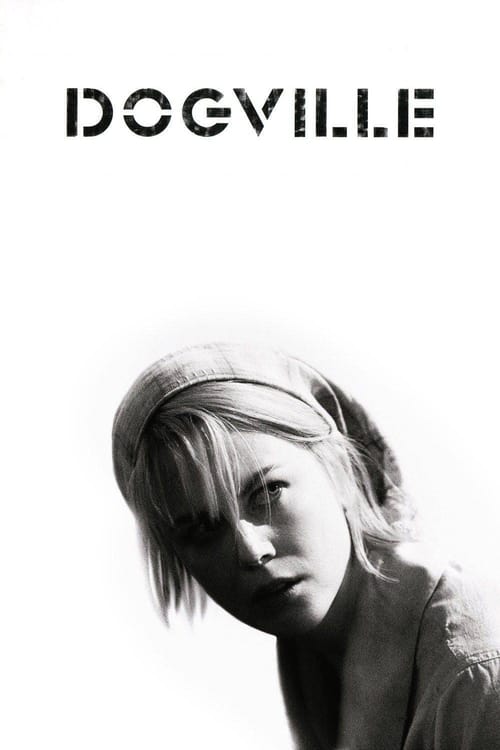
Dogville
"A quiet little town not far from here."
Overview
In the depression-era Rocky Mountains, a fugitive named Grace arrives in the isolated township of Dogville. Pursued by gangsters, she is offered sanctuary by Tom Edison Jr., the town's self-appointed moral philosopher. He convinces the skeptical residents to hide her in exchange for her labor, initiating a "moral experiment" to prove the town's inherent goodness.
Initially, Grace's presence brings light to the community, and she forms bonds with the quirky inhabitants. However, as the police search intensifies and the town realizes the leverage they hold over her, the dynamic shifts. The residents' demands grow from reasonable chores to exploitation, abuse, and enslavement, stripping Grace of her dignity while maintaining a facade of neighborly righteousness.
The film is visually unique, shot entirely on a black soundstage with minimal props and chalk outlines representing houses and streets. This transparency forces the audience to witness every act of betrayal and cruelty without the shelter of walls, culminating in a devastating confrontation when Grace's past finally catches up with her.

Core Meaning
The Arrogance of Unconditional Forgiveness. Lars von Trier uses Dogville to challenge the traditional Christian notion of turning the other cheek. The film argues that infinite forgiveness is not a virtue but a form of moral arrogance—by refusing to judge others for their actions, one denies their humanity and responsibility.
Through the character of Grace, the director demonstrates that allowing oneself to be a victim without seeking justice ultimately breeds evil in the oppressors. The film serves as a cynical critique of communal hypocrisy and suggests that true morality requires the fortitude to hold others accountable, even if it means delivering ruthless judgment.
Thematic DNA
The Arrogance of Forgiveness
The film's central philosophical pivot reveals that Grace's refusal to judge the townspeople is actually condescending. By forgiving them for atrocities she would never permit herself to commit, she treats them as inferior beings (like dogs) incapable of higher ethics, rather than as equal moral agents responsible for their choices.
Power and Exploitation
Dogville illustrates how power corrupts seemingly decent people. When the town realizes Grace is defenseless and dependent, their collective morality disintegrates. The transition from hospitality to slavery highlights the terrifying speed at which human rights can be stripped away when checks and balances are removed.
Hypocrisy of the Community
The town prides itself on being "good, honest folks," yet they collectively rationalize rape and slavery. Tom Edison Jr. epitomizes this as the intellectual who uses high-minded rhetoric to justify his own cowardice and manipulation. The invisible walls metaphorically show that their private sins are visible to all, yet ignored.
The Outsider as Scapegoat
Grace serves as the classic sacrificial lamb. The town projects their frustrations and desires onto her. Her status as a stranger allows them to suspend their usual social contracts, treating her as a commodity rather than a neighbor.
Character Analysis
Grace Mulligan
Nicole Kidman
Motivation
Initially: To escape her father's criminal world and find goodness in ordinary people.
Finally: To rid the world of the evil she has witnessed, believing it is the only moral choice left.
Character Arc
She begins as a martyr, endlessly turning the other cheek and seeking acceptance through service. After suffering horrific abuse, she undergoes a radical transformation (the "metanoia"), realizing her forgiveness was arrogance, and becomes the agent of the town's apocalyptic destruction.
Tom Edison Jr.
Paul Bettany
Motivation
To be the spiritual leader of Dogville and to use Grace as an "illustration" for his philosophical lectures.
Character Arc
Tom presents himself as the town's moral compass and Grace's savior. However, his desire for power and his fear of confrontation lead him to betray Grace repeatedly. He ultimately calls the gangsters to remove her, proving he is the most dangerous resident of all.
The Big Man
James Caan
Motivation
To bring his daughter back and teach her that wielding power and judgment is a necessary part of leadership.
Character Arc
He appears as the antagonist Grace flees from, but reveals himself to be the voice of harsh reality. He serves as the catalyst for Grace's final transformation, debating her on the nature of morality.
Chuck
Stellan Skarsgård
Motivation
To exercise dominance and take what he believes he is owed by a world that has disappointed him.
Character Arc
Initially the most skeptical of Grace, he becomes her first rapist. He represents the raw, animalistic exploitation that lies beneath the town's polite surface.
Symbols & Motifs
The Chalk Lines
They symbolize the fragility of civilization and the artificiality of social boundaries. They force the audience to see the "invisible" truth—that privacy is an illusion and that the town's moral decay is happening in plain sight.
The entire set consists of white lines drawn on a black floor to designate houses and streets. Actors mime opening doors, emphasizing that the barriers between them are mental, not physical.
The Porcelain Figurines
These represent Grace's fragile ideals, her dignity, and the only tangible possessions she has. Their destruction symbolizes the town's complete domination over her spirit.
Grace buys seven figurines from the local shop. Later, in a scene of cruel coercion, Vera smashes them one by one to force Grace to suppress her emotions, mirroring the town's crushing of her humanity.
Moses (The Dog)
Moses represents honest nature. Unlike the humans who lie to themselves, the dog acts according to its nature (biting when his bone is stolen). He is the only resident spared because he never pretended to be anything other than a dog.
For most of the film, the dog is just a chalk outline labeled "DOG." In the final shot, he becomes real flesh and blood, barking at the burning town.
Light and Changing Seasons
Light represents the harsh truth that exposes the town's sins. As the seasons change, the "merciful" light that once hid their flaws becomes a penetrating glare that reveals every imperfection.
The narrator explicitly describes how the light changes, signaling the shift from the town's acceptance of Grace to their exposure as monsters.
Memorable Quotes
Dogs can be taught many useful things, but not if we forgive them every time they obey their own nature.
— The Big Man
Context:
The climax of the film, during the conversation in the Cadillac between Grace and her father, just before she decides the town's fate.
Meaning:
This is the film's thesis statement. It argues that holding people accountable is necessary for civilization, and that infinite forgiveness essentially reduces humans to the status of animals who cannot control their instincts.
So I'm arrogant. I'm arrogant because I forgive people?
— Grace Mulligan
Context:
The pivotal philosophical debate in the car where Grace's worldview is deconstructed.
Meaning:
Grace questions her father's accusation, leading to the realization that her "mercy" was actually a refusal to see the townspeople as her equals. She thought she was better than them, and thus they couldn't help themselves.
If there is any town this world would be better without, this is it.
— Grace Mulligan
Context:
After stepping out of her father's car, moments before ordering the massacre.
Meaning:
The moment of judgment. Grace looks at the town under the moonlight and decides that allowing Dogville to exist would be a greater sin than destroying it.
Goodbye, Tom.
— Grace Mulligan
Context:
Spoken right before she personally shoots Tom in the head.
Meaning:
The final severance of her last emotional tie to the town. It is an execution order delivered with cold intimacy.
Philosophical Questions
Is unconditional forgiveness actually a vice?
The film suggests that forgiving everyone for everything removes their agency and dignity. If we don't hold people to ethical standards, we treat them like animals, which is the ultimate form of arrogance.
Does environment determine morality?
Von Trier explores whether the townspeople are evil by nature or if their poverty and isolation force them into evil. Grace initially excuses them based on their circumstances, but ultimately rejects this, holding them personally accountable.
What is the nature of justice?
Is justice about rehabilitation and mercy, or is it about retribution and elimination? The film ends with a terrifying endorsement of retributive justice as the only way to "make the world a better place."
Alternative Interpretations
The Religious Allegory: Grace represents Jesus Christ, descending to earth to offer salvation. However, unlike the New Testament Jesus who forgives, she transforms into the Old Testament God of wrath, judging the wicked. Her father represents the vengeful God the Father, whom she eventually aligns with.
The Political Critique: The film is seen as a critique of US foreign policy (interventionism). Grace tries to impose her "democracy" and "goodness" on a foreign culture (Dogville), but when rejected, she destroys them with overwhelming firepower.
Critique of Liberalism: Tom represents the impotent liberal intellectual who loves humanity in theory but fails in practice, ultimately enabling fascism through his inability to take a hard stance.
Cultural Impact
Dogville sparked a firestorm of debate upon its release. Critics were sharply divided; some hailed it as a masterpiece of avant-garde cinema that revived Brechtian alienation effects, while others condemned it as a pretentious, anti-American diatribe from a director who had never visited the US. In Europe, it was largely celebrated for its philosophical depth and formal daring.
Culturally, it became a touchstone for discussions about moral relativism and mob mentality. It challenged the cinematic norm of realism, proving that emotional immersion is possible even without physical sets. The film's term "Dogville" has since entered the lexicon of film criticism to describe isolated communities that harbor dark secrets and collective guilt.
Audience Reception
Praises: Audiences often cite the film as a unique, unforgettable experience. The acting, particularly by Nicole Kidman, is universally acclaimed. Viewers appreciate how the lack of walls forces them to focus entirely on the psychological drama and dialogue.
Criticisms: Many viewers find the film "torture porn" due to the prolonged suffering of the protagonist. The 3-hour runtime and the theatrical staging act as barriers for casual viewers. Some American audiences felt insulted by the perceived anti-American tone and the pessimistic view of humanity.
Verdict: It is generally considered a "love it or hate it" film—a difficult watch that rewards patience with a powerful intellectual punch.
Interesting Facts
- Nicole Kidman refused to return for the sequel 'Manderlay' due to the emotional toll of the role.
- The film was the first in a planned trilogy titled 'USA - Land of Opportunities'; only the first two were made.
- The 15 actors had to stay on the soundstage for the entire shooting day, even when not in a scene, due to the open set design.
- Lars von Trier was inspired by the televised version of the RSC's 'Nicholas Nickleby' for the stage-like setting.
- The car used by the gangsters is a 1931 Cadillac V-16, one of the few real props in the film.
- During the filming of the whipping scene, the cast and crew were reportedly very emotional and disturbed.
- Lars von Trier wrote the script in Danish and had it translated to English; he has never visited the United States due to a fear of flying.
Easter Eggs
Pirate Jenny
The plot mirrors the song "Pirate Jenny" from Brecht's The Threepenny Opera, where a kitchen maid dreams of a pirate ship bombarding the town and killing everyone who mistreated her.
Dictum Ac Factum
A Latin phrase carved into the beam of the mine entrance, meaning "Said and Done." It foreshadows that words and promises in Dogville will eventually translate into harsh actions.
Tom Edison's Name
Named after Thomas Edison, the inventor of the light bulb. Ironically, Tom brings "light" (Grace) to the town, but instead of enlightenment, it only exposes their ugliness.
Young Americans
The closing credits feature David Bowie's song "Young Americans" played over Jacob Holdt's photos of American poverty, juxtaposing the film's abstract setting with gritty reality.
⚠️ Spoiler Analysis
Click to reveal detailed analysis with spoilers
Frequently Asked Questions
Explore More About This Movie
Dive deeper into specific aspects of the movie with our detailed analysis pages
Comments (0)
No comments yet. Be the first to share your thoughts!