La Grande Vadrouille
Don't Look Now... We're Being Shot At! - Symbolism & Philosophy
Symbols & Motifs
The Parachutes
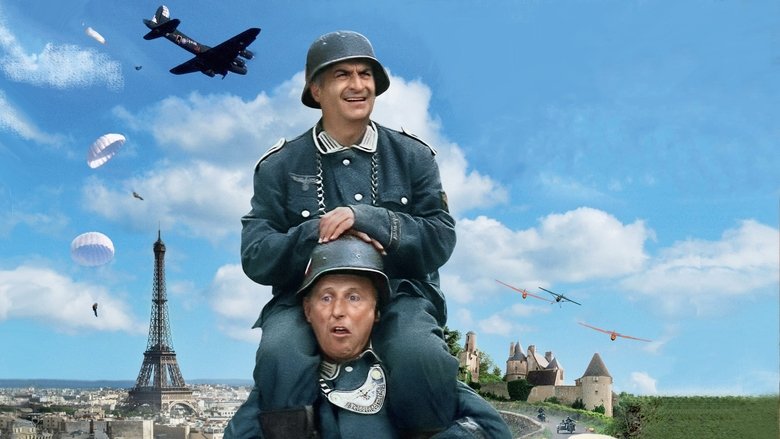
The parachutes symbolize the sudden and disruptive intrusion of the war into the everyday lives of ordinary French citizens. They literally drop the conflict from the sky and onto the doorsteps of Augustin and Stanislas, forcing them out of their routines and into the larger historical narrative.
At the beginning of the film, the British airmen's white parachutes descend upon Paris, with one landing on Augustin's scaffolding and another on the roof of the Opéra Garnier where Stanislas is conducting. This event is the catalyst for the entire plot.
Shoes and Bicycles
The recurring motif of shoes and bicycles symbolizes the social and physical struggles of the journey, as well as the shifting power dynamic between Stanislas and Augustin. Control over these basic items of transport represents a small victory or a moment of leverage in their desperate situation.
There are several scenes where shoes become a point of contention, most notably when the arrogant Stanislas ends up with Augustin's more practical footwear. Augustin's lament, "Mon vélo, mes chaussures..." ("My bike, my shoes...") becomes a recurring, comedic expression of his exasperation.
The Turkish Baths (Hammam)
The Turkish baths symbolize a neutral, liminal space where identities are blurred and unexpected alliances are formed. The steam and anonymity of the location allow for a clandestine meeting, but also create immense comedic confusion, highlighting the precarious nature of their mission.
The British airmen designate the Turkish baths at the Grand Mosque of Paris as their rendezvous point. The famous scene involves Augustin and Stanislas, who have never met, attempting to identify their English contact, "Big Moustache," by whistling "Tea for Two," leading to a hilarious misunderstanding where they realize they are both French.
Pumpkins
The pumpkins symbolize the rustic, unassuming, and surprisingly effective nature of the French resistance. What appears to be a simple vegetable becomes a chaotic and effective weapon against the technologically superior German forces, representing the triumph of ingenuity and resourcefulness over brute force.
In a memorable chase scene, the heroes use a cart full of pumpkins, rolling them down a hill to thwart their German pursuers. The absurdity of using pumpkins as weapons is a prime example of the film's burlesque humor.
Philosophical Questions
What is the nature of everyday heroism?
The film explores the idea that heroism isn't limited to soldiers or designated leaders. It portrays courage as a quality that can emerge from ordinary people when they are confronted with moral choices. Augustin and Stanislas are not brave by nature; their heroism is situational and develops out of a series of reluctant decisions. The film asks what motivates someone to risk their life for another and suggests that it often stems from basic human decency and solidarity rather than grand ideology.
Can comedy be an effective tool for processing historical trauma?
By making a comedy about the German Occupation, a deeply traumatic period in French history, the film raises questions about the role of humor in confronting the past. “La Grande Vadrouille” uses laughter not to erase the pain of the past, but to make it bearable and to celebrate the resilience of the human spirit. It proposes that by ridiculing the oppressors and focusing on the absurdity of the situation, a collective trauma can be processed and a positive, unifying narrative can be constructed, even if it is a mythologized one.
Do societal roles and class distinctions matter in the face of a common threat?
The film directly confronts the issue of social class through the relationship between the working-class Augustin and the bourgeois Stanislas. Initially, their interactions are defined by their social positions. However, as they face shared dangers, these distinctions become increasingly irrelevant. The film suggests that fundamental human qualities like loyalty and courage are more important than social status, and that true unity is forged through shared experience and a common purpose, rendering class structures meaningless.
Core Meaning
The core meaning of “Don't Look Now... We're Being Shot At!” lies in its celebration of national unity and solidarity in the face of oppression, transcending social class barriers. Director Gérard Oury sought to create a comedy that could laugh at a tragic period of French history, the German Occupation, without trivializing the underlying gravity. The film posits that ordinary people, regardless of their courage or initial convictions, can become heroes when circumstances demand it. It served as a comforting narrative for a post-war France, promoting a myth of widespread resistance and national unity against the occupier. By focusing on the interpersonal relationships and the comedic friction between its main characters, the film suggests that shared humanity and a common goal can bridge even the widest social divides, turning a simple painter and a prestigious conductor into unlikely patriots and friends.