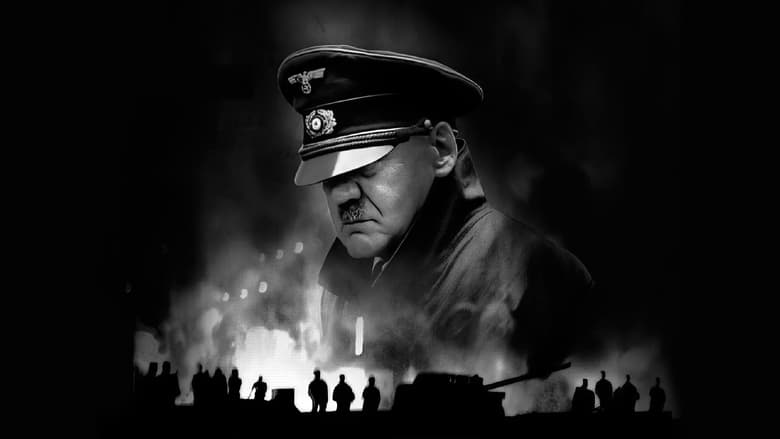
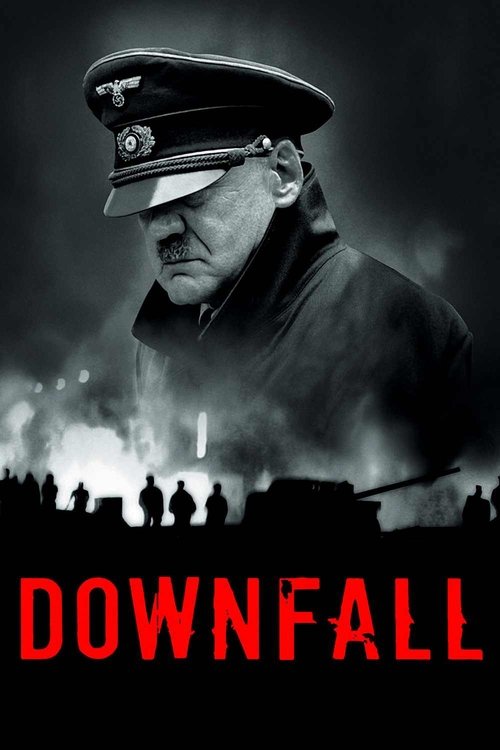
Der Untergang
"April 1945, a nation awaits its... Downfall"
Downfall - Symbolism & Philosophy
Symbols & Motifs
The Führerbunker
The bunker symbolizes the claustrophobic, insular, and decaying world of the Nazi regime in its final days. It is a concrete tomb, both a physical and psychological prison, representing the dead end of Hitler's ideology. Its subterranean location signifies a detachment from the reality of the war devastating Berlin above ground.
The vast majority of the film takes place within the cramped, oppressive corridors and rooms of the bunker. The camera often uses tight framing to enhance the sense of entrapment. The deteriorating conditions within the bunker mirror the collapse of the Third Reich itself.
Hitler's Trembling Hand
Hitler's trembling left hand, which he often hides behind his back, symbolizes his loss of control, his failing health, and the physical decay of the man who once projected an image of absolute power. It is a constant, visible manifestation of the impending downfall of both himself and his regime.
Throughout the film, particularly in moments of stress or contemplation, Hitler's hand is shown shaking, a symptom of what historians believe was Parkinson's disease. Actor Bruno Ganz studied patients with the disease to portray this accurately. The tremor is a stark visual contrast to the iron will he attempts to project.
The Goebbels Children
The six children of Joseph and Magda Goebbels represent the innocent generation sacrificed for a fanatical and bankrupt ideology. Their murder by their own mother is the film's most chilling depiction of the horrifying depths of Nazi fanaticism and the ultimate perversion of morality.
The children are initially shown playing and singing, a stark contrast to the grim atmosphere of the bunker. Their presence highlights the humanity that is about to be extinguished. The scene where Magda Goebbels poisons them one by one is a harrowing and pivotal moment, illustrating the belief that a life without National Socialism is not worth living.
Philosophical Questions
What is the nature of evil, and can it be 'human'?
The film's central philosophical question revolves around the nature of evil. By refusing to portray Hitler as a one-dimensional monster, "Downfall" challenges the audience to consider that evil is not a supernatural force but a product of human behavior, ideology, and choice. It explores how a person can be both a 'charming man' to his secretaries and a genocidal tyrant. This raises profound questions: Does humanizing a figure like Hitler risk normalizing his evil? Or is it more dangerous to mythologize him as a demon, thereby distancing ourselves from the uncomfortable truth that such evil can arise from within our own species?
To what extent are individuals responsible for the crimes of a collective?
Through the character of Traudl Junge and other lower-level functionaries in the bunker, the film delves into the question of individual complicity in collective crimes. Junge's final on-screen confession, where she laments that her youth is no excuse, forces the viewer to consider the moral responsibility of those who 'just followed orders' or were swept up in the fervor of the times. The film doesn't provide an easy answer, instead presenting a spectrum of characters, from enthusiastic perpetrators to those who express late-stage regret, leaving the audience to contemplate the difficult lines between naivety, willful ignorance, and active participation in evil.
Core Meaning
The core meaning of "Downfall" is an exploration of the 'banality of evil' and a powerful warning against the dangers of fanatical ideology and unquestioning loyalty. Director Oliver Hirschbiegel sought to demystify the leading figures of the Third Reich, not to excuse their actions, but to show that they were not abstract monsters, but human beings capable of monstrous acts. The film's intention was to present a historically accurate depiction that allows the German nation to confront its own history and trauma. By portraying Hitler's charm, his moments of kindness to his staff, alongside his terrifying rage and utter lack of compassion for the German people he claimed to champion, the film forces the audience to grapple with the uncomfortable truth that evil can have a human face, making it all the more chilling and cautionary.