The core message of Dr. STONE is an unabashed celebration of human intellect, curiosity, and perseverance. It posits that science is the ultimate tool for progress and the common language that can unite humanity. The series argues that knowledge, accumulated over millions of years, is the most valuable inheritance, capable of overcoming any obstacle, from societal collapse to the laws of nature itself. It champions a profoundly optimistic view of humanity's potential, suggesting that through collaboration, logical problem-solving, and a tireless, step-by-step effort, civilization can not only be rebuilt but also improved. The story is a testament to the idea that even in the bleakest of circumstances, the persistent application of knowledge can create light, connection, and a future.
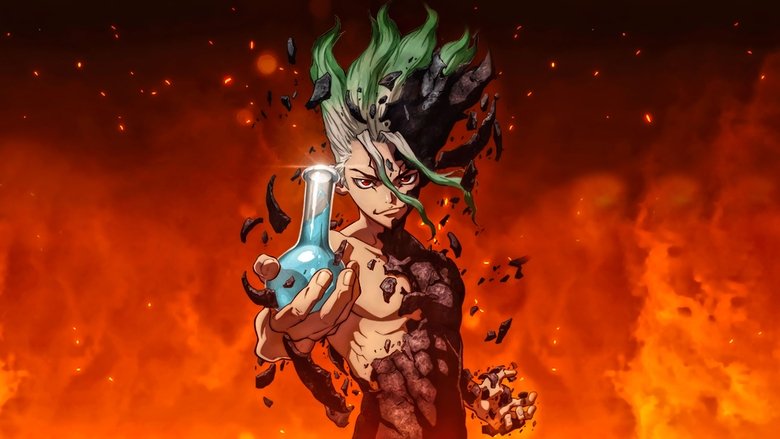
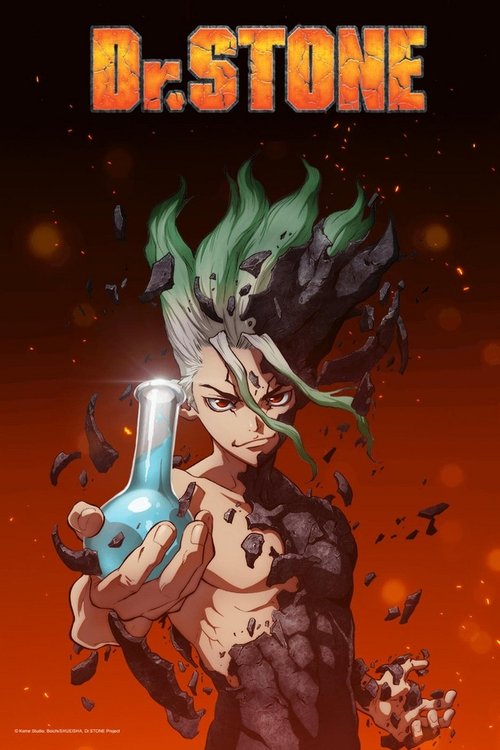
Dr.STONE
Cast: Yusuke Kobayashi, Makoto Furukawa, Kana Ichinose, Manami Numakura, Gen Sato
Dr. STONE — Symbolism & Philosophy
Symbols & Motifs
Petrified Statues
The statues symbolize both the sudden fragility of human civilization and its latent potential for rebirth. They are monuments to a lost world but also the seeds of a new one, representing every individual life that Senku vows to save. The act of piecing together shattered statues signifies hope, healing, and the belief that no one is beyond saving.
The statues are a constant visual motif throughout the series. Initially seen as remnants of a bygone era, they become the central focus of Senku's mission to revive humanity. The conflict with Tsukasa, who destroys statues, directly contrasts his nihilistic selection with Senku's humanistic goal of universal revival.
Senku's 'E=mc²' Tunic
The formula E=mc², scrawled on Senku's clothing, symbolizes his unwavering faith in science as the ultimate and unchangeable law of the universe. It represents the foundation of knowledge from the old world upon which he will build the new one, a constant reminder that the rules of physics and chemistry are the keys to unlocking civilization.
Senku wears this tunic from the very beginning of his awakening in the Stone World. It's his personal flag and a declaration of his identity. It visually separates him from the more primitive attire of the Stone World inhabitants and serves as a beacon for his scientific ambitions.
The 100 Tales
The 100 Tales represent the preservation and oral transmission of human knowledge, culture, and history across generations. They are a bridge from the pre-petrification world to the new one, containing not just practical wisdom but also the story of Byakuya's hope for Senku's future. They symbolize the idea that storytelling is a fundamental technology for civilization.
Passed down for 3,700 years within Ishigami Village, the 100 Tales are initially presented as folklore. Senku, however, realizes they are a time capsule of knowledge left by his father. The final, 100th tale is a direct message to Senku, revealing the village's origins and providing him with invaluable resources, demonstrating the profound connection between father and son across millennia.
Philosophical Questions
Should humanity be rebuilt exactly as it was, including its flaws?
The series explores this through the central ideological conflict between Senku and Tsukasa. Senku believes in reviving all seven billion people, arguing that every human life has potential. Tsukasa contends that the old world was corrupt and that this is a chance for a 'do-over,' to build a better world by weeding out the greedy and destructive elements. The narrative forces viewers to question what aspects of our modern society are worth preserving and whether a perfect world can be built on an imperfect foundation.
What is the relationship between individual genius and the collective?
Senku is a once-in-a-generation genius, but the series repeatedly shows his limitations. He cannot achieve his goals without the physical labor, specialized skills, and emotional support of his community. The Kingdom of Science is a microcosm of human society, demonstrating that progress is a collaborative process. The show explores how leadership, delegation, and trust in others are just as important as raw intellect, celebrating the synergy between the brilliant mind and the hardworking community.
Is science an inherently moral, immoral, or amoral force?
Dr. STONE portrays science as a powerful, neutral tool. In Senku's hands, it creates medicine, light, and communication. However, the same principles can create weapons like gunpowder and dynamite. The series acknowledges this duality, showing that the morality of science is determined by the user. Senku's unwavering ethical compass—to save everyone—positions his use of science as a force for good, while the threat of its misuse is ever-present, particularly during the war with Tsukasa and later conflicts.
Core Meaning
Explore More About This Movie
Dive deeper into specific aspects of the movie with our detailed analysis pages