Dr. STONE
A post-apocalyptic saga of exhilarating ingenuity, where humanity's stone slumber is shattered by the defiant spark of scientific rediscovery.
Dr. STONE

Dr. STONE

Dr.STONE

05 July 2019 — 25 September 2025 Japan 4 season 82 episode Returning Series ⭐ 8.5 (1,566)
Cast: Yusuke Kobayashi, Makoto Furukawa, Kana Ichinose, Manami Numakura, Gen Sato
Animation Sci-Fi & Fantasy Action & Adventure Comedy
The Power of Science and Knowledge Rebuilding Civilization and Defining Ideals Collaboration vs. Individualism Generational Legacy and Hope

Overview

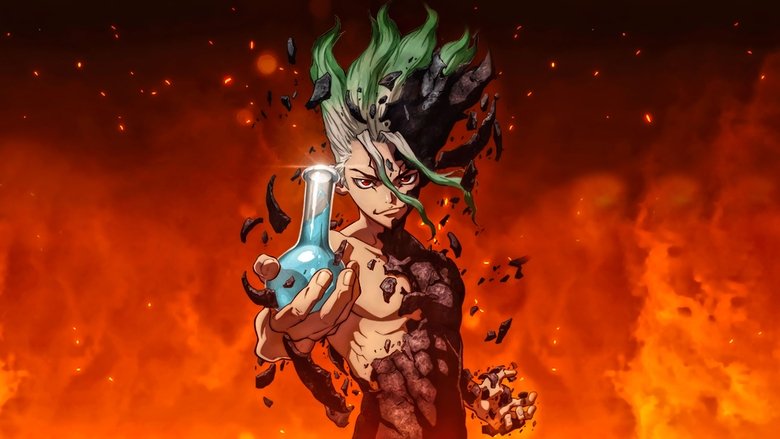
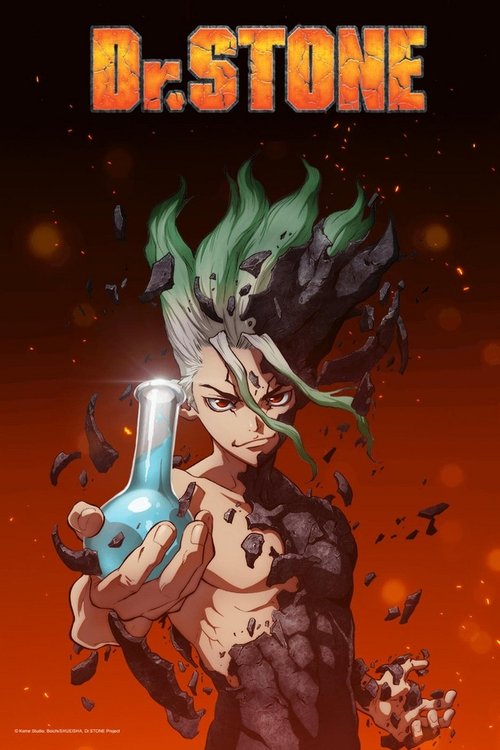
Dr. STONE begins with a cataclysmic event where a mysterious flash of green light instantly petrifies all of humanity. For over 3,700 years, civilization crumbles as nature reclaims the Earth. The story follows Senku Ishigami, a brilliant and eccentric high school student with an encyclopedic knowledge of science, who awakens from his stone prison. In this new 'Stone World,' Senku resolves to use his intellect to restart civilization from scratch, one scientific invention at a time.

Joined by his brawny but loyal friend Taiju Oki and their classmate Yuzuriha Ogawa, Senku founds the 'Kingdom of Science.' Their mission is to de-petrify all seven billion humans and rebuild society. However, their path is immediately challenged by Tsukasa Shishio, a powerful martial artist who believes the old world was corrupt and seeks to create a new world order by only reviving the young and pure of heart. This ideological clash ignites the 'Stone Wars' between Senku's burgeoning scientific society and Tsukasa's Empire of Might.

Across its seasons, the series expands from a local conflict to a global expedition. After the Stone Wars, Senku and the Kingdom of Science build a ship, the Perseus, to explore the world and uncover the original source of the petrification beam. Their journey takes them to new lands, introduces new allies and adversaries, and forces them to rapidly accelerate their technological roadmap—from inventing cell phones to seeking the materials needed for space travel—as they confront the ultimate mystery of the 'Why-man,' the entity responsible for humanity's downfall.
Core Meaning

The core message of Dr. STONE is an unabashed celebration of human intellect, curiosity, and perseverance. It posits that science is the ultimate tool for progress and the common language that can unite humanity. The series argues that knowledge, accumulated over millions of years, is the most valuable inheritance, capable of overcoming any obstacle, from societal collapse to the laws of nature itself. It champions a profoundly optimistic view of humanity's potential, suggesting that through collaboration, logical problem-solving, and a tireless, step-by-step effort, civilization can not only be rebuilt but also improved. The story is a testament to the idea that even in the bleakest of circumstances, the persistent application of knowledge can create light, connection, and a future.

Thematic DNA

The Power of Science and Knowledge 35%
Rebuilding Civilization and Defining Ideals 30%
Collaboration vs. Individualism 20%
Generational Legacy and Hope 15%

The Power of Science and Knowledge

This is the central theme of the entire series. Senku embodies the belief that every problem has a scientific solution. From creating revival fluid with nitric acid to developing electricity, antibiotics, and even cell phones, the narrative demonstrates how the scientific method is a powerful force for survival and advancement. The series meticulously breaks down complex inventions into a step-by-step 'roadmap,' illustrating that modern technology is built upon layers of accumulated knowledge. It evolves from basic survival science to complex engineering, showing that knowledge is humanity's greatest weapon against despair and the wilderness.

Rebuilding Civilization and Defining Ideals

The series constantly explores the philosophical question of what a new world should look like. This is primarily framed through the conflict between Senku and Tsukasa. Senku aims to revive everyone, believing in the potential of all humanity, flaws included. In contrast, Tsukasa seeks to create a utopia free of the corruption of the old world by selectively reviving only the 'pure.' This theme forces characters and the audience to consider the ethics of a societal reset: who deserves to be a part of a new world, and what principles should it be built upon?

Collaboration vs. Individualism

While Senku is a singular genius, the series emphasizes that he cannot succeed alone. His vast knowledge is useless without the manpower of Taiju, the craftsmanship of Kaseki, the resourcefulness of Chrome, and the strength of warriors like Kohaku. The 'Kingdom of Science' is a testament to the power of teamwork, where different skills and strengths are combined to achieve goals that are impossible for any single individual. The series shows that progress is not just the work of geniuses but the collective effort of a community.

Generational Legacy and Hope

A poignant and crucial theme is the idea of passing knowledge and hope to future generations. This is most powerfully illustrated through the story of Senku's adoptive father, Byakuya Ishigami, and his fellow astronauts. As the only humans who escaped the petrification, they founded Ishigami Village and left behind the '100 Tales'—a collection of stories containing essential knowledge and a message of hope for their descendants, and ultimately for Senku. This demonstrates that science and culture are legacies that transcend lifetimes, connecting the past to the future.

Character Analysis

Senku Ishigami

Yusuke Kobayashi

Archetype: The Scientist/Hero
Key Trait: Genius-level intellect and unwavering optimism

Motivation

Senku's primary motivation is to restore all 7 billion petrified humans and rebuild a civilization powered by science. He is driven by an insatiable curiosity and an unwavering belief in the power of human progress. This motivation evolves from a purely intellectual challenge to a personal mission to save his friends and fulfill the hopes of his father, Byakuya. He wants to use science to ensure a future where humanity can reach its full potential, including reaching for the stars.

Character Arc

Senku begins as a supremely confident, logical, and somewhat arrogant genius focused solely on the scientific roadmap to rebuilding civilization. Initially, he views people as resources and manpower. Throughout the series, particularly through his interactions with the Ishigami villagers and his conflict with Tsukasa, he develops a deeper appreciation for teamwork, friendship, and the human element behind science. He learns to inspire and lead, not just instruct. His arc is one of tempering pure logic with empathy, realizing that saving humanity means saving their hearts and dreams, not just their bodies. By the later seasons, he is still driven by logic, but his motivations are deeply rooted in his bonds with his friends.

Tsukasa Shishio

Yuichi Nakamura

Archetype: The Antagonist/Idealist
Key Trait: Immense physical strength and radical idealism

Motivation

Tsukasa is motivated by a desire to create a utopia for the young and innocent, free from the greed, control, and corruption of adults and technology in the old world. His methods are ruthless, but his core goal stems from a sincere, albeit twisted, desire to protect the pure and prevent the suffering he witnessed in his past. His motivation shifts to ensuring his sister's survival and, eventually, to supporting Senku's broader mission after their truce.

Character Arc

Tsukasa is introduced as the primary antagonist, an immensely powerful warrior with a traumatic past that fuels his hatred for the 'corrupt' old world. He aims to create a pure, new world based on natural strength. His arc is one of gradual understanding and reconciliation. The 'Stone Wars' arc reveals the deep, personal reason for his ideology: protecting his brain-dead sister. When Senku's science offers a way to save her, Tsukasa's worldview is shattered. He transitions from an enemy to a reluctant ally, ultimately recognizing the value of Senku's vision and sacrificing himself to protect the Kingdom of Science, completing his transformation from a purist antagonist to a tragic hero.

Gen Asagiri

Kengo Kawanishi

Archetype: The Trickster/Mentalist
Key Trait: Psychological manipulation and cunning

Motivation

Initially, Gen's motivation is pure self-preservation and the pursuit of personal comfort. He craves the conveniences of the modern world. This shallow motivation deepens as he spends time with Senku; he becomes motivated by a genuine desire to be part of the exhilarating project of rebuilding civilization and to see Senku's 'boring' but hopeful world come to fruition. He finds a sense of purpose and belonging that he lacked in his old life.

Character Arc

Gen is introduced as a self-serving, opportunistic 'mentalist' revived by Tsukasa to spy on Senku. Initially, his allegiance is entirely flexible, leaning towards whoever seems most likely to provide him with a comfortable life (and a bottle of cola). His character arc is about finding something to believe in. After witnessing Senku's miraculous scientific achievements and his unwavering dedication to saving everyone, Gen's cynical exterior cracks. He becomes one of Senku's most loyal and indispensable allies, using his skills in manipulation, diplomacy, and psychological warfare for the good of the Kingdom of Science. He evolves from a selfish actor to a key strategist who genuinely cares for his new friends.

Chrome

Gen Sato

Archetype: The Sorcerer/Apprentice
Key Trait: Insatiable curiosity and resourcefulness

Motivation

Chrome is driven by a boundless and passionate curiosity. He has an innate desire to understand how the world works, collecting materials and experimenting endlessly. His motivation is to learn everything he can from Senku and use that knowledge to help his village and protect his friends. He is the embodiment of the spirit of scientific inquiry.

Character Arc

Chrome starts as the self-proclaimed 'sorcerer' of Ishigami Village, a primitive but intensely curious and inventive young man who independently discovered basic scientific principles. His arc is one of discovery and education. Upon meeting Senku, his 'sorcery' is reframed as fledgling science. He becomes Senku's eager apprentice, representing the inherent scientific curiosity within all of humanity. Chrome's journey is about bridging the gap between the Stone World and the world of modern science, eventually becoming a brilliant scientist in his own right and proving Senku's belief that science can be revived by anyone with a curious mind.

Symbols & Motifs

Petrified Statues

Meaning:

The statues symbolize both the sudden fragility of human civilization and its latent potential for rebirth. They are monuments to a lost world but also the seeds of a new one, representing every individual life that Senku vows to save. The act of piecing together shattered statues signifies hope, healing, and the belief that no one is beyond saving.

Context:

The statues are a constant visual motif throughout the series. Initially seen as remnants of a bygone era, they become the central focus of Senku's mission to revive humanity. The conflict with Tsukasa, who destroys statues, directly contrasts his nihilistic selection with Senku's humanistic goal of universal revival.

Senku's 'E=mc²' Tunic

Meaning:

The formula E=mc², scrawled on Senku's clothing, symbolizes his unwavering faith in science as the ultimate and unchangeable law of the universe. It represents the foundation of knowledge from the old world upon which he will build the new one, a constant reminder that the rules of physics and chemistry are the keys to unlocking civilization.

Context:

Senku wears this tunic from the very beginning of his awakening in the Stone World. It's his personal flag and a declaration of his identity. It visually separates him from the more primitive attire of the Stone World inhabitants and serves as a beacon for his scientific ambitions.

The 100 Tales

Meaning:

The 100 Tales represent the preservation and oral transmission of human knowledge, culture, and history across generations. They are a bridge from the pre-petrification world to the new one, containing not just practical wisdom but also the story of Byakuya's hope for Senku's future. They symbolize the idea that storytelling is a fundamental technology for civilization.

Context:

Passed down for 3,700 years within Ishigami Village, the 100 Tales are initially presented as folklore. Senku, however, realizes they are a time capsule of knowledge left by his father. The final, 100th tale is a direct message to Senku, revealing the village's origins and providing him with invaluable resources, demonstrating the profound connection between father and son across millennia.

Memorable Quotes

This is exhilarating!

— Senku Ishigami

Context:

He says this numerous times throughout the entire series, often with a wide, excited grin. It appears as early as the first few episodes when he begins his work in the Stone World and continues through every major scientific milestone.

Meaning:

This is Senku's catchphrase, uttered whenever he is faced with a seemingly impossible challenge or makes a groundbreaking discovery. It encapsulates his core personality: a pure, unadulterated love for the process of scientific problem-solving. It signifies that for him, the struggle and the intellectual pursuit are the ultimate rewards.

I'm going to use the power of science to rescue every single person.

— Senku Ishigami

Context:

This is stated during the first season as Senku solidifies his opposition to Tsukasa's Empire of Might, setting the stage for the primary conflict of the first part of the series.

Meaning:

This quote is a direct declaration of Senku's core ideology and the central mission of the Kingdom of Science. It stands in stark contrast to Tsukasa's plan of selective revival and establishes the show's humanistic and optimistic foundation. It's not just about rebuilding technology; it's about saving every life.

Ten billion percent.

— Senku Ishigami

Context:

Used frequently throughout the series in various situations, often to reassure his more skeptical friends or to state a bold claim with unshakeable confidence, such as when he was 'ten billion percent certain' that Taiju was still alive.

Meaning:

Another one of Senku's iconic catchphrases, used to express his absolute certainty about a scientific fact or the success of one of his plans. It's a humorous exaggeration that highlights his immense confidence and the reliable, rule-based nature of science. When Senku says 'ten billion percent,' it's treated as an undeniable truth.

It's not that there are things that science can't explain. You look for the rules behind those things. Science is just the steady, pain in the ass effort that goes into it.

— Senku Ishigami

Context:

This line is said in a conversation with Chrome, explaining the difference between Chrome's 'sorcery' and true science. It's a key moment where Senku mentors Chrome and articulates the foundational mindset of a scientist.

Meaning:

This quote perfectly defines Senku's philosophy of science. He demystifies the concept, rejecting the idea of 'magic' or the 'inexplicable.' For him, science is not a set of answers but a process—a difficult, laborious, and incremental process of uncovering the underlying rules of the universe. It highlights the theme of perseverance and hard work.

Episode Highlights

Stone World

S1E1

The series premiere establishes the entire premise. A mysterious green light petrifies humanity, and 3,700 years later, genius Senku Ishigami awakens. The episode masterfully sets up the post-apocalyptic setting and Senku's grand ambition to rebuild civilization with science, starting with the revival of his friend Taiju.

Significance:

This episode is the foundation for the entire series, introducing the central conflict, the main characters, and the core theme of science as the key to humanity's salvation. It hooks the viewer with a unique and intriguing apocalyptic scenario.

King of the Stone World

S1E5

Forced to revive the powerful martial artist Tsukasa Shishio for survival, Senku and Taiju immediately find themselves in an ideological war. Tsukasa reveals his plan to create a new world by destroying petrified adults, leading to a schism. In a shocking cliffhanger, Tsukasa seemingly kills Senku to stop the advancement of science.

Significance:

This episode establishes the primary antagonist and the core philosophical conflict of the first arc. Senku's apparent death is a major turning point that forces the narrative to expand and ultimately leads to the discovery of Ishigami Village.

A Tale for the Ages

S1E17

Through a flashback, the origin of Ishigami Village is revealed. Senku's adoptive father, Byakuya, and five other astronauts were on the International Space Station during the petrification event. They returned to Earth and founded a settlement, passing down knowledge and hope through 'The 100 Tales' in the belief that Senku would one day awaken. Senku discovers his father's grave and is moved to tears.

Significance:

This episode provides a massive emotional core to the series. It explains the existence of the village, creates a deep, multi-generational link for Senku's mission, and beautifully showcases the theme of legacy and enduring hope.

The Culmination of Two Million Years

S1E23

The Kingdom of Science achieves one of its most incredible feats: the invention of the cell phone. After an arduous process involving creating vacuum tubes and plastic, Senku and his allies successfully make the first long-distance call in the Stone World. This invention is presented as the key weapon for the upcoming 'Stone Wars'.

Significance:

The creation of the cell phone represents a monumental leap in the scientific roadmap. It's a powerful symbol of connection and a strategic game-changer, demonstrating how far the Kingdom of Science has come and setting the stage for the tactical complexities of Season 2.

PROLOGUE OF Dr. STONE

S2E11

The 'Stone Wars' conclude. After a fierce battle, a truce is called when Senku agrees to revive Tsukasa's sister, Mirai. However, the true enemy Hyoga betrays them, mortally wounding Tsukasa. Senku and a reformed Tsukasa team up to defeat Hyoga. To save Tsukasa's life, Senku places him in a cryogenic state, vowing to find the secret of petrification to heal him. He then announces their next goal: to build a ship and sail the world.

Significance:

This episode resolves the series' first major conflict, transforming the primary antagonist into a tragic hero and ally. It concludes the 'Stone Wars' arc and masterfully sets up the next grand adventure, expanding the scope of the story from a local struggle to a global quest for answers.

Philosophical Questions

Should humanity be rebuilt exactly as it was, including its flaws?

The series explores this through the central ideological conflict between Senku and Tsukasa. Senku believes in reviving all seven billion people, arguing that every human life has potential. Tsukasa contends that the old world was corrupt and that this is a chance for a 'do-over,' to build a better world by weeding out the greedy and destructive elements. The narrative forces viewers to question what aspects of our modern society are worth preserving and whether a perfect world can be built on an imperfect foundation.

What is the relationship between individual genius and the collective?

Senku is a once-in-a-generation genius, but the series repeatedly shows his limitations. He cannot achieve his goals without the physical labor, specialized skills, and emotional support of his community. The Kingdom of Science is a microcosm of human society, demonstrating that progress is a collaborative process. The show explores how leadership, delegation, and trust in others are just as important as raw intellect, celebrating the synergy between the brilliant mind and the hardworking community.

Is science an inherently moral, immoral, or amoral force?

Dr. STONE portrays science as a powerful, neutral tool. In Senku's hands, it creates medicine, light, and communication. However, the same principles can create weapons like gunpowder and dynamite. The series acknowledges this duality, showing that the morality of science is determined by the user. Senku's unwavering ethical compass—to save everyone—positions his use of science as a force for good, while the threat of its misuse is ever-present, particularly during the war with Tsukasa and later conflicts.

Alternative Interpretations

While the series presents Senku as the clear hero, a significant alternative interpretation questions the inherent goodness of his mission. This perspective explores the validity of Tsukasa's ideals, suggesting that his desire for a 'pure' world free from the corruption, inequality, and weapons of the old one is not entirely villainous. This reading frames the central conflict not as good vs. evil, but as a clash of legitimate, albeit opposing, philosophies: technocratic progressivism vs. anarcho-primitivism.

From this viewpoint, is Senku's quest to restore civilization simply a path to recreating the same problems that plagued the past? Does science, which can create weapons as easily as medicine, truly hold the answer? This interpretation suggests the series is a more nuanced debate about the very nature of civilization, with Tsukasa serving as a tragic figure who raises valid concerns about the dark side of human progress, rather than a simple antagonist.

Cultural Impact

Dr. STONE has had a significant cultural impact primarily through its popularization of 'edutainment' in the anime sphere. By making complex scientific concepts accessible, exciting, and central to its plot, the series has been widely praised for inspiring interest in STEM fields among its audience. It stands out in the often grim post-apocalyptic genre for its relentless optimism and focus on rebuilding rather than mere survival, offering a hopeful narrative about human potential.

Critically, the series is lauded for its unique premise, well-developed characters, and the seamless integration of education and entertainment. It has fostered a large online community dedicated to discussing the real-world science behind Senku's inventions. The series' positive message about the power of collaboration and intellect over brute force has resonated with a global audience, solidifying its legacy as a modern shonen classic that champions knowledge, curiosity, and the indomitable spirit of human innovation.

Audience Reception

Audience reception for Dr. STONE has been overwhelmingly positive across all seasons. Viewers consistently praise its unique and refreshing premise, which sets it apart from typical shonen action series. The protagonist, Senku Ishigami, is frequently cited as a favorite character due to his intelligence, witty dialogue, and infectious passion for science.

The 'edutainment' aspect is a major point of acclaim; audiences appreciate learning real scientific principles in an engaging and exciting context. The series' optimistic tone and focus on constructive problem-solving are also highlighted as a welcome change of pace. While some minor criticisms exist regarding the extreme compression of scientific timelines and the occasional reliance on shonen tropes, the overall verdict is that Dr. STONE is a smart, funny, and inspiring anime that successfully blends action, comedy, and education. The evolution of the plot from a localized conflict to a global adventure in later seasons has generally been well-received for keeping the narrative fresh and expanding the world.

Interesting Facts

  • The series' original writer, Riichiro Inagaki, and its artist, Boichi, have collaborated almost entirely remotely and have rarely met in person. Inagaki creates detailed storyboards, which are then sent to Boichi to illustrate.
  • The artist Boichi, renowned for his detailed and dynamic style, holds a degree in physics, which contributes to the plausible and intricate depictions of Senku's inventions.
  • Senku's last name, 'Ishigami' (石神), is a combination of the Japanese kanji for 'stone' (石) and 'god' (神), literally meaning 'Stone God,' which is fitting for his role in the Stone World.
  • The series utilizes a real-life science consultant named Kurare, who ensures the scientific accuracy of the inventions and processes depicted. Kurare often tests the experiments to confirm their viability.
  • Senku's character design and personality were partially inspired by Agon Kongo, an arrogant and brilliant character from Riichiro Inagaki's previous popular manga series, 'Eyeshield 21.'
  • The Japanese voice actor for Senku, Yusuke Kobayashi, also voices Arthur Boyle in 'Fire Force,' another popular shonen anime that was airing around the same time.

Easter Eggs

In a manga chapter celebrating the 20th anniversary of 'One Piece,' a robot is shown in the background wearing Monkey D. Luffy's signature straw hat.

This was part of a larger tribute across multiple 'Weekly Shonen Jump' series, where various artists hid a straw hat in their chapter for that week to honor the legendary manga.

During a scene in the anime where Senku imagines the components needed for a generator, the character Hiruma Yoichi from 'Eyeshield 21' makes a brief cameo appearance.

This is a direct homage to writer Riichiro Inagaki's previous major work, 'Eyeshield 21,' a highly successful football manga.

In one scene, Senku is shown sprinkling salt in a pose that directly mimics the viral internet meme of Turkish chef Nusret Gökçe, also known as 'Salt Bae.'

This is a humorous, direct reference to contemporary pop culture, breaking the fourth wall for comedic effect and showing the series' playful side.

When Yuzuriha makes new clothes for Senku, he strikes a pose identical to one of Freddie Mercury's iconic stances.

This is a visual tribute to the legendary lead singer of the band Queen, recognized globally for his flamboyant stage presence.

⚠️ Spoiler Analysis

Click to reveal detailed analysis with spoilers

Frequently Asked Questions

Explore More About This Movie

Dive deeper into specific aspects of the movie with our detailed analysis pages

Comments (0)

Leave a comment

No comments yet. Be the first to share your thoughts!