Giù la testa
"Two daredevils battle for a fortune in gold, and it will take an army to stop them!"
Duck, You Sucker - Symbolism & Philosophy
Symbols & Motifs
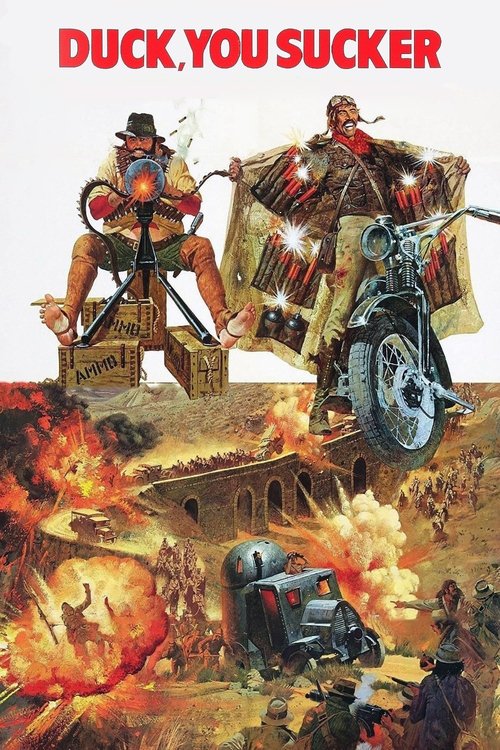
Dynamite
Represents John's lost faith and his only remaining belief system. It is a tool of both destruction and liberation, symbolizing the volatile and indiscriminate nature of the revolution itself.
John carries dynamite inside his coat like a talisman. He uses it to blow up bridges and save Juan, stating he 'believes only in dynamite' after losing faith in God and country.
The Bank of Mesa Verde
Symbolizes the false promises of the establishment and the illusion of wealth. For Juan, it represents the ultimate prize; its reality reveals the emptiness of his material dreams.
Juan dreams of the bank throughout the first half. When he finally blasts it open, he finds it filled with starving political prisoners instead of gold, forcing him into the role of a revolutionary hero.
The Motorcycle
A symbol of modernity and John's foreign, technological intrusion into the archaic world of Mexico. It represents mobility and the ability to escape, which John eventually abandons.
John enters the film riding a motorcycle, confusing the bandits. In the end, it becomes a tool of war, further emphasizing the transition from the Old West to the 20th century.
Philosophical Questions
Is political neutrality possible in times of war?
The film explores this through Juan, who tries to remain 'apolitical' and focus on his family. The narrative brutally punishes this stance, killing his family and forcing him into the conflict, suggesting that war consumes everyone eventually, regardless of their consent.
Does the end justify the means?
John's use of dynamite kills hundreds, including innocents, for the 'cause.' The film questions the morality of revolutionary violence, portraying it as a destructive force that often mirrors the tyranny it seeks to overthrow.
What is the nature of heroism?
Juan becomes a hero by accident, while the 'true' revolutionary John is a haunted terrorist. The film posits that heroism is often a narrative constructed by others (the people, the history books) rather than an inherent quality of the individual.
Core Meaning
Sergio Leone uses the backdrop of the Mexican Revolution to deconstruct the romantic myths of political uprising and heroism. The film argues that revolution is often an intellectual game played by the elite at the expense of the poor, who suffer the bloody consequences. Ultimately, it suggests that human connection and friendship are the only tangible truths in a world driven by ideology and violence.