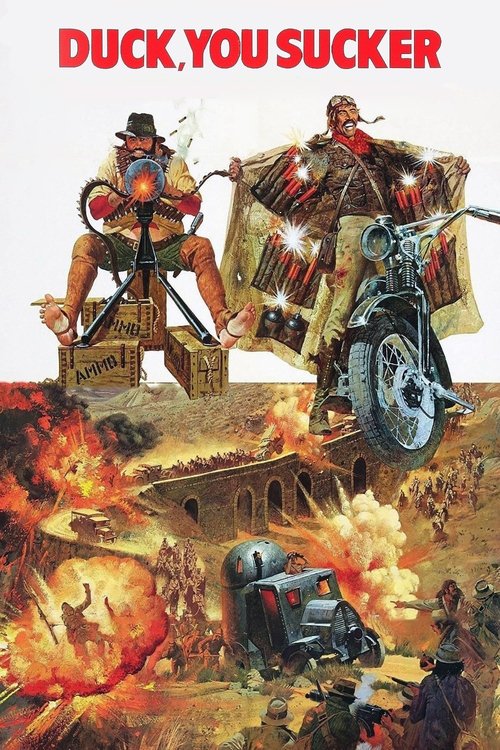
Duck, You Sucker
Giù la testa
"Two daredevils battle for a fortune in gold, and it will take an army to stop them!"
Overview
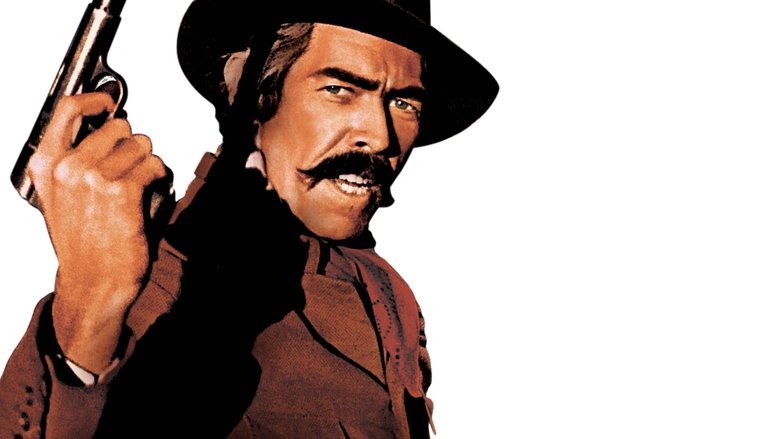
In 1913 Mexico, Juan Miranda, a coarse Mexican bandit leading a family of outlaws, encounters John (Sean) Mallory, an Irish Republican Army explosives expert on the run. Juan, seeing John's skills with dynamite as the key to robbing the majestic Bank of Mesa Verde, tricks and cajoles the Irishman into a partnership. However, John has different plans, steering Juan inextricably toward the chaos of the Mexican Revolution.
As they journey together, Juan's simple desire for riches is repeatedly thwarted by John's revolutionary fervor. When they finally hit the bank, Juan discovers not gold, but political prisoners, inadvertently becoming a hero of the revolution he despises. The film follows their deepening bond amidst large-scale battles, betrayals, and massacres, stripping away their defenses until only their humanity remains.
Core Meaning
Sergio Leone uses the backdrop of the Mexican Revolution to deconstruct the romantic myths of political uprising and heroism. The film argues that revolution is often an intellectual game played by the elite at the expense of the poor, who suffer the bloody consequences. Ultimately, it suggests that human connection and friendship are the only tangible truths in a world driven by ideology and violence.
Thematic DNA
The Cynicism of Revolution
Leone portrays revolution not as a glorious struggle for freedom, but as a chaotic cycle of violence that trades one master for another. Through Juan's eyes, we see that the poor remain poor, while the intellectuals (like John and Dr. Villega) debate theories that result in mass death.
Friendship and Male Bonding
The heart of the film is the relationship between Juan and John. It follows a 'reversed Pygmalion' arc where the intellectual John learns emotional honesty from the earthy Juan. Their bond transcends their political differences, becoming the film's only source of genuine warmth.
Betrayal and Guilt
John is haunted by a past betrayal in Ireland, which drives his actions in Mexico. The film explores the nuances of betrayal through the character of Dr. Villega, contrasting John's unforgiving nature with his eventual understanding and mercy, suggesting that judgment is a luxury of the unaffected.
The Myth of the West vs. Modernity
The film bridges the gap between the classic Western and 20th-century warfare. Horseback bandits face armored tanks, machine guns, and aerial bombing, symbolizing the brutal crushing of the romantic outlaw archetype by the industrialized machinery of modern war.
Character Analysis
Juan Miranda
Rod Steiger
Motivation
Initially motivated by greed and the dream of robbing the Mesa Verde bank; later motivated by survival and loyalty to John.
Character Arc
Starts as a selfish, amoral bandit concerned only with his family and money. Through loss and his friendship with John, he gains political awareness and emotional depth, ending as a tragic figure left alone with a 'revolution' he never wanted.
John (Sean) Mallory
James Coburn
Motivation
Driven by guilt over his past in Ireland and a nihilistic reliance on explosives to solve problems.
Character Arc
An IRA revolutionary fleeing a past betrayal. He arrives in Mexico cynical and death-seeking. His relationship with Juan reignites a flicker of humanity, leading him to a final act of sacrificial redemption.
Dr. Villega
Romolo Valli
Motivation
Survival and fear, countering his intellectual commitment to the cause.
Character Arc
A revolutionary leader who betrays his comrades under torture. He serves as a mirror to John's past trauma, allowing John to confront his own history and offer the forgiveness he couldn't grant before.
Symbols & Motifs
Dynamite
Represents John's lost faith and his only remaining belief system. It is a tool of both destruction and liberation, symbolizing the volatile and indiscriminate nature of the revolution itself.
John carries dynamite inside his coat like a talisman. He uses it to blow up bridges and save Juan, stating he 'believes only in dynamite' after losing faith in God and country.
The Bank of Mesa Verde
Symbolizes the false promises of the establishment and the illusion of wealth. For Juan, it represents the ultimate prize; its reality reveals the emptiness of his material dreams.
Juan dreams of the bank throughout the first half. When he finally blasts it open, he finds it filled with starving political prisoners instead of gold, forcing him into the role of a revolutionary hero.
The Motorcycle
A symbol of modernity and John's foreign, technological intrusion into the archaic world of Mexico. It represents mobility and the ability to escape, which John eventually abandons.
John enters the film riding a motorcycle, confusing the bandits. In the end, it becomes a tool of war, further emphasizing the transition from the Old West to the 20th century.
Memorable Quotes
Duck, you sucker!
— John Mallory
Context:
Shouted by John repeatedly throughout the film just before detonating dynamite, often saving Juan or destroying structures.
Meaning:
The film's catchphrase, used as a warning before an explosion. It reflects John's chaotic influence on the world and the inevitability of the violence he brings.
When I started using dynamite... I believed in many things... all of it! Now, I believe only in dynamite.
— John Mallory
Context:
Spoken to Juan during a quiet moment, explaining why an Irishman is fighting in Mexico.
Meaning:
Summarizes John's nihilistic worldview. He has lost faith in the political and religious ideologies that once drove him, finding solace only in the purity of destruction.
The people who read the books go to the people who can't read the books, the poor people, and say, 'We have to have a change.' So, the poor people make the change, ah? And then, the people who read the books, they all sit around the big polished tables, and they talk and talk and talk and eat and eat and eat, eh? But what has happened to the poor people? They are dead!
— Juan Miranda
Context:
Juan delivers this passionate monologue to John, rejecting the romanticism of the revolution and throwing away John's book.
Meaning:
The film's central thesis. It articulates the peasant's perspective on revolution: that it is a cycle of exploitation where the poor die for the ideals of the rich.
What about me?
— Juan Miranda
Context:
Spoken by Juan after the final explosion takes John's life, as he stands alone amidst the wreckage.
Meaning:
The tragic final line of the film. It underscores Juan's total loss—family, friend, and identity—leaving him adrift in a changed world.
Philosophical Questions
Is political neutrality possible in times of war?
The film explores this through Juan, who tries to remain 'apolitical' and focus on his family. The narrative brutally punishes this stance, killing his family and forcing him into the conflict, suggesting that war consumes everyone eventually, regardless of their consent.
Does the end justify the means?
John's use of dynamite kills hundreds, including innocents, for the 'cause.' The film questions the morality of revolutionary violence, portraying it as a destructive force that often mirrors the tyranny it seeks to overthrow.
What is the nature of heroism?
Juan becomes a hero by accident, while the 'true' revolutionary John is a haunted terrorist. The film posits that heroism is often a narrative constructed by others (the people, the history books) rather than an inherent quality of the individual.
Alternative Interpretations
The Love Triangle: Some analyses of the flashbacks suggest a romantic rivalry between John, his friend Nolan, and the woman they both loved. This adds a layer of sexual jealousy to the political betrayal, complicating John's guilt—did he kill Nolan solely for the cause, or was there personal malice?
The Dream Theory: A minority interpretation suggests the entire revolutionary adventure is Juan's dying dream or hallucination, contrasting his grim reality with a fantasy where he becomes a 'great hero,' though the film's gritty realism largely contradicts this.
Cultural Impact
Released during a time of global political unrest (post-1968 student riots, Vietnam War), Duck, You Sucker is a seminal 'Zapata Western' that reflects the cynicism of its era. While initially overshadowed by Leone's Dollars trilogy and Once Upon a Time in the West, it has been critically re-evaluated as a mature, complex masterpiece.
It influenced the 'buddy' genre by injecting it with tragic political weight. The film's critical stance on revolution resonated with Italian audiences grappling with the 'Years of Lead' (political terrorism). Philosophically, it challenged the clear-cut morality of American Westerns, introducing a European ambiguity where 'heroes' are terrorists and 'freedom fighters' are pawns.
Audience Reception
Praised: Viewers celebrate the electrifying chemistry between Rod Steiger and James Coburn, Ennio Morricone's eclectic and emotional score, and Leone's spectacular visual direction. The bridge explosion scene is often cited as one of the best practical effects in cinema history.
Criticized: Some critics find the tonal shifts—from broad slapstick comedy in the first act to dark, tragic drama in the second—jarring. Rod Steiger's over-the-top accent and performance have polarized audiences, with some finding it brilliant and others caricatured.
Verdict: Generally considered the 'dark horse' of Leone's filmography—less iconic than the Dollars trilogy but richer in emotional and political depth.
Interesting Facts
- Sergio Leone initially did not want to direct the film; he wanted Sam Peckinpah or his assistant Giancarlo Santi to do it, but stars Rod Steiger and James Coburn refused to sign unless Leone directed.
- The film was released under several titles, including 'A Fistful of Dynamite' and 'Once Upon a Time... the Revolution'.
- Rod Steiger and Sergio Leone clashed frequently on set due to Steiger's method acting approach, which conflicted with Leone's technical perfectionism.
- The character of John Mallory was allegedly written with Jason Robards or Malcolm McDowell in mind before James Coburn was cast.
- The recurring musical motif 'Sean... Sean... Sean...' in Ennio Morricone's score creates a haunting, siren-like call from the character's past.
- A quote by Mao Zedong about revolution being 'an act of violence' appeared at the beginning of the film in some cuts but was removed in others due to political sensitivity.
- Filming took place in Almería, Spain, which doubled for the Mexican desert, and in Ireland for the flashback sequences.
Easter Eggs
Goya's 'The Disasters of War'
The scene where revolutionaries are executed by firing squad in a trench is a direct visual reference to Francisco Goya's famous print series, recreating the lighting and composition to emphasize the brutality of war.
Mussolini Lookalike
One of the officers executed by the revolutionaries bears a striking physical resemblance to a young Benito Mussolini, a deliberate nod by Leone to Italian anti-fascist sentiments.
Nazi Imagery
The villainous Colonel Günther Reza is portrayed with blonde hair and commands a tank, evoking the image of a Nazi commander. This anachronism links the Mexican Revolution to the horrors of WWII, universalizing the theme of fascism.
⚠️ Spoiler Analysis
Click to reveal detailed analysis with spoilers
Frequently Asked Questions
Explore More About This Movie
Dive deeper into specific aspects of the movie with our detailed analysis pages
Comments (0)
No comments yet. Be the first to share your thoughts!