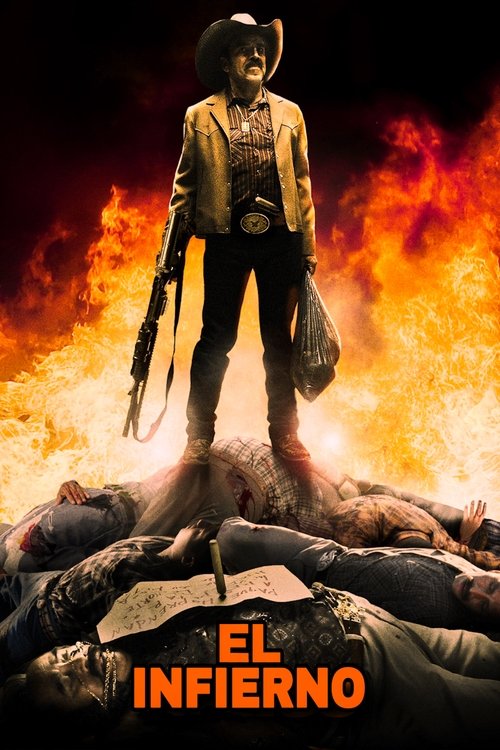
El Infierno
A visceral black-comedy descent into a narco-ravaged Mexico, where bleak, dusty landscapes bleed into a darkly humorous and brutal reality, leaving an aftertaste of despair.
El Infierno
El Infierno

"Mexico 2010, Hell... nothing to celebrate"

03 September 2010 Mexico 148 min ⭐ 7.9 (727)
Director: Luis Estrada
Cast: Damián Alcázar, Joaquín Cosío, Ernesto Gómez Cruz, María Rojo, Elizabeth Cervantes
Drama Crime Action Comedy Western
Corruption and Complicity The Cycle of Violence Loss of Innocence and Moral Decay The Failed American Dream
Box Office: $6,703,873

El Infierno - Ending Explained

⚠️ Spoiler Analysis

The central twist of "El Infierno" is the revelation of who was responsible for the death of Benny's brother, "El Diablo." Throughout the film, it is assumed that he was killed by the rival cartel, Los Panchos. However, Benny eventually learns the devastating truth: his brother was tortured and killed by their own boss, Don José Reyes, for sleeping with Don José's wife. This revelation dismantles the illusion of loyalty and honor within the cartel, exposing it as a world of pure self-interest and brutality.

An even more tragic turn is the discovery that Benny's young nephew, "El Diablito," has been acting as an informant for the rival cartel. He did this to avenge his father's death after discovering that the Reyes family was the true killer. This twist underscores the theme of cyclical violence, as the boy has already been consumed by the same world that took his father. It also adds a layer of tragic irony to Benny's attempts to protect him.

The film's ending is deliberately bleak and cyclical. After surviving being left for dead and discovering Lupe's murder, Benny takes his revenge by massacring Don José and his corrupt associates during the Bicentennial celebration. However, in the film's final moments, an unnamed young man, the grandson of the rival cartel's leader, shoots and kills Benny. The very last shot shows "El Diablito" visiting the graves of his family before driving off, implying he is now fully committed to the narco life to continue the cycle of vengeance. This ending solidifies the film's core message: there is no escape from this hell, and the violence will endlessly perpetuate itself.

Alternative Interpretations

While the primary interpretation of "El Infierno" is a direct, satirical critique of Mexico's political and social reality, some alternative readings exist. One perspective is to view the film as a modern-day Greek or Shakespearean tragedy. Benny's story follows the classic tragic hero arc: a flawed but initially decent man whose ambition and circumstances lead to his inevitable downfall. The themes of vengeance, betrayal, and family curses are central to the plot, echoing the dramatic structures of classic tragedies.

Another interpretation focuses on the film as a deconstruction of the 'narco' genre itself. While it employs many tropes of gangster films—the rise to power, the flashy lifestyle, the violent confrontations—it does so with a satirical edge that exposes the pathetic and grotesque reality behind the myth. The characters, despite their power, are often portrayed as insecure, foolish, and trapped in a system that will ultimately destroy them. In this light, the film isn't just a critique of Mexico, but a critique of the cultural glorification of the narco lifestyle.

Finally, some viewers and critics have debated the film's tone. While director Luis Estrada insists it is a satire and not meant to be a documentary, its realistic depiction of violence led many in Mexico to feel they were watching a reflection of their daily reality. This raises questions about the line between satire and realism, and whether the film's dark humor succeeds in creating critical distance or simply mirrors the absurdity of an already horrific situation.