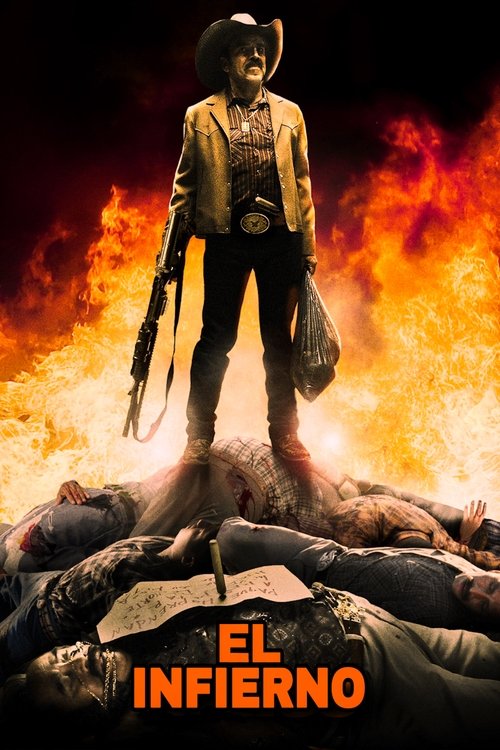
El Infierno
A visceral black-comedy descent into a narco-ravaged Mexico, where bleak, dusty landscapes bleed into a darkly humorous and brutal reality, leaving an aftertaste of despair.
El Infierno

El Infierno

"Mexico 2010, Hell... nothing to celebrate"

03 September 2010 Mexico 148 min ⭐ 7.9 (727)
Director: Luis Estrada
Cast: Damián Alcázar, Joaquín Cosío, Ernesto Gómez Cruz, María Rojo, Elizabeth Cervantes
Drama Crime Action Comedy Western
Corruption and Complicity The Cycle of Violence Loss of Innocence and Moral Decay The Failed American Dream
Box Office: $6,703,873

Overview

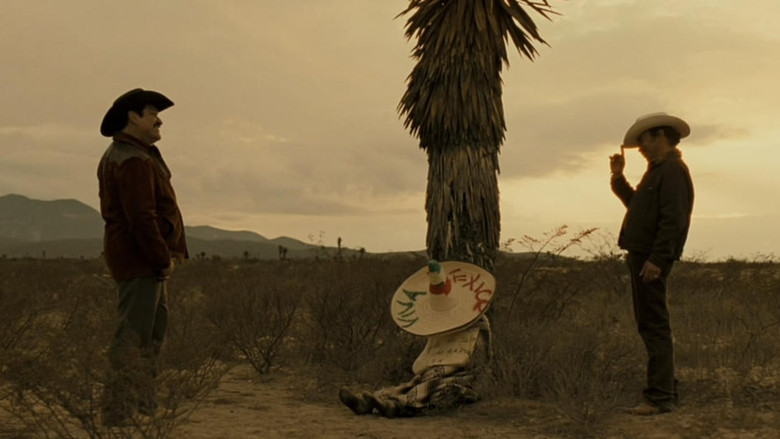
"El Infierno" (Hell) is a satirical black comedy that paints a grim picture of modern Mexico through the eyes of Benjamin "Benny" García (Damián Alcázar). After being deported from the United States after 20 years, Benny returns to his hometown to find it ravaged by poverty and violence, a stark contrast to the home he left behind. He discovers that his younger brother, once a notorious gangster known as "El Diablo," has been killed under mysterious circumstances.

With no viable prospects for honest work, Benny is lured into the lucrative but perilous world of drug trafficking by his childhood friend, "El Cochiloco" (Joaquín Cosío), who works for the powerful Reyes cartel. Benny's initial reluctance gives way to the seduction of money, power, and the affection of his brother's widow, Guadalupe (Elizabeth Cervantes). However, his ascent within the cartel plunges him deeper into a spiral of brutal violence, systemic corruption, and moral decay, forcing him to confront the hellish reality of his choices and the inescapable nature of his new life.
Core Meaning

Director Luis Estrada uses "El Infierno" as a biting political satire and a critical commentary on the state of Mexico. The film's central message is a denunciation of the systemic corruption, violence, and lack of opportunity that have allowed drug cartels to flourish. Released during the bicentennial of Mexico's independence, the film's tagline, "Nada que celebrar" ("Nothing to celebrate"), underscores its provocative stance, questioning the nation's progress and highlighting the devastating social and political consequences of the war on drugs. Estrada argues that the problem is not a simple matter of good versus evil, but a complex web of complicity that implicates everyone from law enforcement and politicians to the church. The film serves as a call for collective reflection on a society trapped in a seemingly endless cycle of violence and corruption.

Thematic DNA

Corruption and Complicity 35%
The Cycle of Violence 30%
Loss of Innocence and Moral Decay 20%
The Failed American Dream 15%

Corruption and Complicity

Corruption is depicted as an all-encompassing force in "El Infierno," permeating every level of society. From the local police who are on the cartel's payroll to the priest who blesses their guns, no institution is spared. This systemic decay is shown to be a primary enabler of the drug trade, making it an almost inescapable part of life in the town. Benny's journey illustrates how even an ordinary man can be drawn into and corrupted by a system where honest living is no longer a viable option.

The Cycle of Violence

The film relentlessly portrays violence as a self-perpetuating cycle. The narrative is structured around a series of revenge killings and betrayals between rival cartels. The tragic climax, where Benny’s young nephew is shown to be the next to take up arms, reinforces the idea that the violence will continue unabated, passed down from one generation to the next. The film's ending suggests a bleak future where this cycle is unbreakable, a core part of the nation's reality.

Loss of Innocence and Moral Decay

Benny's transformation from a hopeful deportee to a ruthless cartel member is a central theme. His initial shock and disgust at the violence gradually erode as he becomes desensitized and complicit. This personal journey mirrors a broader societal decay, where moral values have been supplanted by a ruthless pragmatism dictated by survival and greed. Even Benny's seemingly pure intentions to provide for his family become justifications for his descent into brutality.

The Failed American Dream

The film opens with Benny's deportation, immediately subverting the narrative of finding success in the United States. After 20 years away, he returns with nothing, his American dream having failed. This failure serves as the catalyst for his entry into the criminal underworld, suggesting that for many, the promise of a better life elsewhere is an illusion, and the harsh realities of their homeland are inescapable.

Character Analysis

Benjamín 'Benny' García

Damián Alcázar

Archetype: Antihero
Key Trait: Adaptable

Motivation

Initially, Benny is motivated by a desire to provide for his brother's family and escape poverty. This financial desperation is manipulated by his friend and the allure of easy money. As he becomes more involved, his motivations shift to survival, loyalty to his friend, and eventually, a thirst for vengeance against those who have wronged him.

Character Arc

Benny begins as a sympathetic, down-on-his-luck man returning home with hopes of a simple life. Faced with a lack of opportunities, he is reluctantly drawn into the cartel. His arc follows a tragic descent from a man with a moral compass to a hardened, violent sicario who becomes what he initially despises. While he achieves the wealth he sought, he loses his humanity in the process, culminating in a final act of bloody, nihilistic revenge.

Eufemio 'El Cochiloco' Mata

Joaquín Cosío

Archetype: The Mentor / The Tempter
Key Trait: Volatile

Motivation

Cochiloco is motivated by loyalty to his boss, Don José Reyes, and a desire to maintain his position and lifestyle within the cartel. He also shows a genuine, if twisted, sense of loyalty to Benny, whom he tries to help by bringing him into the business. His actions are driven by the internal rules and codes of the narco world.

Character Arc

"El Cochiloco" (The Crazy Pig) is Benny's childhood friend and his guide into the world of drug trafficking. He is presented as both a charismatic, loyal friend and a brutal killer. His arc is largely static; he is a product of his environment who has fully embraced the narco lifestyle. He serves as a foil to Benny's initial reluctance and represents the path Benny will ultimately follow. His eventual gruesome death highlights the inevitable fate of those in his line of work.

Don José Reyes

Ernesto Gómez Cruz

Archetype: The Corrupt Tyrant
Key Trait: Ruthless

Motivation

Don José's primary motivation is the acquisition and maintenance of power and wealth. He is driven by a deep-seated greed and a desire for control over his territory and family. He enforces a strict code of loyalty, not out of honor, but as a means to protect his empire, and he is willing to eliminate anyone, including his own family, who threatens it.

Character Arc

Don José is the ruthless patriarch of the Reyes cartel and the town's de facto ruler. He operates under a thin veneer of respectability and family values, which masks his extreme brutality and greed. His arc sees him consolidate power, eventually becoming the town's mayor, symbolizing the ultimate fusion of organized crime and politics. He remains a cold and calculating figure throughout, whose hypocrisy is laid bare by his actions.

Guadalupe 'Lupe' Solís

Elizabeth Cervantes

Archetype: The Femme Fatale
Key Trait: Pragmatic

Motivation

Lupe's motivation is rooted in a desire for a better life for herself and her son, away from the poverty and powerlessness she has known. She sees Benny's involvement in the cartel as their only ticket to prosperity and security. Her famous line, "We can get used to anything except starving," encapsulates her worldview.

Character Arc

Lupe is the widow of Benny's brother and becomes his lover. She initially appears as a victim of circumstance, struggling to raise her son. However, she is also pragmatic and ambitious, encouraging Benny to stay in the cartel for the financial security it provides. Her arc is one of complicity; she enjoys the benefits of the narco lifestyle while turning a blind eye to its horrors, a choice that ultimately leads to her demise.

Symbols & Motifs

The Bicentennial Celebration

Meaning:

The recurring motif of Mexico's bicentennial celebration serves as a deeply ironic symbol. It represents the government's official narrative of national pride and progress, which the film starkly contrasts with the grim reality of violence and corruption plaguing the country. The tagline "Nothing to celebrate" makes this symbolism explicit.

Context:

The film was released in 2010 to coincide with the actual bicentennial. The climax of the film takes place during the town's bicentennial celebration, where Benny enacts his revenge against the backdrop of patriotic festivities, highlighting the deep hypocrisy and disconnect between the political rhetoric and the lived experience of the people.

Cowboy Hats and Western Attire

Meaning:

The adoption of Western-style clothing by the narcos, such as cowboy hats and boots, symbolizes their self-perception as modern-day outlaws, figures of power and authority in a lawless land. It's a visual representation of the hyper-masculine and often romanticized image of the narco lifestyle, even as the film deconstructs this image by showing its brutal reality.

Context:

As Benny becomes more entrenched in the cartel, he sheds his deportee clothes for the gaudy attire of a successful narco, including a prominent cowboy hat and a shiny belt buckle. This visual transformation marks his descent into the criminal world and his acceptance of its values and aesthetics.

San Miguel Arcángel

Meaning:

The fictional setting of "San Miguel Arcángel" (Saint Michael the Archangel) is a deeply ironic name for a town that has become a literal hell on earth. Saint Michael is known as the commander of God's army against the forces of evil. The name highlights the complete moral inversion that has taken place, where a place named after a protector against evil is now consumed by it.

Context:

The name of the town is established early on and serves as a constant, subtle commentary on the action. The bleak, dusty, and violent streets of "San Miguel Arcángel" are a visual embodiment of this symbolic irony.

Memorable Quotes

En este pinche país, no haces lo que quieres, sino lo que puedes.

— El Cochiloco

Context:

El Cochiloco says this to Benny early in the film, explaining the harsh realities of their town and justifying his own involvement with the cartel. It's a pivotal moment that frames the difficult choices Benny is about to make.

Meaning:

"In this damn country, you don't do what you want, you do what you can." This quote encapsulates the film's theme of limited opportunities and the sense of fatalism that drives characters like Benny into a life of crime. It speaks to a societal reality where choice is a luxury and survival dictates action.

Me cae que esta vida es ser cabrón. O te chingas o te jodes.

— El Cochiloco

Context:

This is part of Cochiloco's cynical wisdom imparted to Benny as he introduces him to the violent norms of their business. It serves as a stark warning and a piece of advice that Benny will eventually internalize.

Meaning:

Roughly translated as "I swear this life is about being a badass. You either fuck someone over, or you get fucked." This phrase is a blunt expression of the film's kill-or-be-killed philosophy. It reflects the moral vacuum in which the characters operate, where ruthlessness is not just a trait but a necessary survival skill.

¿Ya pensaste qué quieres ser cuando seas grande? Pues qué otra cosa, ¡pues un chingón como mi apá!

— Benjamín 'El Diablito' García

Context:

The boy says this to Benny, showing his admiration for his deceased father, "El Diablo." It's a moment of dramatic irony, as Benny is trying to be a positive influence while simultaneously being drawn deeper into the very world that killed his brother and is now shaping his nephew.

Meaning:

"Have you thought about what you want to be when you grow up? What else, a badass like my dad!" This line, spoken by Benny's young nephew, is chilling as it reveals the deep-seated influence of narco-culture on the next generation. It symbolizes the cyclical nature of violence and the romanticization of the criminal lifestyle in the eyes of the young.

Philosophical Questions

Can an individual remain moral in a systemically corrupt society?

The film explores this question through the character of Benny. He returns to Mexico with a basic moral compass, but the pervasive corruption and lack of legitimate opportunities quickly force him to make compromises. The film suggests that in an environment where every institution is rotten, individual morality becomes a luxury that is difficult, if not impossible, to maintain. Benny's descent implies that the system itself is the primary corrupting force, and that personal ethics are inevitably eroded when survival is at stake.

Is violence an inescapable cycle?

"El Infierno" presents a deeply pessimistic view on this question. The plot is driven by a series of retaliatory acts of violence that only beget more violence. The ending, in which Benny's young nephew is poised to continue the cycle of revenge, strongly suggests that the violence is generational and deeply embedded in the social fabric. The film offers no easy answers or hope for breaking this cycle, portraying it as the fundamental, tragic reality of its setting.

What is the nature of national identity in a failed state?

Set against the backdrop of Mexico's bicentennial, the film constantly questions what it means to be Mexican in a country ravaged by internal conflict. The patriotic slogans and celebrations are depicted as a hollow facade, starkly contrasting with the lived reality of chaos and despair. The film suggests that the official, celebratory version of national identity is a lie, and that the true, contemporary identity is one defined by violence, corruption, and a struggle for survival.

Alternative Interpretations

While the primary interpretation of "El Infierno" is a direct, satirical critique of Mexico's political and social reality, some alternative readings exist. One perspective is to view the film as a modern-day Greek or Shakespearean tragedy. Benny's story follows the classic tragic hero arc: a flawed but initially decent man whose ambition and circumstances lead to his inevitable downfall. The themes of vengeance, betrayal, and family curses are central to the plot, echoing the dramatic structures of classic tragedies.

Another interpretation focuses on the film as a deconstruction of the 'narco' genre itself. While it employs many tropes of gangster films—the rise to power, the flashy lifestyle, the violent confrontations—it does so with a satirical edge that exposes the pathetic and grotesque reality behind the myth. The characters, despite their power, are often portrayed as insecure, foolish, and trapped in a system that will ultimately destroy them. In this light, the film isn't just a critique of Mexico, but a critique of the cultural glorification of the narco lifestyle.

Finally, some viewers and critics have debated the film's tone. While director Luis Estrada insists it is a satire and not meant to be a documentary, its realistic depiction of violence led many in Mexico to feel they were watching a reflection of their daily reality. This raises questions about the line between satire and realism, and whether the film's dark humor succeeds in creating critical distance or simply mirrors the absurdity of an already horrific situation.

Cultural Impact

"El Infierno" was released at a critical moment in Mexican history, coinciding with the nation's bicentennial celebrations and the height of the Mexican Drug War. Its release was a provocative act, directly challenging the government's official narrative of progress and stability. The film's tagline, "Nada que celebrar" ("Nothing to celebrate"), became a rallying cry for many who felt the government was failing to address the country's deep-seated problems of violence and corruption.

Critically acclaimed and a commercial success in Mexico, the film sparked a national conversation about the realities of the drug war, the extent of institutional corruption, and the lack of opportunities for many citizens. It was praised for its courage to tackle such a sensitive and dangerous subject with a unique blend of brutal realism and dark, satirical humor. While some officials, including the president, condemned the film for tarnishing the country's image, audiences responded to its perceived authenticity. "El Infierno" has had a lasting impact on Mexican cinema, demonstrating the power of film as a tool for social and political commentary and solidifying Luis Estrada's reputation as one of Mexico's most important and fearless directors.

Audience Reception

Audiences in Mexico reacted strongly to "El Infierno," making it a box office hit. Viewers praised the film for its realism and its courage in depicting a reality that many were living through. The dark humor was a frequently cited aspect, with many finding the laughter it provoked to be an uneasy but necessary release from the tension of the grim subject matter. Many viewers in Mexico felt the film accurately captured the sense of hopelessness and the pervasive corruption of police, politicians, and even the church. However, some audience members, particularly those outside of the most affected areas, found the level of violence shocking and disturbing. The main point of criticism, echoed by the government, was that the film presented an overly negative and one-sided view of Mexico, potentially harming the country's international image. Despite this, the overwhelming consensus among the Mexican public was that the film was a powerful and necessary, if brutal, reflection of their country's crisis.

Interesting Facts

  • The film was partially funded by a Mexican government commission created to celebrate the country's bicentennial of independence, a fact that became highly controversial given the movie's scathing critique of the nation and its tagline, "Nothing to celebrate."
  • "El Infierno" is the second film in director Luis Estrada's satirical trilogy about Mexico, which also includes "La ley de Herodes" (Herod's Law, 1999) and "The Perfect Dictatorship" (2014).
  • The film was a major box office success in Mexico, despite its graphic content and controversial themes, indicating that its critical message resonated strongly with the public.
  • Director Luis Estrada has mentioned that the film was influenced by the work of directors like Sam Peckinpah, Martin Scorsese, and the Coen Brothers.
  • Then-President of Mexico, Felipe Calderón, publicly criticized the film (without having seen it), arguing that it damaged Mexico's image.
  • Many of the violent acts depicted in the film, such as beheadings and dissolving bodies in acid, were inspired by real-life events that had been reported in the news during Mexico's drug war.

⚠️ Spoiler Analysis

Click to reveal detailed analysis with spoilers

Frequently Asked Questions

Explore More About This Movie

Dive deeper into specific aspects of the movie with our detailed analysis pages

Comments (0)

Leave a comment

No comments yet. Be the first to share your thoughts!