
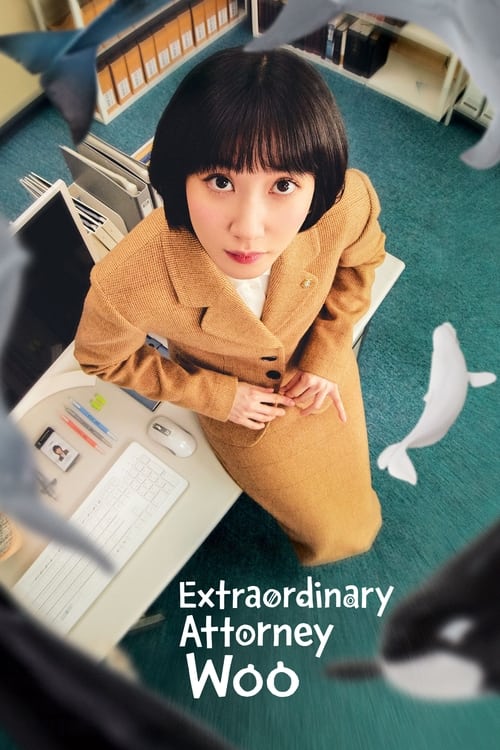
이상한 변호사 우영우
"My name is Woo Young-woo, whether it is read straight or flipped. Kayak, deed, rotator, noon, racecar, Woo Young-woo."
Extraordinary Attorney Woo - Symbolism & Philosophy
Symbols & Motifs
Whales
Whales symbolize Woo Young-woo's inner world, freedom, and unique perspective. They represent a safe space and a source of comfort and inspiration. Whales are majestic, intelligent, and navigate a vast, different world (the ocean), mirroring Young-woo's experience navigating a neurotypical society. They often appear in moments of revelation—her "eureka" moments—symbolizing her unique thought process breaking through to solve a case. They also represent loneliness, as she feels like a solitary narwhal or the 52-hertz whale, which cannot communicate with others of its kind.
Whales are a constant motif. They appear as stunning CGI visuals when Young-woo has an insight, gliding through the courtroom or cityscapes. Her conversations are peppered with whale facts, which she shares passionately, especially with Lee Jun-ho, who makes an effort to listen and understand this core part of her identity. The law firm's name, Hanbada, translates to "One Ocean," further symbolizing the firm as the environment where this unique "whale" can learn to swim.
Gimbap
Gimbap symbolizes order, predictability, and the love of Woo Young-woo's father. Because all the ingredients are visible, gimbap provides her with a sense of safety and control, as there are no unexpected textures or tastes. It represents the structured and reliable world she prefers. It's also a clear symbol of her father's dedicated and meticulous care for her throughout her life.
Woo Young-woo insists on eating gimbap for most meals, often arranged in a perfect roll. Her father runs a gimbap restaurant, and the act of him preparing her food is a recurring visual of their close, protective relationship. The food becomes a point of connection and a way for others, like Choi Su-yeon, to show they care for her.
Revolving Doors
The revolving door symbolizes the social and systemic barriers Woo Young-woo faces when trying to enter the neurotypical professional world. Her initial inability to navigate it represents her difficulty with unwritten social rules and the anxiety this causes. Learning to pass through it, with Lee Jun-ho's help likening it to a waltz, signifies her adaptation and the importance of having allies to help her find her rhythm.
The revolving door is a significant challenge for Young-woo in the first episode as she tries to enter the Hanbada law firm building. Lee Jun-ho patiently helps her, establishing his supportive nature early on. Her eventual mastery of the door parallels her growing confidence and integration into the firm.
Philosophical Questions
What is the true nature of 'competence' and 'normalcy'?
The series consistently challenges conventional definitions of competence. Woo Young-woo is socially awkward and struggles with tasks that are simple for neurotypical people, yet she excels in her complex legal work because of her unique cognitive abilities. The show asks whether 'normal' social behavior is a prerequisite for professional success. It forces other characters to redefine their metrics for competence, moving from valuing smooth social interaction to appreciating tangible results and innovative thinking. It suggests that society's rigid standards of normalcy often exclude exceptional talents and that true competence lies in one's ability to contribute effectively, regardless of how they think or communicate.
Does the law serve justice or simply the client's interests?
This is a recurring ethical question throughout the series. Woo Young-woo often approaches cases with a strong, almost naive, sense of right and wrong, which clashes with the legal system's procedural and often morally ambiguous nature. In several cases, she feels conflicted when her duty to her client requires her to argue against what she personally believes is just. The show explores this tension through her interactions with her mentor, Jung Myeong-seok, who represents a more pragmatic, experienced view of the law. It ultimately asks viewers to consider whether the legal system is a tool for discovering truth or merely a battlefield where the most skilled advocate wins, regardless of the moral implications.
Core Meaning
The core meaning of "Extraordinary Attorney Woo" is a profound exploration of empathy, acceptance, and the value of diversity. The creators aimed to place the viewer directly into the perspective of an autistic person, fostering resonance with her journey without a neurotypical mediator. Through Woo Young-woo's eyes, the series argues that what society deems "different" or "unusual" can be a source of extraordinary strength and creativity. It challenges societal prejudices against those with disabilities and questions the rigid definitions of "normalcy" and "competence." The show posits that embracing diverse perspectives is not just a matter of social justice but is essential for solving complex problems and enriching society as a whole, suggesting that these "extraordinary" qualities have the power to enact positive change.