
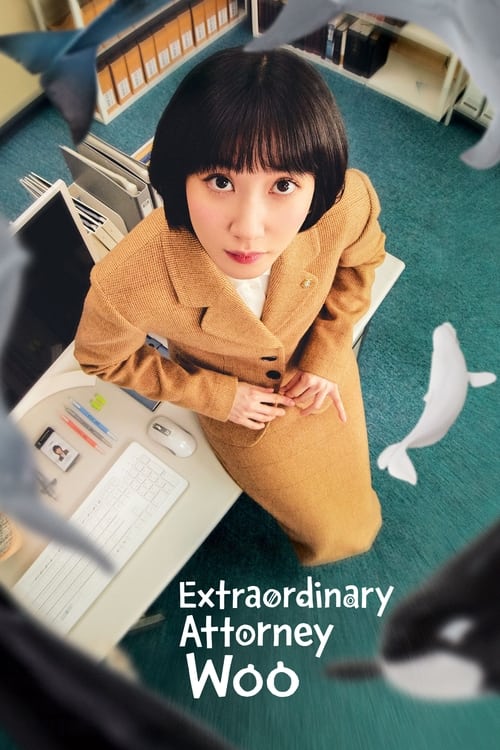
Extraordinary Attorney Woo
이상한 변호사 우영우
"My name is Woo Young-woo, whether it is read straight or flipped. Kayak, deed, rotator, noon, racecar, Woo Young-woo."
Overview
"Extraordinary Attorney Woo" follows the journey of Woo Young-woo, a brilliant young lawyer on the autism spectrum who graduates at the top of her class from a prestigious law school. Despite her genius-level IQ of 164, photographic memory, and creative thinking, she struggles with social interactions and faces widespread prejudice, making it difficult to find a job. She finally gets a chance as a trainee at the prominent Hanbada Law Firm, thanks to a hidden connection.
Each episode features a unique legal case that Woo Young-woo and her team tackle, allowing her to use her unique perspective to see details and solutions others miss. As she navigates the courtroom and office politics, she challenges the biases of her colleagues, including her initially skeptical mentor Jung Myeong-seok and the competitive Kwon Min-woo. The series intertwines these case-of-the-week procedural elements with overarching storylines, including her blossoming romance with the thoughtful litigation assistant Lee Jun-ho, the mystery of her parentage, and the professional rivalry between her firm and the powerful Taesan Law Firm.

Core Meaning
The core meaning of "Extraordinary Attorney Woo" is a profound exploration of empathy, acceptance, and the value of diversity. The creators aimed to place the viewer directly into the perspective of an autistic person, fostering resonance with her journey without a neurotypical mediator. Through Woo Young-woo's eyes, the series argues that what society deems "different" or "unusual" can be a source of extraordinary strength and creativity. It challenges societal prejudices against those with disabilities and questions the rigid definitions of "normalcy" and "competence." The show posits that embracing diverse perspectives is not just a matter of social justice but is essential for solving complex problems and enriching society as a whole, suggesting that these "extraordinary" qualities have the power to enact positive change.
Thematic DNA
Neurodiversity and Social Prejudice
The series' central theme is the experience of a neurodivergent individual in a neurotypical world. It portrays the daily challenges Woo Young-woo faces, from navigating revolving doors to deciphering social cues. More significantly, it highlights the systemic prejudice she encounters in the workplace and legal system, where her abilities are constantly doubted due to her autism. The show breaks down stigmas by humanizing her experience, showcasing her immense capabilities alongside her struggles, and advocating for greater inclusion and understanding in professional environments.
Empathy and Human Connection
While Woo Young-woo struggles with social skills, the series explores empathy from multiple angles. Her unique ability to connect with the logical and factual details of a case often leads to a deeper, unconventional form of justice for her clients. Her relationships with colleagues like Lee Jun-ho, who learns to communicate on her terms, and mentor Jung Myeong-seok, who grows to respect her unique mind, illustrate the importance of adapting and extending empathy to others. The show suggests that true connection requires looking beyond surface-level social norms.
Justice and Morality in Law
Each legal case presents a complex ethical dilemma, forcing the characters to question the intersection of law, justice, and morality. Young-woo's black-and-white view of right and wrong often clashes with the gray areas of the legal profession. The series explores whether an attorney's duty is to their client's interests or to a higher truth. Episodes tackle sensitive social issues like gender inequality, corporate greed, and the rights of the disabled, prompting both the characters and the audience to reflect on what is legally right versus what is morally just.
Family and Identity
A significant subplot revolves around Woo Young-woo's identity and her family history. Raised by a single father, the mystery of her birth mother, Tae Soo-mi, the CEO of a rival law firm, unfolds throughout the series. This arc explores themes of abandonment, parental responsibility, and the complex ways in which family ties shape one's identity and career. Young-woo's journey to understand her origins is intertwined with her professional growth, culminating in a difficult confrontation that forces her to define herself on her own terms.
Character Analysis
Woo Young-woo
Park Eun-bin
Motivation
Her primary motivation is to become a successful attorney and prove her worth in a world that consistently underestimates her. She is driven by a profound love for the law, which she sees as a system of clear rules and principles. As the series progresses, her motivation evolves from simply wanting to succeed to a desire to use her unique abilities to achieve true justice for her clients and understand the complex world of human emotions.
Character Arc
Woo Young-woo begins as a brilliant but socially isolated rookie lawyer, overwhelmed by the sensory and social demands of a large law firm. Initially, she doubts her ability to be a good lawyer because of her autism. Throughout the season, each case serves as a lesson in human emotion and ethical complexity. She learns to connect with clients, collaborate with colleagues, and navigate office politics. Her romantic relationship with Lee Jun-ho challenges her to understand and express her own feelings, while the revelation of her mother's identity forces her to confront issues of abandonment and self-worth. By the finale, she has not only proven herself a competent and valuable attorney but has also grown more confident in her identity, declaring she wants to be a lawyer who stands on the right side of justice. She moves from a state of anxious self-doubt to one of quiet self-assurance, building her own supportive community—her own "pod."
Lee Jun-ho
Kang Tae-oh
Motivation
Initially motivated by kindness and curiosity, his motivation evolves into a deep-seated affection and admiration for Young-woo. He is driven by a desire to see her succeed and to be a source of safety and support in her life. He wants to bridge the gap between her world and his, not by changing her, but by learning her language and being a true partner in her journey.
Character Arc
Lee Jun-ho starts as a popular and kind-hearted member of the litigation support team. He is immediately intrigued by Young-woo's unique personality and is one of the first to see beyond her social awkwardness. His arc is one of learning and deepening patience. He actively seeks to understand Young-woo's world, listening to her talk about whales for hours and finding creative ways to help her with social challenges. He navigates the difficulties of being in a relationship with someone on the spectrum, facing judgment from his peers and his own moments of frustration. His journey is about moving from simple kindness to a profound, committed love that requires active effort, understanding, and a willingness to adapt, solidifying his role as her most steadfast supporter.
Jung Myeong-seok
Kang Ki-young
Motivation
His initial motivation is professional success and maintaining his high-status position at the firm. He is driven by efficiency and winning. Through his mentorship of Young-woo, his motivation shifts. He becomes driven by a desire to nurture her unique talent and to become a more compassionate and principled lawyer himself, eventually questioning the high-pressure career that has cost him his personal life.
Character Arc
Jung Myeong-seok begins as a skeptical, workaholic senior attorney who is initially reluctant to take on an autistic rookie. He doubts her ability to handle cases and interact with clients. However, his arc is a journey of unlearning his prejudices. As he witnesses Young-woo's brilliant legal insights time and again, his skepticism turns into deep respect and mentorship. Working with her forces him to re-evaluate his own life, his priorities, and what it truly means to be a good lawyer, moving beyond just winning cases to understanding the human stories behind them. He becomes a fierce protector and a father figure to Young-woo within the firm, fundamentally changed by her influence.
Choi Su-yeon
Ha Yoon-kyung
Motivation
Su-yeon is motivated by a desire for professional recognition and to be seen as competent on her own merits, separate from her connection to Young-woo. She is also driven by an innate sense of fairness and kindness, which often puts her in conflict with her competitive side. Ultimately, her motivation becomes about being a good colleague and friend, realizing that supporting others does not diminish her own value.
Character Arc
Choi Su-yeon starts as Young-woo's law school classmate who carries a complicated mix of jealousy and concern for her. She appears competitive and sometimes frustrated by Young-woo, but consistently helps her in subtle ways. Her arc is about overcoming her own insecurities and fully embracing her supportive nature. The turning point is when Young-woo nicknames her "Spring Sunshine" for her warm, kind acts, which makes Su-yeon see herself through Young-woo's unfiltered, appreciative eyes. She evolves from a reluctant helper into one of Young-woo's most loyal friends and staunchest defenders in the office.
Symbols & Motifs
Whales
Whales symbolize Woo Young-woo's inner world, freedom, and unique perspective. They represent a safe space and a source of comfort and inspiration. Whales are majestic, intelligent, and navigate a vast, different world (the ocean), mirroring Young-woo's experience navigating a neurotypical society. They often appear in moments of revelation—her "eureka" moments—symbolizing her unique thought process breaking through to solve a case. They also represent loneliness, as she feels like a solitary narwhal or the 52-hertz whale, which cannot communicate with others of its kind.
Whales are a constant motif. They appear as stunning CGI visuals when Young-woo has an insight, gliding through the courtroom or cityscapes. Her conversations are peppered with whale facts, which she shares passionately, especially with Lee Jun-ho, who makes an effort to listen and understand this core part of her identity. The law firm's name, Hanbada, translates to "One Ocean," further symbolizing the firm as the environment where this unique "whale" can learn to swim.
Gimbap
Gimbap symbolizes order, predictability, and the love of Woo Young-woo's father. Because all the ingredients are visible, gimbap provides her with a sense of safety and control, as there are no unexpected textures or tastes. It represents the structured and reliable world she prefers. It's also a clear symbol of her father's dedicated and meticulous care for her throughout her life.
Woo Young-woo insists on eating gimbap for most meals, often arranged in a perfect roll. Her father runs a gimbap restaurant, and the act of him preparing her food is a recurring visual of their close, protective relationship. The food becomes a point of connection and a way for others, like Choi Su-yeon, to show they care for her.
Revolving Doors
The revolving door symbolizes the social and systemic barriers Woo Young-woo faces when trying to enter the neurotypical professional world. Her initial inability to navigate it represents her difficulty with unwritten social rules and the anxiety this causes. Learning to pass through it, with Lee Jun-ho's help likening it to a waltz, signifies her adaptation and the importance of having allies to help her find her rhythm.
The revolving door is a significant challenge for Young-woo in the first episode as she tries to enter the Hanbada law firm building. Lee Jun-ho patiently helps her, establishing his supportive nature early on. Her eventual mastery of the door parallels her growing confidence and integration into the firm.
Memorable Quotes
제 이름은 우영우입니다. 똑바로 읽어도 거꾸로 읽어도 우영우. 기러기, 토마토, 스위스, 인도인, 별똥별, 우영우.
— Woo Young-woo
Context:
She uses this introduction frequently throughout the series, starting from her first day at Hanbada in Season 1, Episode 1. It immediately establishes her quirky personality and her different way of communicating with the world.
Meaning:
"My name is Woo Young-woo. It's the same whether you read it forwards or backwards. Kayak, deed, rotator, noon, racecar. Woo Young-woo." This is Young-woo's standard introduction. It's more than just a name; it's a reflection of her identity. The palindrome represents the consistency, order, and logic she values. It's her way of presenting her unique, structured way of thinking to the world from the very beginning, turning a potentially awkward introduction into a memorable and defining statement.
당신은 봄날의 햇살 같아요. 로스쿨 다닐 때부터 그렇게 생각했어요. 너는 나한테 강의실의 위치와 휴강 정보와 바뀐 시험 범위를 알려주고, 동기들이 나를 놀리거나 속이거나 따돌리지 못하게 하려고 노력했어. 지금도 너는 나를 위해 물병을 열어주고, 다음에 또 구내식당에 김밥이 나오면 나한테 꼭 알려주겠다고 해. 너는 밝고, 따뜻하고, 착하고, 다정한 사람이야. '봄날의 햇살' 최수연이야.
— Woo Young-woo
Context:
This occurs in Season 1, Episode 5, when Su-yeon is feeling frustrated and overlooked at work. Young-woo's heartfelt declaration of appreciation leaves her speechless and teary-eyed, solidifying their friendship.
Meaning:
"You're like the spring sunshine... You're a bright, warm, kind, and sweet person. You're 'Spring Sunshine Su-yeon'." This quote is a pivotal moment for Choi Su-yeon's character. Young-woo, in her direct and sincere way, lists all the kind things Su-yeon has done for her, giving her a nickname that perfectly captures her inner warmth. It shows Young-woo's deep appreciation and her unique ability to see the best in people, profoundly affecting the often-insecure Su-yeon.
제가 하는 사랑은 어렵습니다. 제가 고래를 좋아하는 만큼이나, 제가 감당해야 하는 외로움의 총량도 어마어마합니다. 하지만 괜찮습니다. 저는 변호사니까요.
— Woo Young-woo
Context:
This is part of her internal monologue as she reflects on her relationship with Lee Jun-ho and the difficulties they face. It highlights her maturity in understanding the complexities of her emotions and her place in the world.
Meaning:
"The love I have is difficult. Just as much as I love whales, the total amount of loneliness I have to endure is immense. But it's okay. Because I'm a lawyer." This quote encapsulates Young-woo's self-awareness about the challenges her autism presents in forming relationships. She acknowledges the loneliness that comes with her condition but finds strength and identity in her profession. It's a statement of resilience and acceptance of who she is.
장애인에 대한 차별은 법으로 금지돼 있습니다! 당신네들이 성적은 최상위권인데도 자폐가 있다는 이유로 취업을 시켜주지 않는 게 바로 차별이고, 비리고, 부정입니다.
— Woo Gwang-ho
Context:
This happens in an early episode when Woo Gwang-ho confronts a lawyer from a firm that rejected Young-woo. It establishes the deep, protective love he has for his daughter and the societal barriers she is up against from the very start.
Meaning:
"Discrimination against the disabled is legally prohibited! The fact that you won't hire her despite her top-tier grades, just because she has autism, is discrimination, corruption, and injustice!" This passionate outburst from Young-woo's father powerfully condemns the systemic prejudice she faces. It articulates the core social justice theme of the show: that denying opportunities based on disability is not just unfair, but a violation of legal and moral principles.
Episode Highlights
Extraordinary Attorney Woo
The first episode masterfully introduces Woo Young-woo as she begins her first day at Hanbada Law Firm. We see her core traits: her genius, her struggles with social norms like revolving doors, and her deep love for whales. Her first case involves an elderly woman accused of attempting to murder her husband. Young-woo's unique perspective allows her to see a crucial detail that changes the nature of the case from attempted murder to assault causing injury, saving the defendant from losing her home.
This episode sets the tone for the entire series. It establishes the central conflict of Young-woo's brilliance versus societal prejudice, introduces the key supporting characters and their initial reactions to her, and demonstrates the show's formula of combining a compelling legal case with heartfelt character development. It immediately gets the audience to root for the underdog heroine.
This Is Pengsoo
Young-woo defends a young man on the autism spectrum accused of killing his older brother. The case is deeply personal and challenging, as she must understand a defendant who communicates differently. She successfully proves his innocence, but the client's father asks that she be taken off the case, believing another autistic person cannot adequately represent his son. This rejection causes Young-woo to have a crisis of confidence, leading her to resign from Hanbada.
This episode is a critical turning point for Young-woo's early character arc. It's the first time she confronts prejudice from the very people she is trying to help, making her question if her autism is an insurmountable obstacle in her profession. Her brief resignation forces her colleagues to realize her value and sets the stage for her return with a stronger resolve.
A Tale About Sodeok-dong (1 & 2)
The Hanbada team travels to Jeju Island to handle a complex lawsuit where villagers are suing the government over the construction of a highway. The case is significant as Hanbada faces off against their rival, Taesan Law Firm, which is where Young-woo's birth mother, Tae Soo-mi, is a senior partner. During this case, Young-woo has a powerful confrontation with her mother without revealing her identity, and her relationship with Jun-ho deepens significantly. The case centers on a beautiful Hackberry tree that the villagers want to protect.
This two-part episode expands the show's world, introduces the main antagonist firm, and brings the central mystery of Young-woo's parentage to the forefront. The emotional stakes are raised, and the story moves beyond just cases in Seoul. It marks a major development in both her professional and personal life, forcing her to work opposite the mother she never knew.
Holding Hands Can Wait
Young-woo takes on a controversial case defending a man accused of sexually assaulting a woman with an intellectual disability. The case forces her to confront uncomfortable societal prejudices and question the nature of consent and love between people with disabilities. Simultaneously, her own romance with Jun-ho faces scrutiny from his peers, making her doubt whether she can make him happy. This leads to her creating a list of dating activities and their breakup.
This episode is thematically one of the most complex and emotionally charged. It directly parallels the legal case with Young-woo's personal romantic struggles, exploring societal views on relationships involving disabled individuals. Her decision to break up with Jun-ho is a pivotal moment of self-doubt and an attempt to protect him, showcasing the internal conflicts she faces regarding her own worthiness of love.
Though Unusual and Peculiar
In the series finale, Young-woo is on a case involving a massive data leak from an e-commerce platform. The key witness and hacker turns out to be the son of Tae Soo-mi, making him her half-brother. This puts her in a profound ethical dilemma. She must win the case for her client while navigating the explosive family secret and protecting her brother. Jun-ho reaffirms his love for her, and she decides to remain at Hanbada, feeling a sense of belonging for the first time.
The finale masterfully ties together the professional, personal, and familial threads of the season. Young-woo faces her most complex case yet, which is deeply intertwined with her own identity. Her decision to reveal the truth to her mother and her choice to stay at Hanbada signify her immense growth in confidence and self-acceptance. It concludes her rookie year not with a neat resolution to all problems, but with a mature understanding of her place in the world, surrounded by people who support her.
Philosophical Questions
What is the true nature of 'competence' and 'normalcy'?
The series consistently challenges conventional definitions of competence. Woo Young-woo is socially awkward and struggles with tasks that are simple for neurotypical people, yet she excels in her complex legal work because of her unique cognitive abilities. The show asks whether 'normal' social behavior is a prerequisite for professional success. It forces other characters to redefine their metrics for competence, moving from valuing smooth social interaction to appreciating tangible results and innovative thinking. It suggests that society's rigid standards of normalcy often exclude exceptional talents and that true competence lies in one's ability to contribute effectively, regardless of how they think or communicate.
Does the law serve justice or simply the client's interests?
This is a recurring ethical question throughout the series. Woo Young-woo often approaches cases with a strong, almost naive, sense of right and wrong, which clashes with the legal system's procedural and often morally ambiguous nature. In several cases, she feels conflicted when her duty to her client requires her to argue against what she personally believes is just. The show explores this tension through her interactions with her mentor, Jung Myeong-seok, who represents a more pragmatic, experienced view of the law. It ultimately asks viewers to consider whether the legal system is a tool for discovering truth or merely a battlefield where the most skilled advocate wins, regardless of the moral implications.
Alternative Interpretations
One alternative interpretation focuses on the character of Lee Jun-ho. While widely seen as an ideal, supportive partner (a "green flag"), some critics and viewers have questioned if his character is too idealized. This perspective suggests that the portrayal of his near-perfect patience and understanding might be unrealistic, potentially setting an impossibly high standard for partners of individuals with disabilities. It could be argued that the series, in its effort to create a heartwarming romance, sidesteps a deeper exploration of the caregiver fatigue and relational complexities that can arise in real-world situations.
Another interpretation concerns the series' overall tone. While praised as a "healing drama," some analyses suggest it presents an overly optimistic view of societal acceptance. The Hanbada law firm, with its ultimately supportive mentor and colleagues, could be interpreted not as a realistic workplace but as an idealized fantasy. This reading argues that the show may downplay the harshness and frequency of the discrimination that many autistic individuals face, offering a comforting narrative that doesn't fully grapple with the systemic changes still needed in society.
Cultural Impact
"Extraordinary Attorney Woo" became a global cultural phenomenon in 2022, topping Netflix's non-English TV charts and achieving unprecedented ratings in South Korea for a new cable channel. Its most significant impact was sparking widespread public conversation about autism spectrum disorder. The series was praised for presenting a protagonist with autism in a positive, empowering lead role rather than as a peripheral character, challenging stereotypes and fostering empathy. It humanized the condition for a mass audience, leading to increased awareness of the challenges and unique strengths of autistic individuals.
However, the show also faced criticism. Some members of the autistic community and their families described the portrayal of Woo Young-woo as a 'fantasy,' pointing out that savant syndrome is rare and the show doesn't represent the full, diverse spectrum of autism. There were also concerns that her portrayal could create unrealistic expectations for autistic individuals. Debates also arose over the casting of a non-autistic actor in the role and the original Korean title, which translates to "Weird Lawyer." Despite these critiques, the consensus is that the show served as a crucial step forward for disability representation in media, opening doors for more nuanced discussions about neurodiversity and inclusion in the workplace and society at large. Its legacy lies in its ability to blend a heartwarming story with important social commentary, leaving a lasting mark on pop culture and disability discourse.
Audience Reception
"Extraordinary Attorney Woo" received overwhelmingly positive audience reception, becoming a massive word-of-mouth hit both domestically and internationally. Viewers praised the series for its heartwarming and wholesome tone, often calling it a "healing drama." The lead performance by Park Eun-bin as Woo Young-woo received universal acclaim for its nuance and sensitivity. The character of Lee Jun-ho, played by Kang Tae-oh, was also extremely popular, with fans celebrating him as a non-toxic, supportive male lead.
The main points of praise focused on the show's successful blend of engaging case-of-the-week legal procedural with a compelling overarching story and heartfelt character development. The positive and respectful portrayal of an autistic protagonist was a major draw for many viewers.
However, the series did attract criticism, particularly from within the autistic community. Some felt the character was an unrealistic representation, focusing on the rare 'savant' stereotype and not reflecting the diverse experiences of most autistic people. The infantilization of Young-woo through some of her mannerisms was also a point of contention for some viewers. Despite these critiques, the overall verdict from audiences was overwhelmingly positive, with many eagerly anticipating a second season.
Interesting Facts
- The director, Yoo In-shik, and writer, Moon Ji-won, waited for a full year to cast Park Eun-bin in the lead role, as they were convinced she was the only actress who could portray Woo Young-woo. She had initially turned down the role multiple times due to the pressure of portraying a character on the autism spectrum.
- The character of Woo Young-woo was partly inspired by the real-life Dr. Temple Grandin, a renowned American scientist and autism advocate who was also diagnosed with autism at a young age.
- The production cost for the series was approximately 20 billion Korean won (about $15 million USD), partly due to the high-quality CGI effects used for the whale visuals and the construction of the Hanbada law firm set.
- Several of the legal cases depicted in the series were inspired by real-life cases or essays written by attorneys in South Korea.
- Kang Tae-oh, who plays Lee Jun-ho, announced that this would be his last project before his mandatory military enlistment, which added a poignant note to his character's popularity.
- The show's original Korean title is '이상한 변호사 우영우' (Isanghan Byeonhosa U Yeong-u), which translates to 'Weird Lawyer Woo Young-woo'. The English title was changed to 'Extraordinary Attorney Woo,' sparking some debate among viewers.
- The series was broadcast on a new and relatively unknown cable channel, ENA, and its viewership skyrocketed from 0.9% for the first episode to over 17.5% for the finale, becoming a massive, unexpected hit.
- Following the popularity of the drama, it was adapted into a 60-part webtoon.
Easter Eggs
In one episode, Woo Young-woo's business card is briefly shown, and the last four digits of her phone number are '5252'.
This is believed to be a subtle reference to the '52-hertz whale,' also known as the 'world's loneliest whale.' This whale communicates at a unique frequency of 52 Hz, much higher than other whales, meaning they cannot understand it. This cleverly symbolizes Woo Young-woo's own feelings of isolation and her unique way of communicating that often separates her from her neurotypical peers.
⚠️ Spoiler Analysis
Click to reveal detailed analysis with spoilers
Frequently Asked Questions
Explore More About This Movie
Dive deeper into specific aspects of the movie with our detailed analysis pages
Comments (0)
No comments yet. Be the first to share your thoughts!