Faust - Eine deutsche Volkssage
"The Voice of the Tempter."
Faust - Symbolism & Philosophy
Symbols & Motifs
Light and Shadow
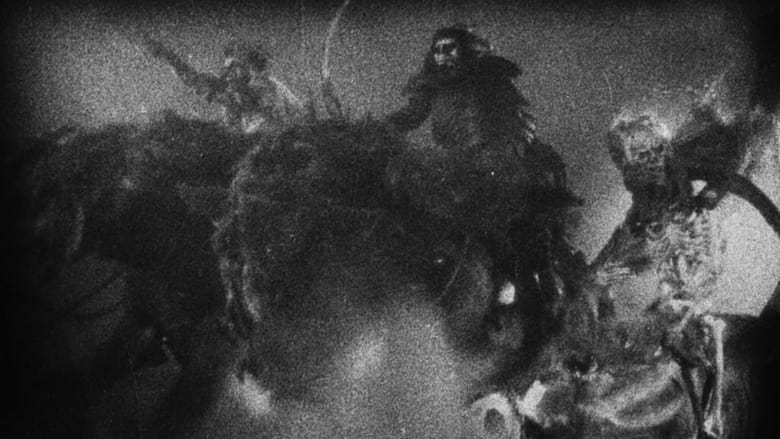
The film's German Expressionist style heavily utilizes chiaroscuro (the contrast between light and dark) to symbolize the cosmic battle between good and evil. Light represents purity, divinity, and goodness, as seen in the radiant Archangel and the idyllic scenes with Gretchen. Shadows and darkness represent Mephisto's corrupting influence, despair, and the plague he unleashes. Murnau famously "painted with light and shadow" to create a visual and moral landscape where this struggle is made manifest.
This symbolism is present throughout the film, from the opening scene where the massive, dark form of Mephisto literally blots out the light over Faust's town, to the glowing heavens of the Archangel. The interplay of light and shadow on the characters' faces and within the sets constantly reinforces their moral state and the forces acting upon them.
The Pact
The contract signed in blood is a powerful and traditional symbol of the irreversible selling of one's soul. It represents the ultimate transgression: a conscious and deliberate choice to abandon divinity and morality in exchange for temporary, earthly gains. It is the physical manifestation of Faust's despair and his fateful decision.
Faust signs the pact with Mephisto after his initial attempts to use demonic power for good are thwarted. The fiery inscription of the terms on the parchment is a visually memorable scene that took an entire day to film, emphasizing its significance. This act seals his fate and sets in motion the tragic events of the story.
Fire
Fire in the film carries a dual symbolism of damnation and purification. It is the element of Hell, used by Mephisto to write the pact and a destructive force. However, it also becomes a means of redemption and transcendence. The flames of Gretchen's pyre become a crucible where Faust's ultimate sacrifice purifies both their souls.
Initially, a desperate Faust throws his books and the Bible into the fire. Later, the most dramatic use of fire is the climax at the stake. As Gretchen is about to be burned, Faust, now an old man again, throws himself onto the pyre. The flames consume them together, but their spirits, purified by this act of love, rise to heaven.
Mirrors and Reflections
Mirrors and reflections symbolize Faust's transformation and the transient nature of the youth and beauty granted to him by Mephisto. His youthful reflection is an illusion, a temporary mask for his true, aged self. Its destruction signifies the end of the pact's benefits and his return to his mortal state.
After Faust sees Gretchen being led to the stake, he expresses his regret and wishes he had never asked for youth. In a fit of rage, Mephisto smashes the mirror containing Faust's youthful reflection, causing him to instantly revert to his old age just before he runs to the pyre.
Philosophical Questions
What is the true nature of good and evil?
The film explores this question by moving beyond a simple binary. Good is not merely the absence of sin, and evil is not just a demonic force. Faust, a good man, is driven to a pact with evil through desperation and a noble desire to help others. Mephisto, the embodiment of evil, is also charismatic and at times, comically grotesque. The film suggests that good and evil are intertwined forces, constantly at war within the human soul. It posits that the ultimate good, "Love," is a human-centered virtue powerful enough to redeem a soul from the ultimate evil.
Is humanity inherently flawed or inherently good?
This is the central wager between the Archangel and Mephisto. The Archangel believes in humanity's innate goodness, while Mephisto believes everyone can be corrupted. The film's narrative tests this proposition. It shows humanity at its worst: superstitious, cruel, and quick to judge. Yet, it concludes on an optimistic note. Faust's final, selfless act of love for Gretchen proves the Archangel's point. The film argues that while humans are fallible and prone to temptation, their capacity for love and sacrifice is a divine spark that can overcome their darkest impulses.
What is the price of knowledge and power?
The film serves as a powerful allegory for the dangers of unchecked ambition. Faust's quest begins with a desire for the knowledge and power to save lives, but it quickly devolves into a selfish pursuit of pleasure. The film illustrates that power gained without moral grounding leads to destruction, not just of the self, but of the innocent. The ultimate price Faust pays is the loss of his soul, a price he can only reverse by relinquishing all the power he sought and embracing vulnerability through love.
Core Meaning
At its heart, F. W. Murnau's "Faust" is a profound exploration of the eternal struggle between good and evil, not just as cosmic forces, but as an intimate battle within the human soul. The film posits that humanity's capacity for both great nobility and terrible weakness is a central aspect of its nature. Through Faust's journey, the film questions the value of knowledge and power when devoid of compassion and love. It ultimately suggests that redemption is possible, not through divine intervention alone, but through the transformative and sacrificial power of love. The final message is that love is the one force capable of triumphing over evil and absolving sin, a single word that can break the devil's pact.