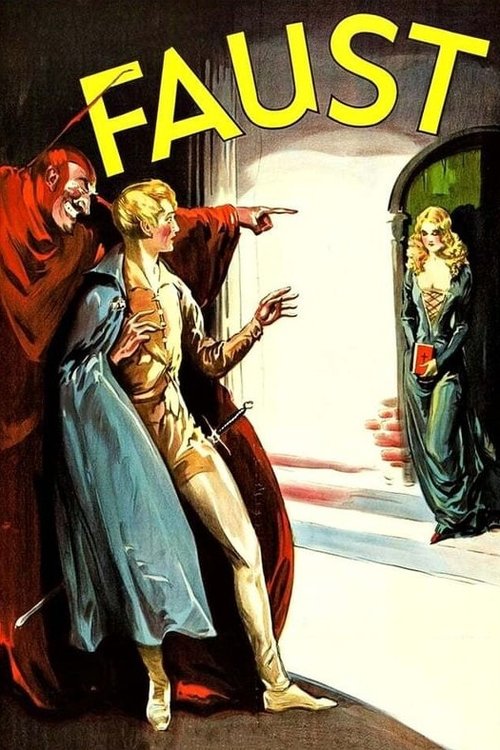
Faust
Faust - Eine deutsche Volkssage
"The Voice of the Tempter."
Overview
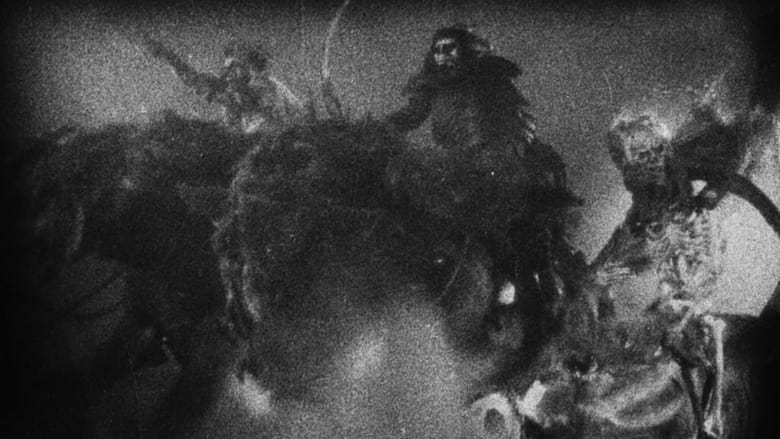
"Faust - Eine deutsche Volkssage" is a monumental silent film by F. W. Murnau and a prime example of German Expressionist cinema. The story begins with a wager between an Archangel and the demon Mephisto over the soul of the righteous alchemist, Faust. Mephisto unleashes a devastating plague upon Faust's town, and in his desperation to find a cure and alleviate the suffering, the devout Faust renounces God and summons the demon.
Mephisto offers Faust a deal: worldly pleasures, youth, and the power to heal in exchange for his immortal soul. Initially making a 24-hour pact to help his people, Faust is shunned when they discover his unholy alliance. Despondent, he makes a permanent deal, regaining his youth and embarking on a journey of debauchery. However, he grows weary of mindless pleasure and yearns for home.
Upon his return, he falls for the innocent Gretchen. Their love is pure, but Mephisto's machinations lead to tragedy, causing the deaths of Gretchen's mother and brother. Ostracized and in despair, Gretchen accidentally causes the death of her newborn child and is condemned to be burned at the stake. Faust, filled with remorse, must confront the consequences of his pact in a desperate attempt to save her.
Core Meaning
At its heart, F. W. Murnau's "Faust" is a profound exploration of the eternal struggle between good and evil, not just as cosmic forces, but as an intimate battle within the human soul. The film posits that humanity's capacity for both great nobility and terrible weakness is a central aspect of its nature. Through Faust's journey, the film questions the value of knowledge and power when devoid of compassion and love. It ultimately suggests that redemption is possible, not through divine intervention alone, but through the transformative and sacrificial power of love. The final message is that love is the one force capable of triumphing over evil and absolving sin, a single word that can break the devil's pact.
Thematic DNA
The Duality of Human Nature
The film delves into the inherent conflict within humanity, personified by Faust. He is initially a righteous and learned man dedicated to helping others, but he also harbors a deep-seated ambition and a vulnerability to despair that Mephisto exploits. His transformation from a venerable scholar to a hedonistic youth and finally to a repentant lover showcases the capacity for both good and evil that exists within a single person. The visual contrast between the aged, wise Faust and his youthful, impulsive counterpart emphasizes this internal struggle.
Redemption Through Love
A central tenet of the film is that love is the ultimate redemptive force. Faust's pact with Mephisto leads him down a path of selfishness and destruction. However, his genuine love for Gretchen awakens his dormant conscience and compels him to sacrifice himself. In the end, it is this act of love, his willingness to join her in the flames, that breaks the pact and allows their souls to ascend. The Archangel's final declaration that Mephisto has lost because of the word "Love" solidifies this theme.
The Corrupting Influence of Power
The legend of Faust is a classic cautionary tale about the corrupting nature of absolute power. Initially, Faust seeks power for a noble cause: to save his village from the plague. However, once he possesses supernatural abilities, he is quickly seduced by personal gratification, pleasure, and vanity. His journey from altruism to hedonism illustrates how easily power can divert even the best intentions, leading to moral decay and tragic consequences for himself and those around him.
Knowledge vs. Experience
The film contrasts the limitations of scholarly knowledge with the allure of worldly experience. The elderly Faust is a master of alchemy and philosophy, yet his books and prayers are useless against the plague. This disillusionment drives him to seek the power and sensory experiences offered by Mephisto. His journey suggests that a life of pure intellectual pursuit is incomplete and that true understanding comes from engaging with the world, with all its pleasures and pains, and ultimately, through the profound experience of love.
Character Analysis
Faust
Gösta Ekman
Motivation
Initially, his motivation is altruistic: to gain the power to end the suffering and death caused by the plague. After this fails and he is ostracized, his motivation shifts to the pursuit of youth and earthly pleasures. Ultimately, his love for Gretchen becomes his driving force, motivating him to seek redemption and sacrifice himself.
Character Arc
Faust begins as a pious, elderly alchemist, desperate to save his community from a plague. His arc is a tragic fall from grace driven by despair. After making a pact with Mephisto, he is rejuvenated and indulges in a life of hedonism. However, his love for the innocent Gretchen reawakens his conscience. Witnessing her suffering, caused by his actions, he renounces the gifts of the devil. His final act is one of selfless sacrifice, choosing to die with Gretchen, which ultimately redeems his soul.
Mephisto
Emil Jannings
Motivation
Mephisto's primary motivation is to win his bet with the Archangel and gain control over the Earth by proving that humanity is inherently corruptible. He delights in temptation, chaos, and the suffering of mortals, using Faust as his pawn to achieve his cosmic ambitions. His actions are driven by a fundamental opposition to divinity and goodness.
Character Arc
Mephisto is a powerful and cunning demon who serves as the film's antagonist. His character does not have a developmental arc in the traditional sense; he is consistently evil and manipulative from beginning to end. He wagers with an Archangel for dominion over the Earth, contingent on his ability to corrupt Faust's soul. Jannings' performance portrays Mephisto with a mix of terrifying power, grotesque humor, and sinister charm, making him a compelling and multifaceted villain.
Gretchen (Marguerite)
Camilla Horn
Motivation
Gretchen is motivated by pure and simple love for Faust. Her actions are guided by her innocence and piety. Even in her deepest despair, her character remains fundamentally good. Her love is so powerful that it ultimately becomes the key to Faust's salvation.
Character Arc
Gretchen is the embodiment of purity and innocence. She is charmed by the youthful Faust and falls in love with him. Her arc is a tragic one, as she becomes the primary victim of Faust's pact. Through Mephisto's manipulations, her life is destroyed: her mother dies of shock, her brother is killed, she is publicly shamed, and she loses her child. Despite her suffering, her spirit remains pure. In the end, her love for Faust is the catalyst for his redemption, and she recognizes his true self even as an old man in the flames.
Valentin
William Dieterle
Motivation
Valentin is motivated by a protective and righteous duty towards his sister and family honor. He is quick to anger when he perceives that his sister has been dishonored, leading to his fatal confrontation with Faust.
Character Arc
Valentin is Gretchen's brother, a soldier who represents honor and familial protection. His arc is short and tragic. He returns home to find his sister with a lover and, incited by Mephisto, challenges Faust to a duel. Mephisto intervenes, stabbing Valentin in the back. In his dying breaths, he condemns Faust as a murderer and curses his sister, publicly shaming her. He acts as a catalyst for Gretchen's public downfall.
Symbols & Motifs
Light and Shadow
The film's German Expressionist style heavily utilizes chiaroscuro (the contrast between light and dark) to symbolize the cosmic battle between good and evil. Light represents purity, divinity, and goodness, as seen in the radiant Archangel and the idyllic scenes with Gretchen. Shadows and darkness represent Mephisto's corrupting influence, despair, and the plague he unleashes. Murnau famously "painted with light and shadow" to create a visual and moral landscape where this struggle is made manifest.
This symbolism is present throughout the film, from the opening scene where the massive, dark form of Mephisto literally blots out the light over Faust's town, to the glowing heavens of the Archangel. The interplay of light and shadow on the characters' faces and within the sets constantly reinforces their moral state and the forces acting upon them.
The Pact
The contract signed in blood is a powerful and traditional symbol of the irreversible selling of one's soul. It represents the ultimate transgression: a conscious and deliberate choice to abandon divinity and morality in exchange for temporary, earthly gains. It is the physical manifestation of Faust's despair and his fateful decision.
Faust signs the pact with Mephisto after his initial attempts to use demonic power for good are thwarted. The fiery inscription of the terms on the parchment is a visually memorable scene that took an entire day to film, emphasizing its significance. This act seals his fate and sets in motion the tragic events of the story.
Fire
Fire in the film carries a dual symbolism of damnation and purification. It is the element of Hell, used by Mephisto to write the pact and a destructive force. However, it also becomes a means of redemption and transcendence. The flames of Gretchen's pyre become a crucible where Faust's ultimate sacrifice purifies both their souls.
Initially, a desperate Faust throws his books and the Bible into the fire. Later, the most dramatic use of fire is the climax at the stake. As Gretchen is about to be burned, Faust, now an old man again, throws himself onto the pyre. The flames consume them together, but their spirits, purified by this act of love, rise to heaven.
Mirrors and Reflections
Mirrors and reflections symbolize Faust's transformation and the transient nature of the youth and beauty granted to him by Mephisto. His youthful reflection is an illusion, a temporary mask for his true, aged self. Its destruction signifies the end of the pact's benefits and his return to his mortal state.
After Faust sees Gretchen being led to the stake, he expresses his regret and wishes he had never asked for youth. In a fit of rage, Mephisto smashes the mirror containing Faust's youthful reflection, causing him to instantly revert to his old age just before he runs to the pyre.
Memorable Quotes
Die Erde ist mein!
— Mephisto
Context:
This line is spoken at the very beginning of the film, as Mephisto, wreathed in darkness, challenges the Archangel's assertion that man is good and that the Earth belongs to God. It sets the stage for the entire narrative conflict.
Meaning:
"The Earth is mine!" This quote, delivered during the opening confrontation with the Archangel, encapsulates Mephisto's arrogance and ambition. It establishes the stakes of the cosmic wager that will determine the fate of humanity.
Das Wort, das du vergaßest... Liebe.
— Archangel
Context:
At the end of the film, after Faust and Gretchen have perished in the fire and their spirits ascend, Mephisto claims he has won the wager. The Archangel refutes him with this line, revealing that Faust's act of sacrificial love has rendered the pact void and ensured his redemption.
Meaning:
"The word that you forgot... Love." This is the film's ultimate thematic statement, delivered by the Archangel to a defeated Mephisto. It signifies that love is the one power superior to evil, capable of breaking any demonic pact and ensuring salvation.
Ich biete dir das höchste Glück: Jugend. Greif zu!
— Mephisto
Context:
Mephisto says this to the elderly Faust, who is lamenting his old age and inability to experience life's pleasures. This offer is the turning point that leads Faust to agree to the pact, abandoning his scholarly life for a chance to be young again.
Meaning:
"I offer you the greatest happiness: Youth. Seize it!" This line is the core of Mephisto's temptation of the aged Faust. It preys on Faust's despair and regret for a life unlived, equating happiness not with wisdom or piety, but with the fleeting pleasures of youth.
Philosophical Questions
What is the true nature of good and evil?
The film explores this question by moving beyond a simple binary. Good is not merely the absence of sin, and evil is not just a demonic force. Faust, a good man, is driven to a pact with evil through desperation and a noble desire to help others. Mephisto, the embodiment of evil, is also charismatic and at times, comically grotesque. The film suggests that good and evil are intertwined forces, constantly at war within the human soul. It posits that the ultimate good, "Love," is a human-centered virtue powerful enough to redeem a soul from the ultimate evil.
Is humanity inherently flawed or inherently good?
This is the central wager between the Archangel and Mephisto. The Archangel believes in humanity's innate goodness, while Mephisto believes everyone can be corrupted. The film's narrative tests this proposition. It shows humanity at its worst: superstitious, cruel, and quick to judge. Yet, it concludes on an optimistic note. Faust's final, selfless act of love for Gretchen proves the Archangel's point. The film argues that while humans are fallible and prone to temptation, their capacity for love and sacrifice is a divine spark that can overcome their darkest impulses.
What is the price of knowledge and power?
The film serves as a powerful allegory for the dangers of unchecked ambition. Faust's quest begins with a desire for the knowledge and power to save lives, but it quickly devolves into a selfish pursuit of pleasure. The film illustrates that power gained without moral grounding leads to destruction, not just of the self, but of the innocent. The ultimate price Faust pays is the loss of his soul, a price he can only reverse by relinquishing all the power he sought and embracing vulnerability through love.
Alternative Interpretations
While the film presents a clear moral conclusion where love conquers evil, some critical interpretations offer more nuanced readings. One perspective focuses on the film's critique of organized religion. The clergy are depicted as largely ineffective and hysterical in the face of the plague, and the townspeople, who claim to be pious, are quick to turn on Faust with violence when they discover his pact, even though he made it to save them. This reading suggests that Murnau is critical of a rigid, dogmatic faith that lacks compassion, positing that true divinity lies in the human capacity for love, independent of religious institutions.
Another interpretation delves into a potential queer reading of the relationship between Faust and Mephisto. Some scholars have noted the intense, almost intimate bond between the two characters. Mephisto's control over Faust is possessive, and their journey together is a twisted parody of a romantic partnership. Gretchen's arrival can be seen as an intrusion into this dynamic. From this perspective, Gretchen is less a love interest for Faust and more of a symbolic female alter ego who must suffer to expiate his sins, which are tied to his unnatural pact and liaison with Mephisto. This reading views the film as a labyrinth of hidden identities and repressed desires, reflecting the personal struggles of its homosexual director, F.W. Murnau.
Cultural Impact
F. W. Murnau's "Faust" stands as a landmark of silent cinema and a pinnacle of the German Expressionist movement. Released in 1926, during the creatively fertile period of the Weimar Republic, the film was a massive undertaking for the Ufa studio, showcasing unprecedented technical ambition and visual artistry. Its innovative special effects, including elaborate miniatures, complex superimpositions, and a masterful use of light and shadow, significantly advanced cinematic techniques.
Upon its release, "Faust" received a mixed reception in Germany. Many critics felt it was a vulgarization of Goethe's revered national epic, condemning it as sentimental "kitsch." It also failed to recoup its massive 2-million Reichsmark budget at the box office. However, its influence on the future of cinema was profound and undeniable. The film's visual language, particularly its expressionistic use of chiaroscuro to represent the struggle between good and evil, has been cited as an influence on countless filmmakers and genres, most notably in horror films and film noir. Its depiction of the supernatural directly inspired imagery in later works, most famously Disney's "Fantasia."
Today, "Faust" is regarded as a masterpiece. Critics and scholars praise its stunning visual design, its thematic depth, and its powerful storytelling, which transcends the limitations of silent film. It is recognized not just as a key work of German Expressionism but as a testament to the artistic potential of cinema itself, a "dazzling display of the high artistry of which silent cinema was now capable."
Audience Reception
Upon its initial release in 1926, "Faust" was a commercial failure and met with a harsh critical reception in its native Germany. Many German critics felt it was a simplistic and overly sentimental take on a cornerstone of their national literature, Goethe's "Faust," decrying it as a "kitsch travesty." However, over the decades, the perception of the film has dramatically shifted. Today, modern audiences and critics almost universally regard it as a masterpiece of the silent era. On review aggregator Rotten Tomatoes, the film holds a high approval rating, with the consensus praising it as offering "one of the most astonishing visual experiences the silent cinema has to offer." Audiences frequently praise the film's stunning, groundbreaking visuals, the epic scale of its production, and the powerful, archetypal performances, especially Emil Jannings' Mephisto. The main points of criticism from contemporary viewers sometimes center on the exaggerated, theatrical acting style, a common trait of silent films that can be jarring to those unfamiliar with the medium. Some also find the central section, which veers into romantic comedy, to be a tonal shift from the dark, dramatic opening and closing acts. Overall, however, the verdict is overwhelmingly positive, with many viewers expressing awe at how well the film's technical achievements and emotional power hold up nearly a century after its creation.
Interesting Facts
- The film was the most expensive and technically elaborate production undertaken by the German studio Ufa until it was surpassed by Fritz Lang's "Metropolis" the following year.
- Filming took six months, and director F. W. Murnau used two cameras for many scenes to have different takes and angles to choose from for the domestic and international versions.
- The international versions of the film were often assembled from the secondary takes, leading to versions with less impressive special effects and even mistakes.
- A single short sequence, showing the demonic pact being written on parchment by fire, took an entire day to film.
- The flames used for Gretchen's burning at the stake were real, and the heat on set was so intense that actress Camilla Horn reportedly fainted.
- The sequence of Mephisto and Faust flying over a moonlit landscape was created using detailed miniature models.
- This was Murnau's last film made in Germany before he moved to Hollywood to direct "Sunrise: A Song of Two Humans" (1927).
- Murnau had wanted American actress Lillian Gish to play Gretchen, but she insisted on her own cinematographer, so the role went to newcomer Camilla Horn.
- The actor William Dieterle, who played Gretchen's brother Valentin, would later move to Hollywood and become a successful director himself, helming films like "The Hunchback of Notre Dame" (1939).
Easter Eggs
Influence on Disney's "Fantasia"
The iconic opening scene of "Faust," featuring the gigantic Mephisto spreading his dark wings over a town, was a direct visual inspiration for the "Night on Bald Mountain" segment in Walt Disney's 1940 animated feature, "Fantasia." The depiction of the demon Chernabog looming over the mountain is strikingly similar to Murnau's composition.
Prohibition Reference in the U.S. Version
Murnau filmed slightly different scenes for the version of the film intended for American audiences. In one scene, Gretchen's aunt offers Mephisto a drink. In the German version, he rejects it, complaining of heartburn. In the U.S. version, he rejects it because it contains alcohol, a direct and ironic reference to the ongoing Prohibition in the United States at the time.
⚠️ Spoiler Analysis
Click to reveal detailed analysis with spoilers
Frequently Asked Questions
Explore More About This Movie
Dive deeper into specific aspects of the movie with our detailed analysis pages
Comments (0)
No comments yet. Be the first to share your thoughts!