
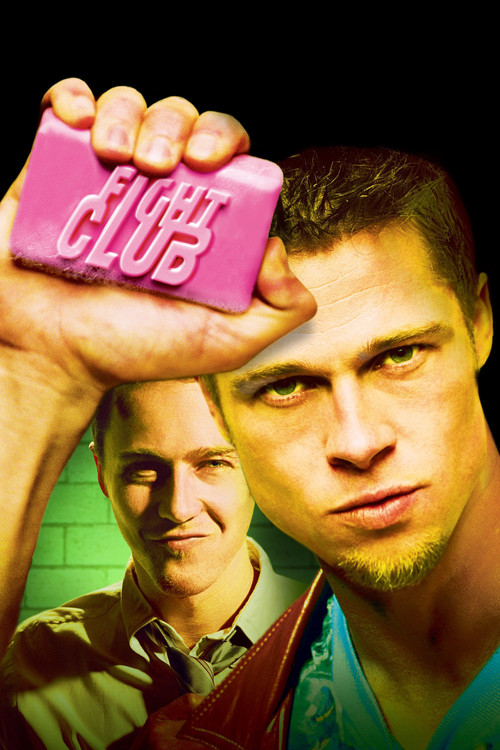
"Mischief. Mayhem. Soap."
Fight Club - Symbolism & Philosophy
Symbols & Motifs
Soap
Soap symbolizes a central duality in the film. On one hand, it represents the cleansing of the self from the filth of consumer society, a way to strip away superficiality to get to something real. On the other hand, it represents hypocrisy and the ugly truth behind consumerism, as Tyler makes his luxury soap from human fat liposuctioned from the wealthy—literally selling the rich their own fat asses back to them.
Tyler Durden is a soap salesman. He and the Narrator learn to make soap together, and the pink bar of soap with the "Fight Club" title embossed on it became the film's primary marketing image. Tyler's business, "Paper Street Soap Company," is the financial engine for Project Mayhem.
The Narrator's Apartment vs. Tyler's House
The Narrator's IKEA-filled apartment represents the sterile, conformist, and materialistic life he is trying to escape. It's a prison of consumer goods that promises happiness but provides none. Tyler's dilapidated house on Paper Street is the complete opposite: a symbol of decay, freedom from materialism, and a rejection of societal norms. It is a space of deconstruction where the characters can rebuild themselves.
The film opens with a sequence where the camera moves through the Narrator's apartment as his possessions are virtually cataloged. Its explosion is the inciting incident that forces him to connect with Tyler. He then moves into Tyler's decaying mansion, which becomes the headquarters for Fight Club and Project Mayhem.
Scars and Bruises
Physical pain, scars, and bruises are symbols of authentic experience and being alive in a world that numbs individuals. In the context of the club, they are badges of honor, proof that the members can feel something real, even if it's pain. The chemical burn scar on the Narrator's hand, inflicted by Tyler, serves as a permanent reminder of his connection to Tyler's philosophy and his journey toward enlightenment through pain.
The members of Fight Club return to their mundane jobs with black eyes and broken teeth, a visible sign of their secret rebellion. The scene where Tyler gives the Narrator a chemical burn using lye is a pivotal moment of initiation into his destructive philosophy.
Philosophical Questions
Does modern consumer society strip individuals of their identity and purpose?
The film relentlessly explores this question by portraying its protagonist as an "everyman" who has followed all the rules of society—get a job, buy furniture, build a home—yet feels completely empty and dead inside. Tyler Durden's entire philosophy is a reaction to this, arguing that consumerism has turned people into commodities and that true identity can only be found by destroying the artificial self built on material possessions. The film asks whether we control our possessions or if our possessions control us.
Is violence a legitimate path to self-discovery and authenticity?
"Fight Club" presents physical violence as a way for its characters to feel something real in a numbing world. The pain and risk of the fights provide a visceral, immediate experience that contrasts with the sterile safety of their everyday lives. However, the film complicates this idea by showing how this outlet for violence evolves into the organized, destructive terrorism of Project Mayhem, questioning whether the initial, personal catharsis can be separated from its larger, socially destructive potential. It ultimately critiques violence as a solution, showing it leads to fascism and death.
What is the nature of the self?
The central plot twist—that the Narrator and Tyler are the same person—forces a deep exploration of identity. The film uses the concept of dissociative identity disorder as a metaphor for the fragmented nature of the modern psyche. It draws on Jungian ideas of the "shadow self"—the repressed, darker part of our personality. The film suggests that acknowledging and integrating this shadow is necessary for wholeness, but allowing it to take complete control leads to annihilation. The Narrator's final act of shooting himself to kill Tyler is a paradoxical act of self-destruction for the sake of self-preservation.
Core Meaning
The core meaning of "Fight Club" is a satirical critique of consumer culture and the crisis of masculinity in contemporary society. Director David Fincher presents a world where men, emasculated by corporate jobs and a society of "shopping," have lost their sense of purpose and identity. The film explores the rebellion against this sterile existence, questioning the values of a society that defines individuals by their possessions. It posits that the modern man is trapped between the superficial comfort of materialism and a primal yearning for authentic experience, even if that experience is violent and self-destructive. However, the film is not a glorification of this rebellion; it is a cautionary tale about the dangers of unchecked nihilism and fascism, showing how a movement born from a desire for freedom can devolve into a destructive cult. Ultimately, it suggests that true self-knowledge requires confronting and integrating one's own inner darkness, rather than letting it run rampant.