Straume
"Surrender to the storm."
Flow - Symbolism & Philosophy
Symbols & Motifs
The Flood
The flood represents an overwhelming, uncontrollable force of change and crisis. It is the catalyst that destroys the Cat's world of isolation and forces it into a new reality defined by interdependence. It also serves as a powerful symbol of environmental catastrophe and nature's power to reclaim the world from human influence.
The flood is the central event of the film, initiating the entire plot. It transforms the landscape from a familiar forest into a vast, perilous ocean, visually representing the scale of the challenge the characters must face together.
The Sailboat
The sailboat symbolizes a makeshift community and a vessel of hope. It is a small, fragile ark in a vast, dangerous world, representing the delicate nature of the bonds formed between its diverse passengers. It is their shared space, where cooperation is not a choice but a necessity for survival.
The Cat first boards the boat occupied by the Capybara, and it becomes the central location for most of the film's narrative. The boat gathers more animals along the way, becoming a microcosm of a new, multi-species society.
The Giant Cat Sculptures
The sculptures are haunting remnants of the past, symbolizing the Cat's former solitary life and the lost human world that revered it. As the floodwaters rise and submerge these statues, it signifies the end of the Cat's old identity and the impossibility of returning to its isolated existence. They represent a static past being washed away by the 'flow' of the present.
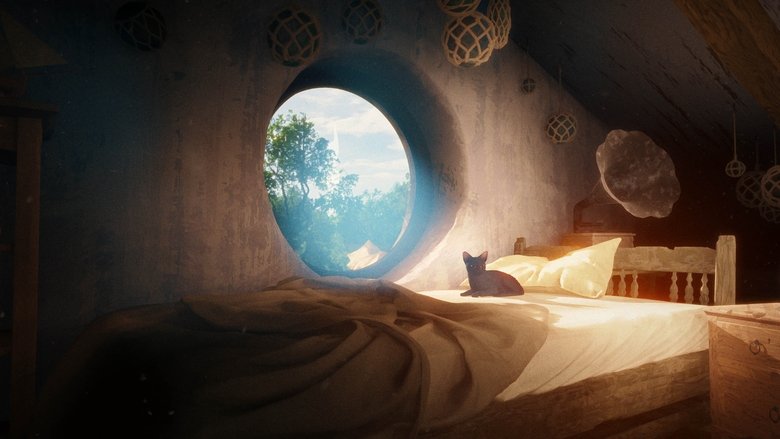
Early in the film, the Cat lives in and around a cabin filled with wooden cat carvings. As the flood begins, it desperately clings to a giant stone cat head before it is completely submerged, marking the final, definitive moment the Cat must leave its past behind.
The Secretary Birds
The flock of Secretary Birds can be interpreted as representing a rigid, exclusionary society that punishes deviation. The specific white Secretary Bird that joins the boat symbolizes sacrifice and transcendence. It initially acts as a protector but is cast out by its own kind for showing compassion, mirroring a Christ-like figure. Its eventual ascension into the sky suggests a spiritual release or a return to a different plane of existence.
The animals encounter the flock of birds, which acts with hostility. One bird defects and joins the boat, becoming its navigator. After being wounded in a fight defending the group from its former flock, it ultimately flies away into a storm, achieving a form of spiritual transcendence.
Philosophical Questions
Is true independence possible, or is community essential for survival and meaning?
The film directly explores this question through the protagonist Cat's arc. It begins as a self-sufficient loner, but the flood makes its solitary existence impossible. Its survival becomes contingent on joining a community aboard the sailboat. The film suggests that while independence is a powerful trait, absolute self-reliance is a fallacy in the face of overwhelming adversity. True strength is found in the ability to adapt and form bonds.
What is humanity's place in nature?
By completely removing humans from the narrative while leaving behind their ruins, the film prompts reflection on our impact on the planet. The story unfolds as a natural drama, suggesting that the world and its creatures continue to exist, struggle, and form societies without us. It raises the question of whether humanity is a steward of the planet or simply a transient presence whose absence allows nature to reclaim its balance.
How can we find connection and understanding in the absence of a shared language?
"Flow" is a testament to non-verbal communication. The diverse group of animals cannot speak to one another in a human sense, yet they build a functional and emotionally resonant community. They communicate through actions, gestures, and shared experiences. The film posits that empathy and cooperation are fundamental instincts that can transcend the barriers of language and species, suggesting a more universal form of connection exists.
Core Meaning
At its core, "Flow" is a profound meditation on the transition from staunch independence to the necessity of community in the face of overwhelming crisis. Director Gints Zilbalodis uses the cat's journey as an allegory for his own experience moving from working alone on his first feature, "Away," to collaborating with a large team for the first time. The film explores the idea that survival is not merely a physical struggle but an emotional and social one. It suggests that true resilience is found not in isolation, but in the courage to trust others and form bonds despite inherent differences. Furthermore, "Flow" serves as a quiet environmental fable, reflecting on humanity's fragile relationship with nature and the devastating consequences of ecological imbalance without ever showing a human character. The narrative champions empathy, cooperation, and the universal language of shared experience that transcends species and words.