Flow
A dialogue-free animated fable where a solitary cat, displaced by a world-altering flood, navigates themes of survival and reluctant community aboard a makeshift ark, rendered in hauntingly beautiful, immersive visuals.
Flow

Flow

Straume

"Surrender to the storm."

29 August 2024 Latvia 85 min ⭐ 8.1 (2,336)
Director: Gints Zilbalodis
Animation Family Fantasy Adventure
Community vs. Individualism Survival in a Post-Human World Empathy and Communication Beyond Words The Cycle of Destruction and Renewal
Budget: $3,700,000
Box Office: $17,660,107

Overview

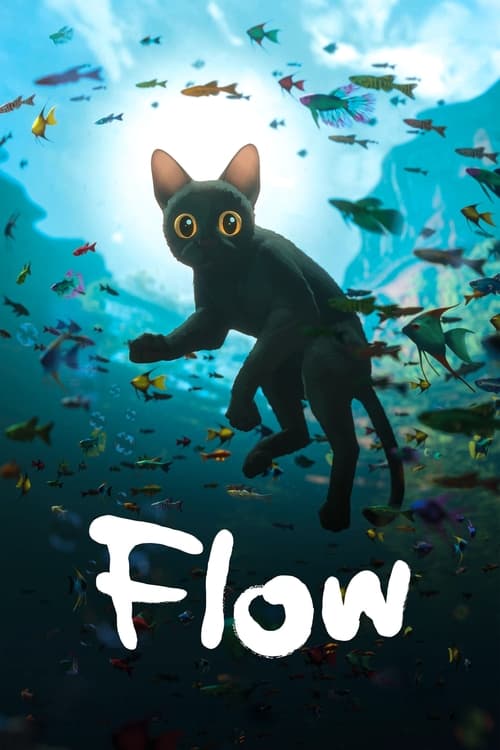
"Flow" is a wordless animated film that follows a fiercely independent black cat living a solitary life in a forest dotted with mysterious human-made cat sculptures. This tranquil existence is shattered by a catastrophic flood that submerges the entire landscape, forcing the cat to abandon its home. To survive, it takes refuge on a small sailboat steered by a gentle and placid Capybara.

As they drift through the drowned world, this unlikely pair gradually forms a small, ragtag community of survivors. They are joined by a lively, trinket-collecting Lemur, a majestic but conflicted Secretary Bird, and a friendly Labrador Retriever who separates from its more aggressive pack. With no dialogue, the story unfolds through the animals' realistic behaviors, expressive animation, and their silent interactions. Together, they must learn to cooperate and trust one another to navigate the perils of their new aquatic reality, facing storms, dwindling resources, and other creatures in their search for dry land.
Core Meaning

At its core, "Flow" is a profound meditation on the transition from staunch independence to the necessity of community in the face of overwhelming crisis. Director Gints Zilbalodis uses the cat's journey as an allegory for his own experience moving from working alone on his first feature, "Away," to collaborating with a large team for the first time. The film explores the idea that survival is not merely a physical struggle but an emotional and social one. It suggests that true resilience is found not in isolation, but in the courage to trust others and form bonds despite inherent differences. Furthermore, "Flow" serves as a quiet environmental fable, reflecting on humanity's fragile relationship with nature and the devastating consequences of ecological imbalance without ever showing a human character. The narrative champions empathy, cooperation, and the universal language of shared experience that transcends species and words.

Thematic DNA

Community vs. Individualism 35%
Survival in a Post-Human World 30%
Empathy and Communication Beyond Words 20%
The Cycle of Destruction and Renewal 15%

Community vs. Individualism

The central theme revolves around the protagonist Cat's evolution from a determined loner to a crucial member of a diverse group. Initially self-reliant, the flood forces it to depend on others, beginning with the Capybara. The film contrasts the Cat's initial reluctance with the eventual synergy of the group, where each animal's unique traits contribute to their collective survival. This mirrors the director's own journey from solo filmmaker to collaborative leader, exploring the anxieties and ultimate rewards of teamwork.

Survival in a Post-Human World

The film is set in a world where humans are conspicuously absent, leaving only remnants of their existence like buildings and giant cat sculptures. The narrative is a pure tale of animal survival against a natural disaster, which may or may not be human-caused. This focus on the animal perspective, free from human dialogue and intervention, creates a powerful environmental allegory about resilience, adaptation, and the enduring force of nature.

Empathy and Communication Beyond Words

As a dialogue-free film, "Flow" powerfully demonstrates that communication and emotional connection do not require language. The relationships between the animals are built on actions, shared experiences, and observing behavior. The audience is invited to interpret the animals' intentions and feelings through their movements and vocalizations, fostering a deeper, more intuitive form of empathy. The film champions the idea that understanding and cooperation are universal concepts.

The Cycle of Destruction and Renewal

The great flood acts as a cleansing or resetting force, destroying the old world to make way for a new one. This theme is reminiscent of mythological flood narratives like Noah's Ark, but without the direct religious allegory. The film's ending, where the waters recede and life finds a way to continue, suggests a powerful message of hope and resilience. The post-credits scene showing the guardian-like whale alive reinforces this idea of nature's enduring cycle.

Character Analysis

Cat

N/A

Archetype: The Loner / Reluctant Hero
Key Trait: Independent

Motivation

Initially, the Cat's sole motivation is survival. It seeks food, shelter, and safety for itself. As the story progresses, this motivation expands to include the well-being of its newfound companions, driven by a developing sense of loyalty and connection.

Character Arc

The Cat begins as a staunchly independent and solitary creature, comfortable in its isolation. The trauma of the flood forces it onto a boat with others, where it slowly and reluctantly learns the value of trust and cooperation. It evolves from prioritizing self-preservation to actively participating in the group's survival, risking its own safety for its new companions and demonstrating true emotional growth.

Capybara

N/A (Voiced by a baby camel)

Archetype: The Stoic Caretaker / The Moral Center
Key Trait: Placid

Motivation

The Capybara is motivated by a natural sense of peace and inclusivity. It readily accepts others onto its boat and acts as a calming presence, driven by an instinct to help and create harmony.

Character Arc

The Capybara is the calm, stable center of the group from the beginning. It is the first to offer shelter to the Cat. Its arc is less about personal change and more about its steadying influence on the others. It embodies patience and quiet wisdom, teaching the Cat how to swim and fostering a peaceful environment on the boat.

Secretary Bird

N/A

Archetype: The Protector / The Martyr
Key Trait: Protective

Motivation

Initially part of an exclusionary group, its motivation shifts to protecting the vulnerable animals on the boat. It is driven by a sense of duty and compassion that puts it at odds with its own flock.

Character Arc

The Secretary Bird first appears as part of a hostile flock but chooses to help the Cat and join the boat. It becomes a protector and navigator for the group. Its arc is one of sacrifice; it is wounded and cast out by its own kind for its compassion. Ultimately, it transcends its earthly struggles, flying off into a storm in a moment of spiritual release, having fulfilled its role as a guardian.

Labrador Retriever

N/A

Archetype: The Convert / The Loyal Friend
Key Trait: Friendly

Motivation

The Labrador is motivated by a friendly and playful nature, which clashes with the pack's aggressive survival instincts. It seeks companionship and harmony over conflict, leading it to abandon its old group for the new one.

Character Arc

The Labrador initially belongs to a pack of dogs that chases the Cat. However, it shows an individualistic and friendly nature, breaking away from the pack mentality to join the boat's more cooperative community. Its arc is about choosing a different path—learning to be independent from its aggressive group in order to form more meaningful, positive connections.

Symbols & Motifs

The Flood

Meaning:

The flood represents an overwhelming, uncontrollable force of change and crisis. It is the catalyst that destroys the Cat's world of isolation and forces it into a new reality defined by interdependence. It also serves as a powerful symbol of environmental catastrophe and nature's power to reclaim the world from human influence.

Context:

The flood is the central event of the film, initiating the entire plot. It transforms the landscape from a familiar forest into a vast, perilous ocean, visually representing the scale of the challenge the characters must face together.

The Sailboat

Meaning:

The sailboat symbolizes a makeshift community and a vessel of hope. It is a small, fragile ark in a vast, dangerous world, representing the delicate nature of the bonds formed between its diverse passengers. It is their shared space, where cooperation is not a choice but a necessity for survival.

Context:

The Cat first boards the boat occupied by the Capybara, and it becomes the central location for most of the film's narrative. The boat gathers more animals along the way, becoming a microcosm of a new, multi-species society.

The Giant Cat Sculptures

Meaning:

The sculptures are haunting remnants of the past, symbolizing the Cat's former solitary life and the lost human world that revered it. As the floodwaters rise and submerge these statues, it signifies the end of the Cat's old identity and the impossibility of returning to its isolated existence. They represent a static past being washed away by the 'flow' of the present.

Context:

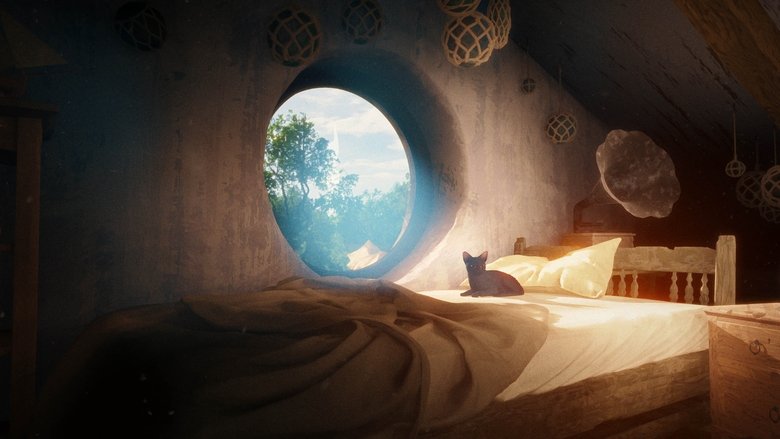
Early in the film, the Cat lives in and around a cabin filled with wooden cat carvings. As the flood begins, it desperately clings to a giant stone cat head before it is completely submerged, marking the final, definitive moment the Cat must leave its past behind.

The Secretary Birds

Meaning:

The flock of Secretary Birds can be interpreted as representing a rigid, exclusionary society that punishes deviation. The specific white Secretary Bird that joins the boat symbolizes sacrifice and transcendence. It initially acts as a protector but is cast out by its own kind for showing compassion, mirroring a Christ-like figure. Its eventual ascension into the sky suggests a spiritual release or a return to a different plane of existence.

Context:

The animals encounter the flock of birds, which acts with hostility. One bird defects and joins the boat, becoming its navigator. After being wounded in a fight defending the group from its former flock, it ultimately flies away into a storm, achieving a form of spiritual transcendence.

Philosophical Questions

Is true independence possible, or is community essential for survival and meaning?

The film directly explores this question through the protagonist Cat's arc. It begins as a self-sufficient loner, but the flood makes its solitary existence impossible. Its survival becomes contingent on joining a community aboard the sailboat. The film suggests that while independence is a powerful trait, absolute self-reliance is a fallacy in the face of overwhelming adversity. True strength is found in the ability to adapt and form bonds.

What is humanity's place in nature?

By completely removing humans from the narrative while leaving behind their ruins, the film prompts reflection on our impact on the planet. The story unfolds as a natural drama, suggesting that the world and its creatures continue to exist, struggle, and form societies without us. It raises the question of whether humanity is a steward of the planet or simply a transient presence whose absence allows nature to reclaim its balance.

How can we find connection and understanding in the absence of a shared language?

"Flow" is a testament to non-verbal communication. The diverse group of animals cannot speak to one another in a human sense, yet they build a functional and emotionally resonant community. They communicate through actions, gestures, and shared experiences. The film posits that empathy and cooperation are fundamental instincts that can transcend the barriers of language and species, suggesting a more universal form of connection exists.

Alternative Interpretations

While the primary reading of "Flow" is a story of survival and newfound community, several alternative interpretations exist. Some viewers see a deep spiritual and mythological allegory within the narrative. In this interpretation, the flood is a divine, purifying event, and the animals' journey is a spiritual test. The Secretary Bird's departure is viewed as a literal ascension, a being returning to a heavenly realm, while the other animals are left to inherit the renewed earth. The giant whale is seen not just as an animal, but as a Leviathan-like guardian of the natural world.

Another interpretation frames the entire story as a metaphor for the creative process itself, specifically director Gints Zilbalodis's transition from a solo artist to a collaborative leader. The independent Cat represents the director working alone, while the boat's diverse crew symbolizes the animation team he had to learn to trust and work with. The perilous journey reflects the challenges of a large-scale film production. A third reading views the film through a more philosophical lens, suggesting the narrative is an exploration of existentialism, where the characters must create their own meaning and community in a seemingly indifferent, post-human universe.

Cultural Impact

"Flow" made a significant impact on the international film stage, earning widespread critical acclaim upon its premiere at the 2024 Cannes Film Festival. It became a major awards contender, winning Best Animated Feature from prestigious groups like the New York Film Critics Circle and the National Board of Review, and was Latvia's official entry for the Academy Awards for both Best International Feature and Best Animated Feature. The film's success challenged the dominance of major animation studios, proving that an independent film from a small country, made with open-source software like Blender, could achieve global recognition and commercial success.

Its dialogue-free format makes it universally accessible, transcending language and cultural barriers. Critics and audiences have lauded its sophisticated visual storytelling, comparing its immersive, exploratory nature to open-world video games like "Stray" and its environmental grandeur to the works of Studio Ghibli. The film resonates with contemporary anxieties about climate change and environmental disaster, offering a poignant, non-didactic reflection on the importance of community and cooperation in a world facing crisis. By focusing on realistic animal behaviors rather than anthropomorphism, "Flow" provides a fresh and profound cinematic experience that encourages empathy and introspection.

Audience Reception

Audience reception for "Flow" has been overwhelmingly positive, with viewers frequently describing it as a "beautiful," "mesmerizing," and "emotionally powerful" experience. Many praise its stunning, unique animation style and the immersive quality of its world-building, which some have compared to the feeling of playing an open-world video game. The dialogue-free approach is widely seen as a major strength, forcing viewers to become more engaged and connect with the characters on a deeper, more instinctual level. The film's ability to convey complex emotions and relationships without words is a frequent point of admiration. While some found the pacing slow, the vast majority of viewers appreciated its meditative and contemplative tone. It has been noted to resonate strongly with both adults and children who love animals, with many viewers reporting being moved to tears by its poignant moments.

Interesting Facts

  • The film is completely dialogue-free, relying entirely on visual storytelling, sound design, and music.
  • Director Gints Zilbalodis was inspired to tell a story about learning to work with a team, as "Flow" was his first film made with a crew after creating his debut feature "Away" entirely by himself.
  • The entire film was animated using Blender, a free and open-source 3D software.
  • Production took five-and-a-half years to complete.
  • Zilbalodis did not use traditional storyboards, instead creating 3D environments and then exploring them with a virtual camera to find shots, a process more akin to live-action filmmaking or video game design.
  • The film has no deleted scenes.
  • The sounds used for the animals are authentic, with one notable exception: the Capybara's vocalizations are actually recordings of a baby camel, as a real capybara's high-pitched sounds didn't fit the character's calm demeanor.
  • The film received numerous accolades, including awards at the Cannes Film Festival and Annecy International Animation Film Festival, and became the most-viewed film in Latvian history.

⚠️ Spoiler Analysis

Click to reveal detailed analysis with spoilers

Frequently Asked Questions

Explore More About This Movie

Dive deeper into specific aspects of the movie with our detailed analysis pages

Comments (0)

Leave a comment

No comments yet. Be the first to share your thoughts!