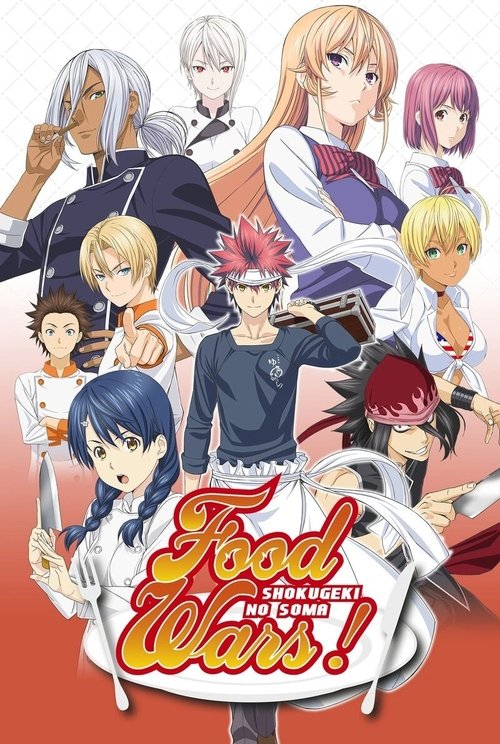
Food Wars! Shokugeki no Soma
食戟のソーマ
Overview
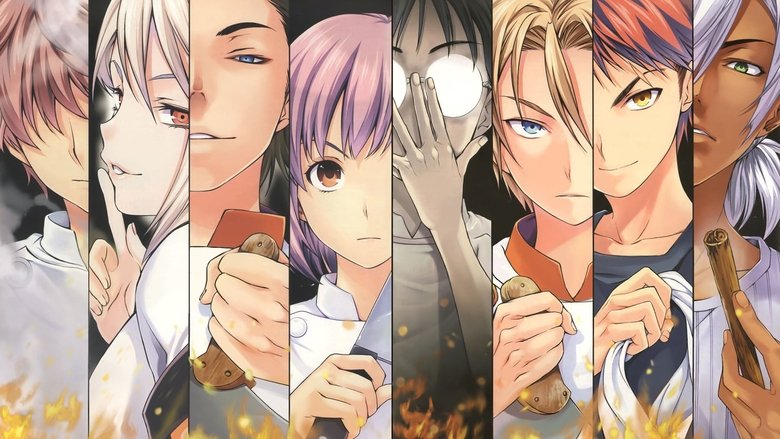
"Food Wars! Shokugeki no Soma" follows the ambitious journey of Soma Yukihira, a talented young chef who hones his skills in his family's small diner. His world is turned upside down when his father enrolls him in the prestigious Totsuki Saryo Culinary Institute, Japan's foremost culinary academy. At Totsuki, cooking disputes are settled through intense, high-stakes cooking duels known as "Shokugeki" (food wars). Soma's common-man cooking style, born from a humble diner, immediately clashes with the elite, gourmet sensibilities of his new classmates, including the gifted and initially arrogant Erina Nakiri, who possesses the divine tasting ability known as the "God Tongue."
Across five seasons, Soma navigates the treacherous and competitive landscape of Totsuki, forming crucial friendships and rivalries that push his culinary creativity to its limits. The series chronicles his participation in grueling training camps, the intense Autumn Elections tournament, and a rebellion against a tyrannical new school administration that threatens to stifle culinary freedom. The ultimate challenge comes in the form of the BLUE tournament, a world-class competition for young chefs. Soma's relentless spirit and innovative approach to cooking challenge the established norms of the culinary world as he strives to surpass his legendary father and claim the top spot at Totsuki.
Core Meaning
The core meaning of "Food Wars! Shokugeki no Soma" is a celebration of passion, perseverance, and the belief that culinary greatness can originate from anywhere, regardless of pedigree. It posits that relentless dedication and a constant desire to learn and experiment are more important than innate genius or a privileged background. The series champions the idea that food is a universal language that connects people, and that the true essence of cooking lies not in perfection, but in the heart and soul a chef pours into their dishes for the sake of making others happy. It is a story about how friendly rivalry and collaboration forge stronger individuals and how one's origins do not define their ultimate potential.
Thematic DNA
Perseverance and Growth Through Failure
Soma Yukihira's entire journey is defined by his reaction to failure. He begins the series with 489 losses to his father, viewing each defeat not as a setback, but as a learning opportunity. This theme is central to the show's philosophy: true growth comes from pushing boundaries, failing, and using that experience to innovate. Whether losing a competition or having a dish criticized, Soma and his friends consistently analyze their shortcomings to come back stronger, demonstrating that resilience and a positive attitude toward failure are the key ingredients for success in the culinary world and in life.
The Power of Friendship and Collaboration
While the Shokugeki format is inherently competitive, the series places immense value on the bonds formed between chefs. Soma's growth is inextricably linked to his friends at the Polaris Dormitory. They support each other, share knowledge, and act as taste-testers for experimental dishes. This theme becomes paramount during the rebellion against Azami Nakiri's Central regime, where the students must band together, combining their individual specialties to defeat a common foe. The show argues that while individual talent is important, collaboration and mutual support elevate everyone's abilities.
Tradition vs. Innovation
"Food Wars!" constantly explores the tension between established culinary traditions and unorthodox creativity. Many of Totsuki's elite students come from families with long, respected culinary histories, specializing in specific, perfected styles. Soma, with his 'Yukihira-style diner food,' represents innovation and adaptability. He respects tradition but is not bound by it, freely combining techniques from different cuisines to create something new and unexpected. The series suggests that the future of cuisine lies in a balance between honoring the past and fearlessly experimenting for the future.
Elitism vs. Humility
The story establishes a clear conflict between the culinary elitism of characters like Erina Nakiri (initially) and the humble, customer-focused approach of Soma. Erina, with her "God Tongue," is raised to believe that only the most refined, expensive cuisine is worthy. Soma, having cooked for everyday people in a family diner, believes that any well-made dish that brings joy to the eater is a masterpiece. Throughout the series, Soma's success forces the elite to recognize the value of 'common' food and the importance of cooking for others rather than for prestige.
Character Analysis
Soma Yukihira
Yoshitsugu Matsuoka
Motivation
Soma's primary motivation is to surpass his father, Joichiro Yukihira, in cooking. This simple goal drives him to constantly challenge himself, experiment with unorthodox techniques, and never back down from a Shokugeki, no matter the odds. His motivation is rooted in a deep love for cooking and the joy he finds in seeing people enjoy his food, a core value instilled in him at his family's diner.
Character Arc
Soma begins as a talented but somewhat arrogant chef, confident only in the context of his small family diner. Upon entering Totsuki, he is immediately humbled by the sheer scale of talent and specialized knowledge. His arc is not about acquiring a new personality but about expanding his worldview. He learns to appreciate different culinary philosophies and techniques, integrating them into his own flexible style. He evolves from a lone wolf aiming to surpass his father into a leader who inspires his peers and spearheads a rebellion to protect their culinary freedom. By the end, he understands that the journey of a chef is a never-ending pursuit of knowledge, and his goal shifts from simply 'being the best' to the perpetual act of learning and creating for others.
Erina Nakiri
Risa Taneda (Seasons 1-2), Hisako Kanemoto (Seasons 3-5)
Motivation
Initially, Erina is motivated by a deep-seated fear and a warped sense of duty instilled by her father, Azami, to uphold a standard of 'true gourmet' cuisine and eliminate all 'inferior' food. As the series progresses, her motivation transforms into a desire to protect her friends and the culinary freedom of Totsuki. Ultimately, she seeks to have her cooking acknowledged by her mother and to finally make the person she admires most—Joichiro Yukihira (and by extension, Soma)—say her food is delicious.
Character Arc
Erina starts as an antagonist—a proud, isolated, and cold culinary elitist who looks down on Soma's cooking. Her arc is the most transformative in the series. Through her interactions with Soma and the residents of Polaris Dorm, her icy exterior melts away, revealing a vulnerable girl traumatized by her father's abusive, perfection-obsessed training. She grows from a passive judge into an active participant and leader, learning to find joy and personal expression in cooking. She reclaims her own palate and passion from her father's influence, ultimately becoming the Headmaster of Totsuki and embracing a future where she can cook with freedom and heart. Her journey is about finding her own identity and learning that the true value of food lies in warmth and connection, not just cold perfection.
Megumi Tadokoro
Minami Takahashi
Motivation
Megumi's initial motivation is simply to survive and not get expelled from Totsuki so she can make her family and hometown proud. As she gains confidence, her motivation evolves. She becomes driven by a desire to support her friends, especially Soma, and to prove that her gentle, hospitality-focused cooking style has a place among the more aggressive, competitive styles at the academy.
Character Arc
Megumi is introduced as a timid, nervous, and under-confident student on the verge of expulsion. Her arc is a classic journey of finding self-worth and courage. Under Soma's influence, she learns to trust her own skills, which are rooted in hospitality and the home-style cooking of her fishing village. She transforms from a follower into a capable chef who can stand on her own, eventually earning a seat on the Council of Ten. Her growth is marked by her ability to channel her empathy and care for others into her cooking, turning what she once saw as a weakness into her greatest strength.
Takumi Aldini
Natsuki Hanae
Motivation
Takumi's motivation is twofold: to prove the superiority of his family's Italian cuisine and to defeat Soma Yukihira in a fair competition. This rivalry with Soma fuels his ambition and pushes him to constantly refine his skills. He is also deeply motivated by his love for his twin brother, Isami, and the desire to uphold the reputation of their family restaurant, Trattoria Aldini.
Character Arc
Takumi Aldini, a half-Japanese chef from Italy, begins his journey as a hot-headed but prodigiously skilled rival to Soma. His arc is centered on learning to manage his pride and emotional volatility. His humiliating defeat to Subaru Mimasaka is a major turning point, forcing him to look beyond his personal rivalry with Soma and grow as a chef and a person. He matures from someone solely focused on defeating Soma into a reliable and powerful ally during the Regimental Shokugeki, learning to channel his passion more constructively and becoming a respected leader in his own right.
Symbols & Motifs
Soma's White Headband
Soma's white headband symbolizes his transformation into a serious, focused chef. It is a physical representation of his dedication and the moment he fully immerses himself in the act of cooking. It is a legacy passed down from his father, connecting him to his roots and his ultimate goal of surpassing him.
Soma ties the headband around his forehead whenever he is engaged in a serious cooking match or developing a new dish. It's a recurring visual cue throughout all five seasons that signals a shift in his demeanor from laid-back to intensely focused. When not in use, it is tied around his wrist.
The God Tongue
The "God Tongue" is a supernatural tasting ability possessed by Erina Nakiri and later revealed to be shared by her mother, Mana. It symbolizes the burden of perfection and the highest echelon of culinary judgment. Initially, it represents Erina's isolation and elitism, as she can only appreciate 'perfect' dishes. Over time, as her character develops, it comes to symbolize her ability to understand the heart and soul within a dish, moving beyond mere technical perfection.
Erina's God Tongue is a major plot device from the very first episode. Her judgment determines the fate of chefs, and her inability to approve of Soma's cooking despite its deliciousness is a central conflict. Her journey to control and understand her own ability, especially in the face of her father's manipulative training, is a key arc across the series.
Takumi's Mezzaluna
The half-moon shaped Mezzaluna knife is a symbol of Takumi Aldini's pride, his Italian culinary heritage, and his intense rivalry with Soma. Losing it to Subaru Mimasaka represents a deep personal and professional humiliation. The quest to reclaim it is a driving force for his character, symbolizing his determination to restore his honor.
The Mezzaluna is central to Takumi's identity as a chef specializing in Italian cuisine. He stakes it in a Shokugeki against Subaru Mimasaka in Season 2 and loses. Soma wins it back on his behalf, but Takumi refuses to accept it until he can defeat Soma in a proper match, making the knife a symbol of their ongoing rivalry. He is shown to have finally won it back in a flashback during the BLUE arc in Season 5.
Memorable Quotes
お粗末!
— Soma Yukihira
Context:
Used countless times throughout all five seasons, typically after he has served a mind-blowingly delicious dish that leaves the judges and his opponents in a state of ecstatic shock. It perfectly encapsulates his character.
Meaning:
Translated as "It was nothing special" or "Happy to serve!" This is Soma's signature catchphrase after presenting a dish. It reflects his laid-back confidence and his core philosophy of cooking for the customer's enjoyment rather than for his own ego. It's a humble yet defiant statement that infuriates his arrogant rivals.
Gotcha.
— Joichiro Yukihira
Context:
This phrase is shown in flashbacks to Soma's childhood throughout the series, establishing the quirky but formative relationship between father and son. It's the foundation of Soma's own fearless, trial-and-error approach to cooking.
Meaning:
A simple phrase Joichiro uses when he offers his often-disgusting experimental dishes to Soma. It symbolizes the playful, experimental, and sometimes cruel side of culinary exploration. It represents the idea that failure and tasting terrible things are a necessary part of the creative process that ultimately leads to innovation.
The trick to being a good chef, is the right woman. The one who's gonna make you want to give her all the food you can cook.
— Joichiro Yukihira
Context:
Joichiro says this to Soma, explaining the true motivation that a chef needs to reach the pinnacle of their craft. This line frames the entire narrative, culminating in Soma's final goal of making Erina acknowledge his food.
Meaning:
This quote reveals the core philosophy behind Joichiro's own culinary journey and foreshadows the series' ultimate emotional endgame. It suggests that the highest level of cooking is achieved not for ambition or glory, but out of love and the desire to dedicate one's craft to a single, cherished person.
Episode Highlights
God Tongue
Soma's first encounter with Erina Nakiri during the Totsuki entrance exam. He is tasked with making an egg dish and, despite Erina's sabotage, he creates a deceptively simple yet transformative Rice with Transforming Furikake. This episode perfectly establishes their dynamic, Soma's creative genius, and Erina's conflicted arrogance.
This episode sets up the central rivalry and core relationship of the entire series. It introduces the key concept of the "God Tongue" and showcases Soma's ability to win over people with his humble but innovative diner-style cooking, planting the seeds for Erina's eventual transformation.
The Banquet of Warriors
The finale of the Autumn Elections preliminary round. Soma, Akira Hayama, and Ryo Kurokiba all present their curry dishes. Soma unveils his Curry Risotto Omurice, a culmination of his past failures and successes. While he narrowly loses to Akira's powerful use of fragrance, the judges are deeply impressed, validating his unique style among the school's elite.
A pivotal moment of growth for Soma. It's one of his first major, high-stakes 'losses' that he takes as a profound learning experience. It establishes Akira Hayama as a major rival and demonstrates that Soma, while brilliant, still has much to learn, reinforcing the theme of growth through failure.
Dawn Will Come Again
Soma's Shokugeki against Subaru Mimasaka in the Autumn Elections quarterfinals. Subaru, a 'perfect trace' specialist, has copied Soma's dish and improved upon it. In a stunning display of improvisation, Soma alters his dish mid-competition, using his creativity to narrowly defeat the mimic chef and win back Takumi Aldini's mezzaluna.
This battle is a testament to Soma's core strength: his adaptability and creativity under pressure. It proves that culinary arts are not just about perfect replication but about personal expression and the ability to think on one's feet. It also deepens his bond with his rival, Takumi.
A New Genius
The final match of the Autumn Elections pits Soma against Akira Hayama and Ryo Kurokiba. The theme is Pacific Saury. Faced with Akira's mastery of spices and Ryo's powerful seafood techniques, Soma pulls from all of his experiences to create a unique salt-crusted saury dish. The episode is a masterclass in tension and culinary creativity.
Rated as one of the best episodes by fans, it represents the peak of the series' competitive cooking formula. The outcome solidifies the power hierarchy of the first-year students and reinforces the idea that different culinary philosophies can lead to equally brilliant results.
The Darkening Dinner Table
The arrival of Erina's father, Azami Nakiri, who stages a coup and becomes the new headmaster of Totsuki. His chilling presence and extremist ideology of 'true gourmet' cuisine immediately cast a dark shadow over the school, setting the stage for the series' largest conflict.
This episode marks a major tonal shift for the series, moving from a competitive school tournament arc to a high-stakes rebellion story. It introduces the main antagonist for the next two seasons and reveals the source of Erina's trauma, kickstarting her most significant character arc.
The Basis for Strength
In the first round of the Regimental Shokugeki against Central, Soma faces Nene Kinokuni, a master of soba noodles. In a seemingly impossible matchup, Soma uses his diner-style knowledge to create an instant, yakisoba-inspired dish that defeats Nene's traditional, perfectly crafted soba, shocking everyone.
This victory is a powerful statement for the show's core theme of innovation vs. tradition. It proves that Soma's 'plebeian' cooking can overcome even the most refined and specialized techniques, reaffirming the strength of the rebel alliance and Soma's role as their trump card.
Song of Hope
The climax of the Regimental Shokugeki. Erina and Soma face off against the top two members of the Elite Ten, Rindo and Tsukasa. The episode is an emotional and culinary tour de force, with Erina finally breaking free from her father's psychological chains and cooking with her own heart for the first time.
This is the culmination of Erina's character arc. Her dish, which combines the strengths of all her friends, symbolizes her transformation into a true leader. The episode resolves the Central storyline and establishes a new, hopeful future for Totsuki under Erina's leadership.
Philosophical Questions
Does true mastery come from natural talent or relentless effort?
The series explores this classic question through its characters. Erina Nakiri is born with the "God Tongue," a supreme natural talent for tasting. Soma, while skilled, achieves his greatness through constant, obsessive trial and error, viewing his thousands of losses to his father as lessons. The show ultimately suggests that while talent provides a head start, it can also be a cage, leading to arrogance and stagnation. It is the relentless effort, the humility to learn from failure, and the passion to constantly improve that define true mastery.
What is the true purpose of a craft: personal expression or service to others?
This question is at the heart of the conflict between Soma's cooking philosophy and that of the Totsuki elite. Initially, many top chefs cook to prove their superiority and express their perfect, individual art. Soma, however, has always cooked with a single goal: to satisfy the customer. His diner background taught him that the purpose of cooking is to serve others and bring them joy. The series argues that the most profound form of artistry is achieved not in isolation, but when a craft is dedicated to connecting with and serving other people.
Alternative Interpretations
One significant alternative interpretation revolves around the identity of the true protagonist. While Soma Yukihira is the main character, a compelling argument can be made that Erina Nakiri is the story's actual protagonist. Soma's character is relatively static; he is confident and talented from the start and primarily serves as a catalyst for change in others. In contrast, Erina undergoes a profound and fundamental transformation, moving from a traumatized antagonist to a confident leader. Her journey of self-discovery, healing from abuse, and finding her own voice is the central emotional arc of the entire series. From this perspective, Soma is the vehicle through which Erina's—the true hero's—story is told.
Cultural Impact
"Food Wars! Shokugeki no Soma" revitalized the cooking genre in anime and manga, blending the high-stakes competitive structure of traditional shonen battle series with meticulously researched culinary arts. Its release in 2015 came at a time of growing international interest in Japanese cuisine, and the show helped popularize a wide array of cooking techniques and dishes for a global audience. The series became famous for its unique visual style, particularly the hyperbolic, fanservice-laden "foodgasm" sequences, which became a widely recognized and parodied trope.
Critics praised the first few seasons for their exciting pacing, lovable characters, and genuine educational content about food. The show inspired countless fans to try cooking the recipes featured in the series, with many tutorials appearing on platforms like YouTube. However, the reception of the later seasons, particularly the fifth and final season, was much more critical. Many viewers and critics felt the introduction of the 'Noir' chefs and supernatural cooking abilities was a departure from the show's more grounded (albeit exaggerated) roots, leading to a rushed and unsatisfying conclusion that failed to live up to the standard set by the earlier arcs. Despite the divisive ending, the series' legacy remains significant. It proved that the shonen formula could be successfully applied to almost any subject, influenced a new wave of niche genre-blending anime, and remains a benchmark for how to make food look incredibly delicious in animation.
Audience Reception
"Food Wars! Shokugeki no Soma" was met with widespread acclaim and popularity during its initial seasons. Audiences and critics praised its energetic animation by J.C.Staff, its unique and engaging premise, a well-developed cast of characters, and the exciting, high-stakes nature of the Shokugeki battles. The first three seasons hold consistently high ratings, celebrated for their perfect blend of comedy, action, and genuinely informative cooking knowledge.
However, audience opinion began to shift during the later arcs of the manga, a sentiment that carried over to the anime's final two seasons. The fourth season, which concluded the highly-praised Regimental Shokugeki arc, was still well-received. The fifth and final season, however, faced significant criticism. Many fans found the new antagonists, the 'Noir,' and the introduction of quasi-supernatural cooking abilities (like stealing skills with kitchen tools) to be absurd and out of place. The pacing was widely considered rushed, sidelining beloved supporting characters and resolving major plot points anticlimactically. This led to a feeling that the series had lost its original charm and focus on grounded, passionate cooking. While the series as a whole is still beloved, the final season is often viewed as a disappointing conclusion to an otherwise exceptional show.
Interesting Facts
- The series' creator, Yuto Tsukuda, came up with the story after illustrator Shun Saeki pitched the initial concept of a girl expressing ecstasy while eating food.
- A real-life celebrity chef and model, Yuki Morisaki, served as the food consultant for the series, providing the intricate recipes that are featured in the manga and anime.
- The exaggerated and often ecstatic reactions to the food, known as "foodgasms," are a signature element of the show, visually representing the incredible taste of the dishes.
- The original voice actress for Erina Nakiri, Risa Taneda, went on hiatus for medical treatment after Season 2. Hisako Kanemoto took over the role from Season 3 onwards.
- There is a spin-off manga titled "Shokugeki no Soma: L'étoile" that focuses on the backstory of the former 7th seat of the Elite Ten, Kojiro Shinomiya.
⚠️ Spoiler Analysis
Click to reveal detailed analysis with spoilers
Frequently Asked Questions
Explore More About This Movie
Dive deeper into specific aspects of the movie with our detailed analysis pages
Comments (0)
No comments yet. Be the first to share your thoughts!