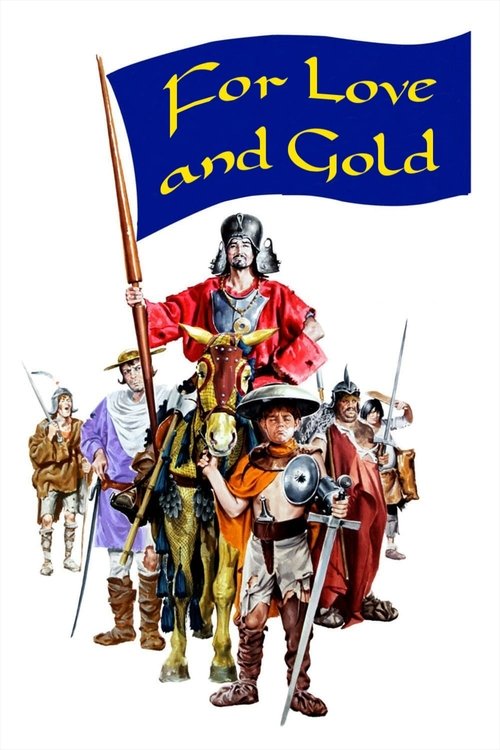
For Love and Gold
A raucous, mud-stained anti-epic that strips the Middle Ages of its shining armor, revealing a hilarious world of rot, cowardice, and delusional optimism. Like a commedia dell'arte troupe lost in a Bergmanesque plague landscape.
For Love and Gold
For Love and Gold

L'armata Brancaleone

07 April 1966 France 120 min ⭐ 7.7 (387)
Director: Mario Monicelli
Cast: Vittorio Gassman, Catherine Spaak, Folco Lulli, Gian Maria Volonté, Maria Grazia Buccella
Comedy Adventure
The Anti-Myth of the Middle Ages Language as Social Mask The Resilience of the Underdog Religious Hypocrisy and Fanaticism
Box Office: $1,314,230

For Love and Gold - Ending Explained

⚠️ Spoiler Analysis

The Twist: The parchment the group has been guarding and following is revealed to be a "white elephant." The fief of Aurocastro was given away by the Emperor because it was indefensible against Saracen pirates. The prize was a trap.

The Climax: When the real owner of the parchment (the German knight with the iron hand) returns, he prepares to execute Brancaleone's band. Their "army" proves useless.

The Resolution: They are saved not by skill, but by the random arrival of the monk Zenone. They are forced to join the Crusades to avoid execution. Brancaleone loses his dream of being a lord but immediately adopts a new dream—being a holy warrior—showing that his identity is fluid and resilient. The cycle of delusion continues.

Alternative Interpretations

Political Allegory: Some critics view the film as a satire of Italian fascism and political ineptitude. Brancaleone's bombastic speeches, his demand for blind loyalty, and his ultimate incompetence can be seen as a parody of Mussolini, while his followers represent the Italian populace—skeptical, self-interested, yet easily led.

Existential Comedy: The film can be read as a comment on the human condition. The characters are trapped in a hostile universe (plague, war, poverty) and their only defense is to invent a narrative of importance (knighthood, holy mission) that is clearly false, yet essential for their survival.