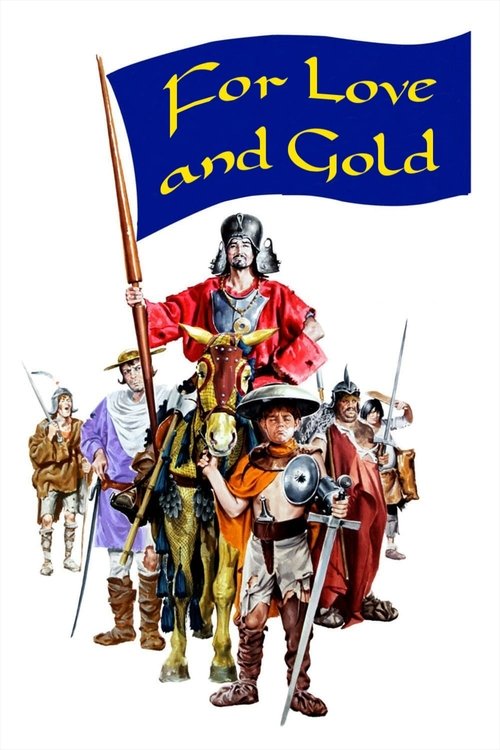
For Love and Gold
A raucous, mud-stained anti-epic that strips the Middle Ages of its shining armor, revealing a hilarious world of rot, cowardice, and delusional optimism. Like a commedia dell'arte troupe lost in a Bergmanesque plague landscape.
For Love and Gold

For Love and Gold

L'armata Brancaleone

07 April 1966 France 120 min ⭐ 7.7 (387)
Director: Mario Monicelli
Cast: Vittorio Gassman, Catherine Spaak, Folco Lulli, Gian Maria Volonté, Maria Grazia Buccella
Comedy Adventure
The Anti-Myth of the Middle Ages Language as Social Mask The Resilience of the Underdog Religious Hypocrisy and Fanaticism
Box Office: $1,314,230

Overview

In 11th-century Italy, a band of motley thieves attacks a German knight, leaving him for dead and stealing a parchment that grants the bearer the fiefdom of Aurocastro in Apulia. Illiterate and leaderless, they enlist the help of Brancaleone da Norcia, a penniless, pompous, and clumsy knight with a yellow nag named Aquilante and a chivalric code that outweighs his common sense.

The group embarks on a disastrous journey southward, encountering a series of medieval misfortunes: a plague-ridden town, a fanatical monk leading a crusade of misfits, a Byzantine aristocrat held for ransom, and a witch saved from the stake. Brancaleone's attempts at heroism consistently backfire, revealing the absurdity of his noble pretensions against the gritty reality of the era.

Upon finally reaching Aurocastro, they discover the fief is a coastal deathtrap plagued by Saracen pirates. Their dream of lordship crumbles when the original German knight returns for vengeance. Saved only by the sudden arrival of the fanatical monk's crusade, the defeated but resilient "army" marches off toward the Holy Land, their optimism inexplicably intact.
Core Meaning

The Demystification of Heroism and History. Mario Monicelli aims to subvert the romanticized, Hollywood view of the Middle Ages (knights in shining armor, courtly love) by presenting a hyper-realistic yet farcical version of the era. The film suggests that survival, not honor, is the true achievement of the common man.

It posits that history is made not just by great leaders, but by the incompetent, the greedy, and the desperate. Through Brancaleone, Monicelli celebrates the resilience of the Italian underdog—one who is constantly beaten down by authority and circumstance but refuses to lose his swagger or hope.

Thematic DNA

The Anti-Myth of the Middle Ages 30%
Language as Social Mask 25%
The Resilience of the Underdog 25%
Religious Hypocrisy and Fanaticism 20%

The Anti-Myth of the Middle Ages

The film strips away the glamour of the period. Instead of clean castles and noble quests, we see mud, rotting teeth, plague, and ignorance. The "glorious" crusade is shown as a chaotic migration of fanatics and fools.

Language as Social Mask

The characters speak an invented macaronic language—a mix of medieval Latin, archaic Italian dialects, and nonsense. This highlights how characters (especially Brancaleone) use high-sounding rhetoric to hide their low status and incompetence.

The Resilience of the Underdog

Despite constant failure, humiliation, and the threat of death, Brancaleone and his band never give up. This reflects a specifically Italian brand of cynicism mixed with an unkillable vitality (the "arrangiarsi" art of making do).

Religious Hypocrisy and Fanaticism

Through the character of the monk Zenone, the film satirizes religious fervor. The "holy" mission is depicted as a dangerous madness that sweeps up the vulnerable, yet it also provides the only safety net for the group at the end.

Character Analysis

Brancaleone da Norcia

Vittorio Gassman

Archetype: The Don Quixote / Miles Gloriosus
Key Trait: Delusional Optimism

Motivation

To claim a fiefdom, gain wealth and status, and live up to the romantic ideal of knighthood he has invented for himself.

Character Arc

Starts as an impoverished, arrogant loner; becomes the leader of a group of misfits; fails to become a lord; ends as a follower in a crusade but retains his delusional dignity. He learns nothing but survives everything.

Teofilatto dei Leonzi

Gian Maria Volonté

Archetype: The Cynical Aristocrat
Key Trait: Machiavellian Cynicism

Motivation

Self-preservation and amusement; he finds the group's incompetence fascinating.

Character Arc

A Byzantine noble captured for ransom who eventually stays with the group because he has nowhere else to fit in. He represents the decay of the old nobility—effeminate, treacherous, yet oddly loyal.

Abacuc

Carlo Pisacane

Archetype: The Pragmatic Survivor
Key Trait: World-weary Pragmatism

Motivation

Profit and survival; he hopes to make money from the fiefdom scheme.

Character Arc

An elderly Jewish merchant who acts as the group's treasurer and voice of pessimistic reason. He endures the journey until his death, serving as the grounding reality to Brancaleone's flights of fancy.

Zenone

Enrico Maria Salerno

Archetype: The Mad Prophet
Key Trait: Religious Mania

Motivation

To cleanse the world of sin and retake the Holy Land.

Character Arc

A fanatical monk who appears intermittently to save or doom the group. He leads a crusade of the poor and eventually absorbs Brancaleone's band into his holy army.

Symbols & Motifs

The Parchment (Scroll)

Meaning:

Symbolizes the bureaucracy of power and the emptiness of official titles. It is the object of their quest, yet it turns out to be a death sentence (granting a indefensible fief), representing how the promises of the ruling class are traps for the poor.

Context:

Stolen from a knight, pasted back together by the illiterate group, and finally revealed to carry a condition that makes the prize worthless.

Aquilante (The Horse)

Meaning:

A parody of the noble steed (like Don Quixote's Rocinante). Yellow, distinctively ugly, and cowardly, the horse often acts more intelligently than its master by refusing to charge into danger.

Context:

Brancaleone constantly addresses the horse with noble epithets, while the animal ignores him or throws him off.

The Iron Hand

Meaning:

Symbolizes the brute, unfeeling force of the true feudal power. It belongs to the "real" knight (German) who is efficient, violent, and humorless—the opposite of Brancaleone.

Context:

The original owner of the scroll has an iron prosthetic hand; when he returns at the end, he represents the crushing return of reality.

The Cage

Meaning:

Represents the captivity of social roles. Brancaleone is often physically trapped (in a cage by bandits, in a net) just as he is trapped in his delusion of knighthood.

Context:

Used when the bandits first capture Brancaleone, and later metaphorically when they are trapped in the castle they thought was their prize.

Memorable Quotes

Branca, Branca, Branca! Leone, Leone, Leone!

— The Army (Chant)

Context:

Sung whenever the group marches to a new location, often accompanied by cartoonish animation on screen.

Meaning:

The group's rhythmic marching chant. It is meant to sound inspiring and martial but is performed by a ragged bunch of beggars, highlighting the gap between their image and reality.

Io vi sono duce! Io vi sono padre!

— Brancaleone

Context:

Brancaleone asserting his authority over his unruly and disrespectful followers.

Meaning:

"I am your leader! I am your father!" A parody of fascist and imperial rhetoric. Brancaleone uses the word "Duce" (Leader), which has heavy historical weight in Italy (Mussolini), mocking the desire for a strongman.

Poco tengo, poco dongo.

— Abacuc

Context:

Said when others ask him for money or resources.

Meaning:

"I have little, I give little." A catchphrase of the miserly Jewish merchant, summarizing the economy of scarcity that defines the film's world.

- Who is that pale but appetizing one? - My sister. - No, I meant the other one beyond, the one with the whore's face. - My mother.

— Brancaleone & Teofilatto

Context:

Brancaleone spying on Teofilatto's family, trying to identify women to court.

Meaning:

Illustrates Brancaleone's complete lack of social grace and the film's bawdy, irreverent humor regarding family and nobility.

Philosophical Questions

Is heroism merely a delusion?

The film suggests that "heroism" is often just stupidity or a lack of self-preservation. Brancaleone is brave only because he is delusional. However, the film also asks if this delusion is necessary to endure the misery of life.

What is the value of 'civilization'?

The 'civilized' characters (the Byzantine nobles, the German knight) are cruel, violent, and decadent. The 'barbaric' peasants are thieves but possess a warmth and loyalty. The film questions whether social hierarchy equates to moral superiority.

Alternative Interpretations

Political Allegory: Some critics view the film as a satire of Italian fascism and political ineptitude. Brancaleone's bombastic speeches, his demand for blind loyalty, and his ultimate incompetence can be seen as a parody of Mussolini, while his followers represent the Italian populace—skeptical, self-interested, yet easily led.

Existential Comedy: The film can be read as a comment on the human condition. The characters are trapped in a hostile universe (plague, war, poverty) and their only defense is to invent a narrative of importance (knighthood, holy mission) that is clearly false, yet essential for their survival.

Cultural Impact

L'armata Brancaleone is a cornerstone of Italian cinema, considered one of the masterpieces of the Commedia all'italiana. Its linguistic creativity changed the Italian language, adding the term "armata Brancaleone" to the dictionary. It influenced a generation of filmmakers to look at history from the "bottom up," focusing on the poor and marginalized rather than kings and queens.

Internationally, it is often compared to Monty Python and the Holy Grail (released nearly a decade later) for its gritty, absurd, and de-romanticized view of the Middle Ages, though Monicelli's film is grounded more in social satire than surrealism. Critics hailed it for successfully blending high culture (literary references, historical accuracy in costumes) with low culture (slapstick, bawdy humor).

Audience Reception

In Italy, the film was a massive box office hit and remains beloved. Audiences praised the inventive language, Gassman's theatrical performance, and the catchy musical score. It is frequently quoted and re-watched.

International reception has been positive but more niche, largely because the linguistic humor is notoriously difficult to translate. English-speaking critics often appreciate the visuals and physical comedy but miss the nuances of the dialogue. It holds a high rating among cinephiles and fans of European comedy.

Interesting Facts

  • The film features a specifically invented language, a mixture of macaronic Latin and medieval Italian dialects, created by screenwriters Age & Scarpelli. It was so influential that it entered modern Italian culture.
  • The title 'Armata Brancaleone' is now a common Italian idiom used to describe a disorganized, incompetent, or motley group of people.
  • Director Mario Monicelli wanted to make a movie that was the complete opposite of Hollywood's polished medieval epics like 'Ivanhoe' or 'El Cid'.
  • Carlo Pisacane (Abacuc) was a character actor famous for playing the 'Capannelle' in Monicelli's 'Big Deal on Madonna Street'.
  • The film's opening credits feature animated sequences by Emanuele Luzzati, which set the tone of a fable or puppet show.
  • A sequel, 'Brancaleone alle Crociate' (Brancaleone at the Crusades), was released in 1970, which includes a famous scene parodying Ingmar Bergman's 'The Seventh Seal'.

Easter Eggs

Parody of 'The Seventh Seal'

While the direct chess parody is in the sequel, the first film's visual style—stark landscapes, silhouettes against the sky, and the plague village sequence—is a deliberate comedic twist on Ingmar Bergman's serious medieval aesthetic.

St. Stylites Reference

The character of the monk Zenone and the background details of hermits on columns reference the historical Stylites (pillar-saints), mocking extreme asceticism common in the Middle Ages.

⚠️ Spoiler Analysis

Click to reveal detailed analysis with spoilers

Frequently Asked Questions

Explore More About This Movie

Dive deeper into specific aspects of the movie with our detailed analysis pages

Comments (0)

Leave a comment

No comments yet. Be the first to share your thoughts!