Jeux interdits
"War ... and how it affects the lives of our children"
Forbidden Games - Symbolism & Philosophy
Symbols & Motifs
The Dead Puppy
The puppy symbolizes Paulette's lost childhood and the physical remains of her parents' death. It acts as the anchor for her grief, which she cannot yet project onto her parents directly.
Paulette carries the corpse of her dog across the countryside, refusing to part with it until Michel helps her find a way to honor its rest.
The Stolen Crosses
The crosses symbolize the children's attempt to 'civilize' death and borrow the authority of the adult world to validate their own sorrow. They also highlight the sacrilegious nature of war itself.
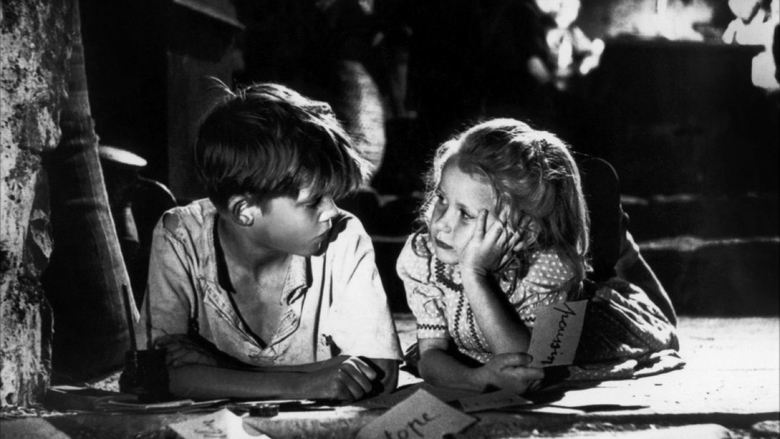
Michel steals various crosses from the local graveyard and even from his own brother's hearse to populate the secret cemetery in the mill.
The Abandoned Watermill
A sanctuary that exists outside the rules of both the war and the family household. It represents the private psychological space children inhabit when adults fail to provide understanding.
The mill serves as the primary location for the animal cemetery and the children's shared 'forbidden' rituals.
The Bridge
The bridge represents the threshold between the safety of the past and the uncertainty of the future, as well as the fragility of life under fire.
The opening scene on the bridge is where Paulette’s life is permanently altered by the German bombardment.
Philosophical Questions
Is innocence a lack of knowledge or a different kind of morality?
The film suggests that children possess a 'savage innocence.' They are innocent of the adults' malice but capable of macabre acts because they do not yet see death as a taboo, but as a natural mystery to be organized.
Does ritual provide real healing or just a temporary delusion?
Paulette and Michel find profound peace in their cemetery, yet the film's ending shows that their ritual world is easily crushed by the weight of reality, questioning the permanence of psychological defenses.
Core Meaning
The core meaning of the film lies in its exploration of how children process the incomprehensible nature of death and the trauma of war through ritual and play. René Clément suggests that children are not merely passive victims but active participants who create their own moral and spiritual logic to survive a reality that has abandoned them. The film serves as a scathing critique of the adult world, where the gravity of warfare and institutional religion is contrasted with the children's desperate, honest attempts to find peace for the dead.