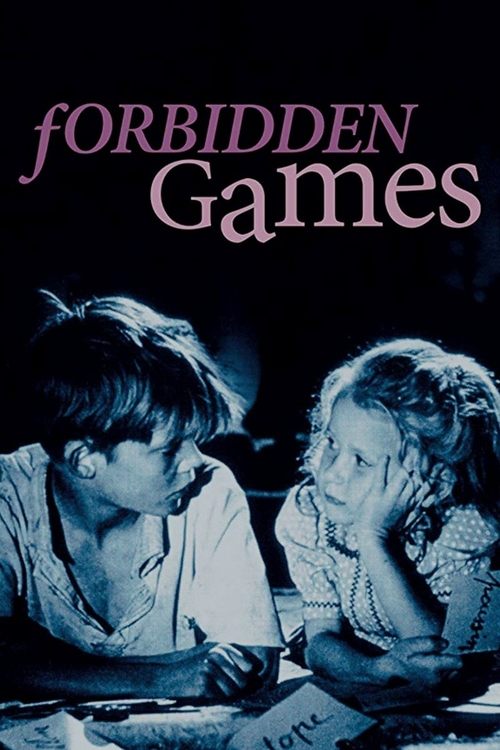
Forbidden Games
Jeux interdits
"War ... and how it affects the lives of our children"
Overview
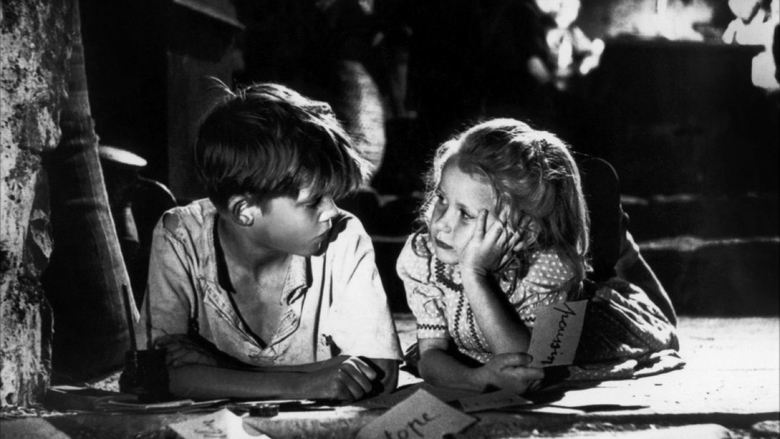
Set in June 1940 during the Battle of France, the film follows five-year-old Paulette, who is orphaned when German air strikes massacre a column of refugees. Terrified and alone in the French countryside, she is discovered by ten-year-old Michel Dollé, the son of a local peasant family. The Dollés take her in, but Paulette remains deeply traumatized by the death of her parents and her pet puppy.
As the adults around them engage in petty feuds and struggle with their own survival, Paulette and Michel form an intense, secret bond. To help Paulette cope with her grief, they begin a "forbidden game": building a private cemetery in an abandoned watermill. What starts as a simple burial for a dog evolves into an obsessive ritual as they collect dead animals and insects, eventually stealing crosses from the village graveyard to adorn their secret sanctuary.
Core Meaning
The core meaning of the film lies in its exploration of how children process the incomprehensible nature of death and the trauma of war through ritual and play. René Clément suggests that children are not merely passive victims but active participants who create their own moral and spiritual logic to survive a reality that has abandoned them. The film serves as a scathing critique of the adult world, where the gravity of warfare and institutional religion is contrasted with the children's desperate, honest attempts to find peace for the dead.
Thematic DNA
The Loss of Innocence
The film portrays the shattering of childhood safety, where war forces children to confront mortality prematurely. This is revealed through Paulette's transition from a sheltered child to someone who views death with a clinical, almost obsessive fascination as a survival mechanism.
Ritual as a Coping Mechanism
Paulette and Michel's animal cemetery represents the human need for order and ceremony amidst chaos. Their mimicry of religious rites shows that for children, the form of a ritual provides more comfort than the abstract doctrines of the adults.
Adult Hypocrisy and Pettiness
The Dollé and Gouard families represent a provincial world obsessed with grudges and property, even while the nation collapses. Their feuds are juxtaposed with the children's "forbidden games," suggesting the adults' conflicts are equally absurd but far more destructive.
The Cruelty of Institution
Religion and the state (represented by the gendarmes and the Red Cross) are shown as cold and uncomprehending of children's emotional needs. The church is a source of symbols to be stolen rather than comfort to be given, and the Red Cross ultimately separates the children in the name of order.
Character Analysis
Paulette
Brigitte Fossey
Motivation
Seeking a sense of security and a way to "keep company" for her dead dog and, by extension, her parents, to prevent them from being truly lost.
Character Arc
Paulette moves from a state of total catatonic shock to finding a morbid but vital purpose in her cemetery, only to be cast back into despair and anonymity when she is separated from Michel at the end.
Michel Dollé
Georges Poujouly
Motivation
An emerging love and protective instinct for Paulette, combined with a rebellion against his father's authority and the dullness of peasant life.
Character Arc
Michel shifts from a mischievous farm boy to a devoted protector who sacrifices his own relationship with his family and his social standing to fulfill Paulette's wishes.
Father Dollé
Lucien Hubert
Motivation
Maintaining his social standing and winning a petty feud with his neighbor, Gouard, while managing his farm during the war.
Character Arc
Remains largely static, embodying the provincial stubbornness and greed that contrast with the children's spiritual searching.
Symbols & Motifs
The Dead Puppy
The puppy symbolizes Paulette's lost childhood and the physical remains of her parents' death. It acts as the anchor for her grief, which she cannot yet project onto her parents directly.
Paulette carries the corpse of her dog across the countryside, refusing to part with it until Michel helps her find a way to honor its rest.
The Stolen Crosses
The crosses symbolize the children's attempt to 'civilize' death and borrow the authority of the adult world to validate their own sorrow. They also highlight the sacrilegious nature of war itself.
Michel steals various crosses from the local graveyard and even from his own brother's hearse to populate the secret cemetery in the mill.
The Abandoned Watermill
A sanctuary that exists outside the rules of both the war and the family household. It represents the private psychological space children inhabit when adults fail to provide understanding.
The mill serves as the primary location for the animal cemetery and the children's shared 'forbidden' rituals.
The Bridge
The bridge represents the threshold between the safety of the past and the uncertainty of the future, as well as the fragility of life under fire.
The opening scene on the bridge is where Paulette’s life is permanently altered by the German bombardment.
Memorable Quotes
Michel! Michel! Michel!
— Paulette
Context:
The closing scene where Paulette is left alone in a Red Cross camp and runs into a crowd, calling for the only person who understood her grief.
Meaning:
One of the most heart-wrenching endings in cinema, these cries signify the final loss of Paulette's only connection to the world and her total abandonment by society.
Ils ne sont pas méchants, les morts.
— Paulette
Context:
A conversation during the children's rituals where Paulette explains why she wants to stay near the graves.
Meaning:
Translating to "The dead are not mean," it highlights the child's perspective that the deceased are to be cared for and befriended rather than feared.
Il faut faire un petit cimetière pour mon chien.
— Paulette
Context:
Spoken to Michel shortly after they meet, setting the plot in motion.
Meaning:
Establishes the central premise of the children's game as a direct response to the lack of mourning for those killed in the war.
Philosophical Questions
Is innocence a lack of knowledge or a different kind of morality?
The film suggests that children possess a 'savage innocence.' They are innocent of the adults' malice but capable of macabre acts because they do not yet see death as a taboo, but as a natural mystery to be organized.
Does ritual provide real healing or just a temporary delusion?
Paulette and Michel find profound peace in their cemetery, yet the film's ending shows that their ritual world is easily crushed by the weight of reality, questioning the permanence of psychological defenses.
Alternative Interpretations
Critics have often viewed the film through a psychoanalytic lens, suggesting that the animal cemetery is a form of 'pathological mourning' where Paulette displaces the grief of her parents' unburied bodies onto the animals she can control. Another reading suggests the film is a national allegory for France's own trauma during the Occupation, where the 'games' represent the desperate attempts of a defeated people to find meaning in a shattered national identity. Some also interpret the film as a dark satire on religion, where the children's theft of crosses exposes the emptiness of religious symbols when they are detached from true compassion.
Cultural Impact
Forbidden Games is considered a cornerstone of post-war French cinema and a pioneer of the "children in war" subgenre. It broke ground by refusing to sentimentalize its young protagonists, instead depicting their behavior with almost documentary-like realism—a style that influenced later masterpieces like The 400 Blows and Grave of the Fireflies.
Historically, the film was controversial for its depiction of the French peasantry and its perceived mockery of Catholic rituals. However, it was hailed internationally as a powerful anti-war statement. Its win at Venice and the Oscars helped rehabilitate the international image of French cinema after the Vichy era. Today, it remains one of the most respected depictions of childhood trauma in history.
Audience Reception
Initial reception in France was mixed to negative, with many audiences offended by the depiction of the rural Dollé family as buffoonish or cruel, and the Church seeing the theft of crosses as sacrilegious. However, international critics were near-unanimous in their praise, particularly for the performances of the two children. Over time, the French public grew to embrace the film, and it is now regarded as a national treasure. The ending is frequently cited by viewers as one of the most emotionally devastating moments in cinema history.
Interesting Facts
- Brigitte Fossey was only five years old when she was cast; the director chose her because she was naturally able to express the shock the role required.
- The iconic guitar soundtrack was performed by Narciso Yepes and became so popular that it is now a standard piece for classical guitarists known as 'Romance'.
- Initially, the film was rejected for competition at the Cannes Film Festival because organizers feared it was too offensive to French peasants and the Church.
- The movie won the Golden Lion at the Venice Film Festival and the Honorary Oscar for Best Foreign Language Film in 1952.
- Director René Clément initially intended for the film to be one of three short stories in an omnibus film about children and war.
- Jacques Tati was reportedly the one who encouraged Clément to expand the short into a feature-length film.
- The film was based on the novel 'Les Jeux Interdits' by François Boyer, which was itself written after his screenplay was rejected by multiple studios.
Easter Eggs
The 'Romance' Melody Origin
While often credited to Narciso Yepes, the melody is actually an anonymous 19th-century piece. Yepes' arrangement and the film's success cemented his career and made the song synonymous with the movie title in France.
Brigitte Fossey's parents cameo
Brigitte Fossey's real-life parents actually play her characters' parents in the opening scene where they are killed, adding a layer of meta-reality to the girl's onscreen shock.
⚠️ Spoiler Analysis
Click to reveal detailed analysis with spoilers
Frequently Asked Questions
Explore More About This Movie
Dive deeper into specific aspects of the movie with our detailed analysis pages
Comments (0)
No comments yet. Be the first to share your thoughts!