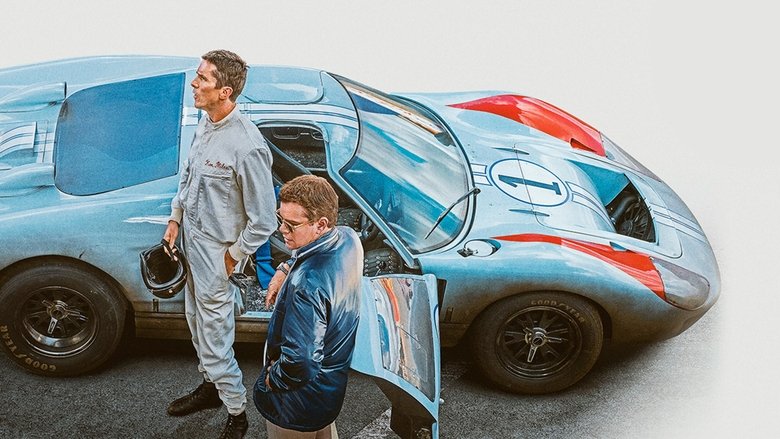
"They took the American dream for a ride"
Ford v Ferrari - Ending Explained
⚠️ Spoiler Analysis
"Ford v Ferrari" follows the development of the Ford GT40, culminating in the 1966 24 Hours of Le Mans. After significant internal conflict with Ford executive Leo Beebe, Carroll Shelby secures Ken Miles a place as a lead driver. During the race, Miles performs brilliantly, overcoming a faulty door at the start and setting new lap records to take a commanding lead.
The major plot twist occurs in the final stages of the race. With Ford cars positioned to finish first, second, and third, Leo Beebe and Henry Ford II order Shelby to have Miles slow down so all three cars can cross the finish line together for a triumphant photo opportunity. Despite his competitive instincts, Miles reluctantly complies out of respect for Shelby and the team. The three Fords cross the line in a staged dead heat. However, due to a technicality in the Le Mans rules—that the car that started further down the grid and traveled a greater distance in the same time wins—Miles is officially placed second behind his teammates Bruce McLaren and Chris Amon. The corporate desire for a perfect image robs the film's hero of his hard-earned and deserved individual victory.
The film's poignant and tragic conclusion occurs a few months later. While testing a new prototype, the Ford J-car, at Riverside International Raceway, Ken Miles suffers a catastrophic mechanical failure and is killed in a high-speed crash. The hidden meaning that becomes clear is that Miles, the purist, could never truly fit into the corporate world. His death while pushing the next boundary of speed solidifies his legacy as a martyr to the pure pursuit of racing, untainted by the compromises that defined his Le Mans experience. The final scene shows Shelby visiting Miles' widow and son, handing Peter the wrench Miles once threw at him—a symbol of their complicated but deep bond—and affirming that Miles's spirit of perfectionism will endure.
Alternative Interpretations
One alternative interpretation focuses on the ending as a critique of the "American dream." While on the surface it's a story of American ingenuity triumphing over European prestige, the conclusion is deeply cynical. Miles, the individualistic hero who embodies skill and passion, is ultimately sacrificed for a contrived image of corporate teamwork. This reading suggests the film is less about a victory and more about the soul-crushing nature of corporate capitalism, where individual achievement is devalued in favor of a marketable narrative. The "win" for Ford is a hollow one, achieved at the cost of its most valuable asset's integrity and spirit.
Another perspective views Leo Beebe not as a simple villain but as a tragic figure representing pragmatic corporate duty. From this viewpoint, Beebe's actions, while antagonistic to Miles, are logically sound from a corporate standpoint. He is tasked with protecting the Ford brand and its multi-million dollar investment. His distrust of the volatile Miles is a calculated business decision, not personal malice. This interpretation sees the film as a tragedy of conflicting, irreconcilable worlds—the passionate, risk-taking world of racing and the cautious, image-conscious world of big business—where neither side is entirely wrong, but they are incapable of coexisting harmoniously.
A third interpretation suggests the film is a metaphor for the filmmaking process itself. Director James Mangold has mentioned seeing parallels between the story and his own experiences in Hollywood. In this reading, Shelby and Miles are the creative forces (the director and actors) battling the "suits" (studio executives) who interfere with their artistic vision for commercial reasons. The quest for the "perfect lap" is analogous to creating a perfect, uncompromised film, and the corporate mandate for a photo finish is akin to a studio forcing a nonsensical ending for marketing purposes.