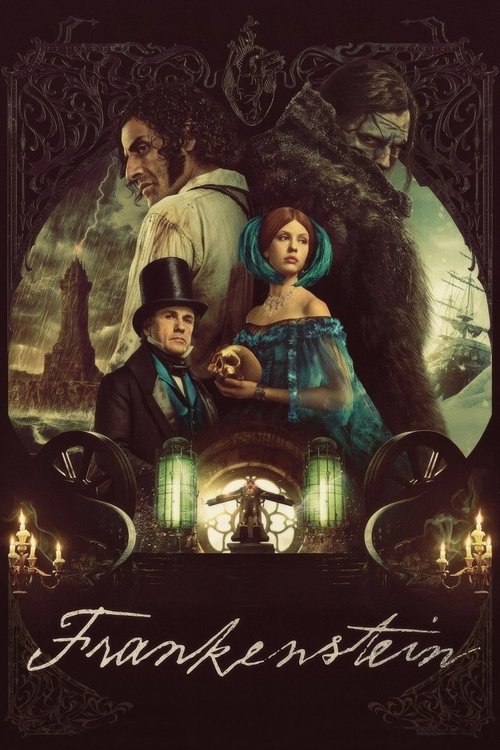
"Only monsters play God."
Frankenstein - Symbolism & Philosophy
Symbols & Motifs
Fire
Fire symbolizes both destruction and a desperate hope for purification or release. It represents Victor's rage and jealousy, but also the Creature's own existential torment.
Victor spitefully sets fire to his laboratory with the Creature inside, attempting to destroy his creation. Later, in the Arctic, the Creature, unable to die, finds Victor and demands he light a stick of dynamite. He holds it like a candle, hoping its explosion will finally end his eternal suffering.
The Color Red
Red is a dominant color symbolizing inherited trauma, guilt, memory, and grief. It is described as the color of a "family curse" rather than simple danger.
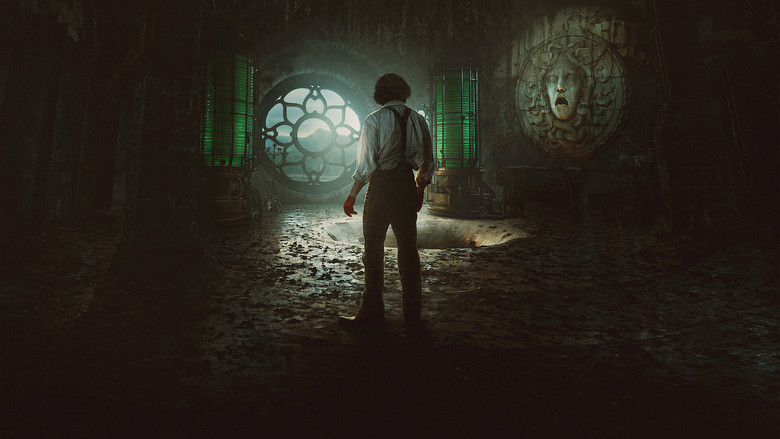
The color follows Victor throughout the film, appearing in his father's surgical gloves, the velvet drapery of his lab, and a recurring dream of a winged crimson angel or demon. It visually links Victor's act of creation to his own painful past and his mother's death. The color notably disappears in the final Arctic scenes, replaced by the cold white and blue of ice, signifying a landscape stripped of the past's warmth and passion.
Light (Sun and Gold)
Sunlight represents life, innocence, and pure creation, while the golden, artificial light of electricity and candles symbolizes the illusion of divinity and the hubris of man-made creation.
The Creature's first experience of the sun is a moment of pure, infectious beauty, with Victor telling him, "Sun is life." In contrast, Victor's laboratory is bathed in a golden glow from electrical equipment, which creates a false sense of heavenly light. This use of gold highlights Victor's attempt to imitate the divine without understanding its true nature or cost, a motif del Toro has used in previous films.
Insects and Entomology
Insects, particularly beetles, symbolize an ethereal, fragile, and perhaps otherworldly nature, connected to the character of Elizabeth.
Elizabeth's character has a keen interest in entomology and botany. Her costume design, by Kate Hawley, intentionally incorporates insect-like motifs. Patterns on her dresses are inspired by butterfly wings, certain fabrics mimic the thinness of beetle wings, and her jewelry, including a Tiffany & Co. necklace, features blue glass beetle designs. This subtly connects her to the natural world and a different kind of creation, contrasting with Victor's unnatural work.
Philosophical Questions
Who is the true monster: the creator or the created?
This is the classic question of the Frankenstein story, which del Toro's film explores explicitly. It presents the Creature as inherently innocent and good, his violent actions being a direct result of the abuse, neglect, and rejection he suffers. The film argues that Victor is the true monster, as his actions are driven by ego, cruelty, and a complete failure of empathy and responsibility. Del Toro uses this dynamic to explore the broader philosophical idea that monstrosity is not an external quality but an internal one, defined by a lack of compassion rather than a grotesque appearance.
Can the cycle of inherited trauma be broken?
The film is structured around the idea that pain is passed down through generations. Victor's cruelty towards the Creature directly mirrors the abuse he received from his own father. The central philosophical struggle is whether this chain can be broken. The film's hopeful ending suggests it can, but only through immense suffering and the radical act of forgiveness. When Victor finally apologizes and the Creature forgives him, the cycle is severed. The Creature is left to live on, free from the pattern of vengeance that defined his and Victor's lives, embodying a 'brokenly' hopeful future.
What is the meaning of life in the face of eternal suffering?
The film makes a significant change from the novel by having the Creature be immortal and unable to die. After the climax, he is left completely alone with the knowledge that his existence will be eternal. This raises profound existential questions. The film's final answer, quoting Lord Byron, is that "the heart will break and yet brokenly live on." It suggests that the meaning of life is not found in avoiding pain, but in the choice to endure and continue to 'welcome the sun' despite it. It's a statement on the resilience of the spirit and the choice to live even when a peaceful end is not an option.
Core Meaning
Guillermo del Toro's primary focus is not on horror but on the profound emotional and philosophical drama of fathers and sons. The film is an intimate exploration of inherited trauma and the possibility of forgiveness. Del Toro reframes the narrative as a "melodrama of a lineage of cruel fathers and mistreated sons," directly linking Victor's cruel treatment of the Creature to the abuse he suffered from his own father. The core message is a meditation on what it means to be human, which del Toro defines as the capacity for imperfection, grace, and seeing the humanity in 'the other'. Ultimately, the film argues against the traditional monster narrative, suggesting that true monstrosity lies not in appearance but in the failure of compassion and the perpetuation of pain. It's a story about breaking the cycle of abuse and finding hope and the will to live on, even when broken.