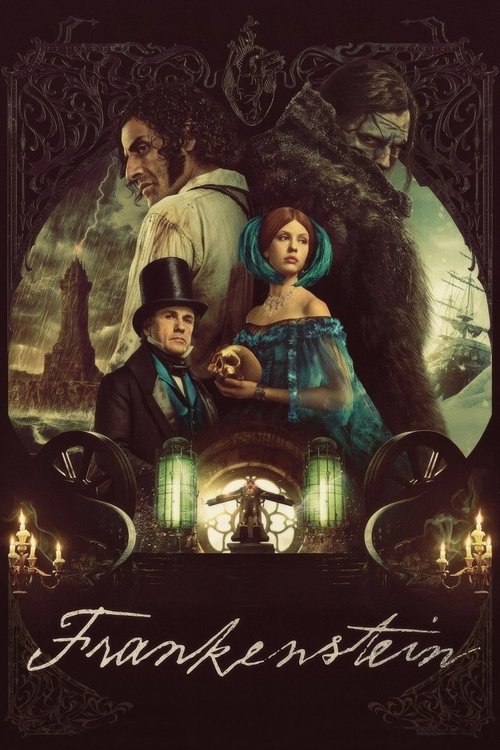
Frankenstein
A gothic melodrama of inherited trauma, where a creator's haunted ambition births a tragic, beautiful creation, mirroring a lineage of cruel fathers and mistreated sons.
Frankenstein

Frankenstein

"Only monsters play God."

17 October 2025 United States of America 150 min ⭐ 7.9 (904)
Director: Guillermo del Toro
Cast: Oscar Isaac, Jacob Elordi, Christoph Waltz, Mia Goth, Felix Kammerer
Drama Fantasy Horror
Fathers and Sons (The Cycle of Abuse) The Nature of Monstrosity Creation and Responsibility Loneliness and the Need for Connection
Budget: $120,000,000
Box Office: $144,496

Overview

Guillermo del Toro's Frankenstein is a gothic science fiction drama that reimagines Mary Shelley's classic 1818 novel. The story is framed by a Royal Danish Navy expedition trapped in the Arctic ice in 1857. They rescue a badly injured Baron Victor Frankenstein (Oscar Isaac), who recounts the harrowing tale of his creation. Haunted by the death of his mother and driven by a fraught relationship with his oppressive father (Charles Dance), Victor, a brilliant but egotistical scientist, becomes obsessed with conquering death.

Funded by the enigmatic Henrich Harlander (Christoph Waltz), Victor assembles a being from the parts of deceased soldiers and, through a monstrous experiment, brings it to life. The result is the Creature (Jacob Elordi), an intelligent and sensitive being who is initially met with horror and abandonment by his creator. The film is structured with a dual perspective, first showing Victor's tale of events, followed by the Creature's own account of his lonely journey of self-discovery, suffering, and search for connection. This narrative structure highlights the complex and ultimately tragic relationship between the two, exploring themes of parental responsibility, inherited trauma, and the true nature of monstrosity.
Core Meaning

Guillermo del Toro's primary focus is not on horror but on the profound emotional and philosophical drama of fathers and sons. The film is an intimate exploration of inherited trauma and the possibility of forgiveness. Del Toro reframes the narrative as a "melodrama of a lineage of cruel fathers and mistreated sons," directly linking Victor's cruel treatment of the Creature to the abuse he suffered from his own father. The core message is a meditation on what it means to be human, which del Toro defines as the capacity for imperfection, grace, and seeing the humanity in 'the other'. Ultimately, the film argues against the traditional monster narrative, suggesting that true monstrosity lies not in appearance but in the failure of compassion and the perpetuation of pain. It's a story about breaking the cycle of abuse and finding hope and the will to live on, even when broken.

Thematic DNA

Fathers and Sons (The Cycle of Abuse) 35%
The Nature of Monstrosity 30%
Creation and Responsibility 20%
Loneliness and the Need for Connection 15%

Fathers and Sons (The Cycle of Abuse)

This is the central theme of the film. Del Toro establishes a clear parallel between Baron Leopold Frankenstein's abusive treatment of his son, Victor, and Victor's subsequent neglect and abuse of his own creation. Victor's ambition to create life is portrayed less as pure scientific hubris and more as a desperate attempt to prove himself superior to his father. By becoming a creator, Victor inadvertently steps into the role of a father, one for which he is woefully unprepared, and repeats the cycle of trauma. The narrative is structured to highlight this devastating inheritance, making the Creature's suffering a direct consequence of Victor's unhealed wounds. The film's climax focuses on the potential for forgiveness and breaking this painful lineage.

The Nature of Monstrosity

Del Toro subverts the traditional horror trope of the monster. While Jacob Elordi's Creature is physically imposing and capable of violence, the film consistently argues that he is the story's most human character—sensitive, intelligent, and yearning for connection. True monstrosity is located in the actions of the human characters, particularly Victor, whose egotism, cruelty, and abandonment of his creation are the source of all the tragedy. The film challenges the audience to look beyond appearances and question who the real monster is, a recurring theme in del Toro's filmography where outcasts are often more noble than the 'normal' humans who persecute them.

Creation and Responsibility

The film delves deeply into the moral and ethical responsibilities of a creator. Victor is obsessed with the act of creation itself—the scientific breakthrough—but gives no thought to the life he is bringing into the world. His immediate rejection of the Creature is a profound failure of parental duty. The narrative explores the devastating consequences of this abandonment, as the Creature's loneliness and suffering curdle into a desire for vengeance aimed solely at the one who made him. The story serves as a cautionary tale about the arrogance of playing God without accepting the profound responsibilities that come with giving life.

Loneliness and the Need for Connection

At its heart, the Creature's story is a tragic quest for companionship. He is born into a world that rejects him on sight, and his journey is marked by profound isolation. He learns about humanity from afar, observing a blind man (David Bradley) and developing a deep desire for acceptance and love. His demand for a mate from Victor stems directly from this unbearable solitude. Elizabeth (Mia Goth) is one of the few characters who shows him genuine kindness, highlighting the Creature's capacity for gentle connection when it is offered. The film posits that loneliness is a torturous state that can drive even a gentle soul to despair.

Character Analysis

Baron Victor Frankenstein

Oscar Isaac

Archetype: The Tragic Antihero
Key Trait: Egotistical Obsession

Motivation

His primary motivation is not just scientific glory but a deeply personal need to surpass his cruel and powerful father, for whom he harbors immense resentment, particularly over the death of his mother.

Character Arc

Victor begins as a brilliant, ambitious, but deeply traumatized scientist, driven to conquer death to spite his abusive father. His initial triumph in creating life quickly turns to horror and disgust, leading him to abandon his creation. This act of negligence sets him on a downward spiral of guilt, fear, and vengeful obsession. Throughout the film, he is portrayed as a "brilliant but egotistical" man who sees himself as a victim, blind to the pain he causes. His arc is one of tragic realization; by the end, hunted by the Creature in the Arctic, he is forced to confront his failures as a creator and a 'father,' culminating in a moment of catharsis and apology before his death.

The Creature

Jacob Elordi

Archetype: The Innocent Monster / The Outcast
Key Trait: Tragic Innocence

Motivation

His core motivation is the universal desire for companionship, acceptance, and an answer to the question of his own existence and purpose.

Character Arc

Born into the world as a fully formed adult but with the mind of an infant, the Creature's journey is a rapid and painful education. Initially innocent and gentle, he is met with rejection and abuse from his creator and society. He learns language, empathy, and the cruelty of the world through observation, particularly of a blind man. His initial wonder turns to profound loneliness and then to rage directed solely at Victor for his cursed, solitary existence. His arc is not one of descending into evil, but of a tragic figure wrestling with an imposed, immortal suffering. In the end, he transcends his desire for vengeance, granting Victor forgiveness and choosing to embrace his eternal life, however brokenly.

Lady Elizabeth Harlander

Mia Goth

Archetype: The Compassionate Heart
Key Trait: Empathy

Motivation

She is motivated by a genuine sense of compassion and an innate kindness, attempting to bridge the gap between the feared Creature and the fearful humans around him.

Character Arc

In this adaptation, Elizabeth is engaged to Victor's younger brother, William, though Victor harbors feelings for her. She is characterized by her kindness and empathy, particularly in her interactions with the Creature, whom she treats with compassion rather than fear. This positions her as a moral center in the film, a stark contrast to Victor's cruelty. Her arc is ultimately tragic; she becomes an innocent victim in the conflict between creator and creation, killed accidentally by Victor. Mia Goth also plays the dual role of Victor's late mother, Claire, adding a Freudian layer to Victor's obsessions.

Baron Leopold Frankenstein

Charles Dance

Archetype: The Tyrannical Father
Key Trait: Cruelty

Motivation

His motivations appear to stem from a place of choleric temper, control, and deep resentment, particularly towards his wife.

Character Arc

Leopold is a static but pivotal character whose influence looms over the entire narrative. He is a renowned physician, but is portrayed as a strict, oppressive, and abusive father to Victor. His cruelty is the catalyst for Victor's entire obsession, establishing the theme of generational trauma that defines the film. He does not have a developmental arc but serves as the origin point for the story's central tragedy, the original 'monster' who created the man that would create another.

Symbols & Motifs

Fire

Meaning:

Fire symbolizes both destruction and a desperate hope for purification or release. It represents Victor's rage and jealousy, but also the Creature's own existential torment.

Context:

Victor spitefully sets fire to his laboratory with the Creature inside, attempting to destroy his creation. Later, in the Arctic, the Creature, unable to die, finds Victor and demands he light a stick of dynamite. He holds it like a candle, hoping its explosion will finally end his eternal suffering.

The Color Red

Meaning:

Red is a dominant color symbolizing inherited trauma, guilt, memory, and grief. It is described as the color of a "family curse" rather than simple danger.

Context:

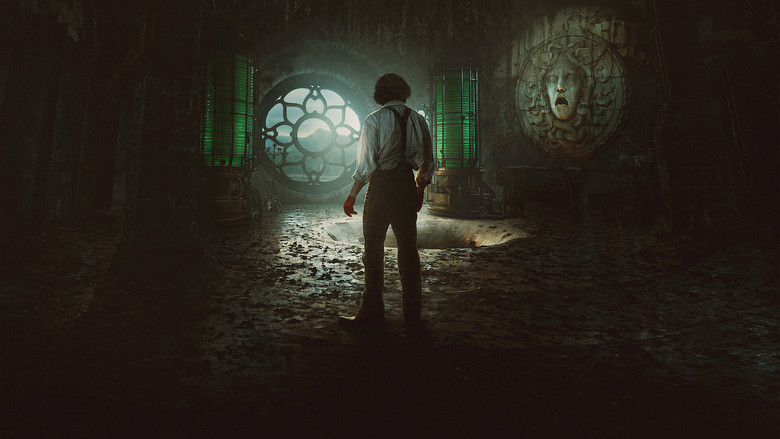
The color follows Victor throughout the film, appearing in his father's surgical gloves, the velvet drapery of his lab, and a recurring dream of a winged crimson angel or demon. It visually links Victor's act of creation to his own painful past and his mother's death. The color notably disappears in the final Arctic scenes, replaced by the cold white and blue of ice, signifying a landscape stripped of the past's warmth and passion.

Light (Sun and Gold)

Meaning:

Sunlight represents life, innocence, and pure creation, while the golden, artificial light of electricity and candles symbolizes the illusion of divinity and the hubris of man-made creation.

Context:

The Creature's first experience of the sun is a moment of pure, infectious beauty, with Victor telling him, "Sun is life." In contrast, Victor's laboratory is bathed in a golden glow from electrical equipment, which creates a false sense of heavenly light. This use of gold highlights Victor's attempt to imitate the divine without understanding its true nature or cost, a motif del Toro has used in previous films.

Insects and Entomology

Meaning:

Insects, particularly beetles, symbolize an ethereal, fragile, and perhaps otherworldly nature, connected to the character of Elizabeth.

Context:

Elizabeth's character has a keen interest in entomology and botany. Her costume design, by Kate Hawley, intentionally incorporates insect-like motifs. Patterns on her dresses are inspired by butterfly wings, certain fabrics mimic the thinness of beetle wings, and her jewelry, including a Tiffany & Co. necklace, features blue glass beetle designs. This subtly connects her to the natural world and a different kind of creation, contrasting with Victor's unnatural work.

Philosophical Questions

Who is the true monster: the creator or the created?

This is the classic question of the Frankenstein story, which del Toro's film explores explicitly. It presents the Creature as inherently innocent and good, his violent actions being a direct result of the abuse, neglect, and rejection he suffers. The film argues that Victor is the true monster, as his actions are driven by ego, cruelty, and a complete failure of empathy and responsibility. Del Toro uses this dynamic to explore the broader philosophical idea that monstrosity is not an external quality but an internal one, defined by a lack of compassion rather than a grotesque appearance.

Can the cycle of inherited trauma be broken?

The film is structured around the idea that pain is passed down through generations. Victor's cruelty towards the Creature directly mirrors the abuse he received from his own father. The central philosophical struggle is whether this chain can be broken. The film's hopeful ending suggests it can, but only through immense suffering and the radical act of forgiveness. When Victor finally apologizes and the Creature forgives him, the cycle is severed. The Creature is left to live on, free from the pattern of vengeance that defined his and Victor's lives, embodying a 'brokenly' hopeful future.

What is the meaning of life in the face of eternal suffering?

The film makes a significant change from the novel by having the Creature be immortal and unable to die. After the climax, he is left completely alone with the knowledge that his existence will be eternal. This raises profound existential questions. The film's final answer, quoting Lord Byron, is that "the heart will break and yet brokenly live on." It suggests that the meaning of life is not found in avoiding pain, but in the choice to endure and continue to 'welcome the sun' despite it. It's a statement on the resilience of the spirit and the choice to live even when a peaceful end is not an option.

Alternative Interpretations

While the film's primary reading is a drama about paternal failure, some interpretations focus on a queer subtext. The intense, fraught relationship between Victor and his beautiful, male creation can be read as a tragic and destructive romance. The act of creation is intimate, and Victor's initial joy upon seeing the beautiful Creature, followed by violent rejection, mirrors patterns of internalized shame and attraction. The Creature's subsequent demand for a companion becomes not just a plea against loneliness, but a desire for a partner that Victor, in his jealousy and self-loathing, refuses to grant. This reading is supported by del Toro's admiration for Christopher Isherwood's script for Frankenstein: The True Story (1973), which was imbued with gay themes of beauty and decay.

Another interpretation views the film through a theological and existentialist lens. Del Toro himself draws parallels between the Creature and religious figures like Jesus and Job, framing the story as a wrestle with a cruel or absent God (represented by Victor). The Creature's immortality and suffering pose existential questions. The film's ending, where the immortal Creature chooses to 'brokenly live on' after forgiving his creator, can be seen as a deeply existentialist statement. It rejects a tragic, romantic end in favor of a more challenging message: that one must find a way to welcome the sun and continue living, even with imperfections and eternal pain, in a world without ultimate answers.

Cultural Impact

Guillermo del Toro's Frankenstein arrived as a significant cinematic event, representing the culmination of a lifelong passion for the director. Released in a limited theatrical run before streaming on Netflix, the film was positioned not merely as a horror adaptation but as a prestigious, emotionally complex drama. The film distinguishes itself from over 80 prior adaptations by its deep psychological focus on inherited trauma and paternal failure, resonating with contemporary cultural conversations around mental health and cycles of abuse. It is also notable for its dual-narrative structure, giving equal weight to the Creature's perspective, a feature of the novel often excised from film versions.

Critics praised the film for its breathtaking visual style, which blends gothic horror with del Toro's signature 'hi-tech stained glass' aesthetic, and for the powerful, acclaimed performances of Oscar Isaac and especially Jacob Elordi. Elordi's portrayal, which is articulate, sensitive, and unconventionally attractive, has been a major point of discussion, shifting the cultural image of the Creature away from the grunting brute of the 1930s back towards the tragic philosopher of Shelley's novel, but filtered through a modern lens of empathy and sex appeal. By centering the story on forgiveness and melodrama rather than pure horror, del Toro has created a version that is both deeply personal and culturally resonant, solidifying the Frankenstein myth as a timeless vessel for exploring what it truly means to be human.

Audience Reception

Audience reception for Guillermo del Toro's Frankenstein has been largely positive, with many viewers praising it as a beautiful, emotional, and thought-provoking adaptation. Many viewers were deeply moved by the film's focus on the relationship between Victor and the Creature, often expressing sympathy and heartbreak for Elordi's portrayal. The visual splendor, score, and the powerful performances from Oscar Isaac and Jacob Elordi were frequently highlighted as major strengths. However, some criticism was directed at the film's long runtime (150 minutes) and deliberate, somber pacing, which some viewers found slow. There were also debates among fans of the novel about the changes made to the source material, though many felt the changes served del Toro's thematic focus on forgiveness and paternal trauma. The gore and brutal scenes, such as an attack by wolves, were noted as being intense and potentially difficult for sensitive viewers.

Interesting Facts

  • The film was a long-gestating passion project for Guillermo del Toro, who has wanted to make it for over 50 years, since he first saw the 1931 classic as a child.
  • Jacob Elordi replaced Andrew Garfield in the role of the Creature due to scheduling conflicts. This change happened just nine weeks before filming, forcing del Toro to scrap nine months of design work for Garfield's Creature and quickly redesign the look for the taller Elordi.
  • The creature's design was heavily inspired by the artwork of comic legend Bernie Wrightson's illustrated edition of Shelley's novel.
  • Oscar Isaac found inspiration for Victor Frankenstein's physicality and artistic mania from musicians like Prince, David Bowie, and Mick Jagger. He specifically studied a video of Prince rehearsing for the Super Bowl and 'stole his walk'.
  • Del Toro insisted on building elaborate, practical 360-degree sets for key locations like the laboratory and the arctic ship, avoiding green screens to achieve an 'old-fashioned craftsmanship'.
  • The film cost approximately $120 million and was shot over about 120 days.
  • Jacob Elordi studied the Japanese dance form Butoh and the movements of his own golden retriever to develop the Creature's physicality, which evolves from animalistic to fluid and coordinated.
  • Mia Goth plays a dual role, portraying both Elizabeth Harlander and Victor's deceased mother, Baroness Claire Frankenstein.
  • Charles Dance, who plays Victor's father, also portrayed the father of Frankenstein in the 2015 film *Victor Frankenstein*.

Easter Eggs

Visual cues from classic Frankenstein films

While creating his own distinct vision, del Toro includes visual nods to James Whale's 1931 Frankenstein and the Hammer Horror Frankenstein films. For example, the inclusion of a compassionate blind man who befriends the Creature echoes a famous sequence from Bride of Frankenstein.

A scene reminiscent of 'The Return of the Living Dead'

One of Victor's early experiments, where half a corpse gasps back to life, is described by critics as a direct and humorous homage to the classic 1985 punk rock horror-comedy film.

The 'Dark Angel' Statue

Victor has a recurring dream of a red, winged statue referred to as a 'dark angel'. This imagery of sentient, often menacing, statues is a recurring motif in Guillermo del Toro's work, seen in films like Cronos and Hellboy II: The Golden Army, connecting Frankenstein to his broader cinematic universe of folklore and dark fantasy.

⚠️ Spoiler Analysis

Click to reveal detailed analysis with spoilers

Frequently Asked Questions

Explore More About This Movie

Dive deeper into specific aspects of the movie with our detailed analysis pages

Comments (0)

Leave a comment

No comments yet. Be the first to share your thoughts!