
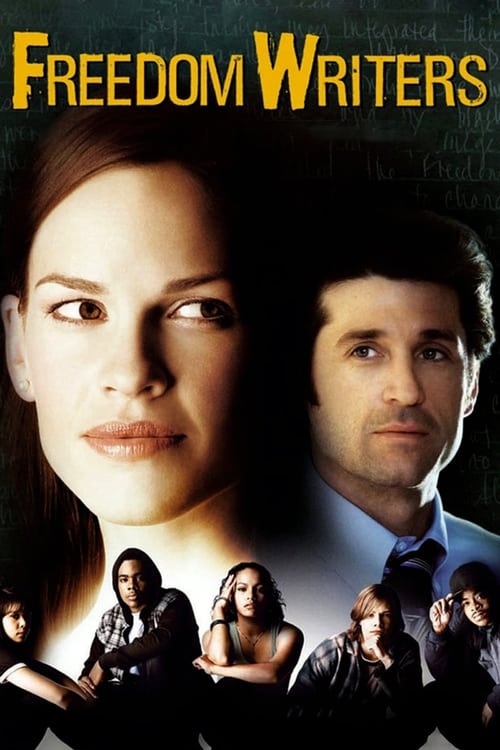
"Their story. Their world. Their future."
Freedom Writers - Ending Explained
⚠️ Spoiler Analysis
The plot of "Freedom Writers" culminates in several key transformative moments for the students, both collectively and individually. A major turning point is Eva's testimony in the murder trial of a fellow Latino gang member. Throughout the film, she is adamant that she will protect her own, even if it means lying on the stand. However, after reading "The Diary of Anne Frank" and hearing from Holocaust survivors, she has a change of heart. In a dramatic courtroom scene, she tells the truth, identifying the actual shooter and breaking the code of silence that has defined her life. This act of courage puts her in danger but also frees her from the cycle of violence and hate. She is forced to leave her home for her safety.
The film's climax resolves the conflict with the school administration. After two years with her students, Erin is told by Margaret Campbell that she will not be allowed to teach them for their junior and senior years due to seniority rules. Devastated, the students, now a unified group, decide to fight for her. They use the skills she taught them to advocate for themselves, and they take their case to the superintendent. The culmination of their efforts is the publication of their journals in a book titled "The Freedom Writers Diary." In the final scenes, Erin, with the support of the superintendent, wins her fight to continue teaching her students until they graduate. The film ends on a hopeful note, with the students, who were once considered hopeless, now on a path to graduation and college, having formed a lasting bond with each other and their teacher. The ending reveals that the ultimate lesson was not just about English or history, but about finding the power within themselves to change their own lives and challenge the world around them.
Alternative Interpretations
One of the primary alternative interpretations of "Freedom Writers" centers on the "white savior" trope. From this perspective, the film can be seen as a story that, while well-intentioned, reinforces a problematic narrative. It positions the white, middle-class teacher, Erin Gruwell, as the sole catalyst for change in the lives of her students of color. This interpretation suggests that the film minimizes the agency and inherent strengths of the students and their communities, implying they are passive recipients of salvation rather than active participants in their own transformation. Critics of this view argue that Gruwell's role is over-glorified, and the film overlooks the systemic issues that create the difficult circumstances in the first place, instead offering a simplified, individualistic solution.
Another interpretation focuses on the film's portrayal of the education system. While on the surface it's a critique of a rigid, under-resourced system, some might argue that it inadvertently demonizes other teachers and administrators, like Margaret Campbell. Instead of presenting a nuanced view of the challenges faced by all educators in such environments, the film creates a simple dichotomy of the heroic new teacher versus the jaded, cynical veterans. This could be seen as an unfair representation that doesn't acknowledge the burnout and systemic pressures that affect longtime teachers in underfunded schools. The film's narrative choice to have Gruwell loop with her students for all four years is also highly unusual in public education and has been pointed out as an unrealistic element that makes her story unique but not easily replicable, potentially setting an impossible standard for other teachers.