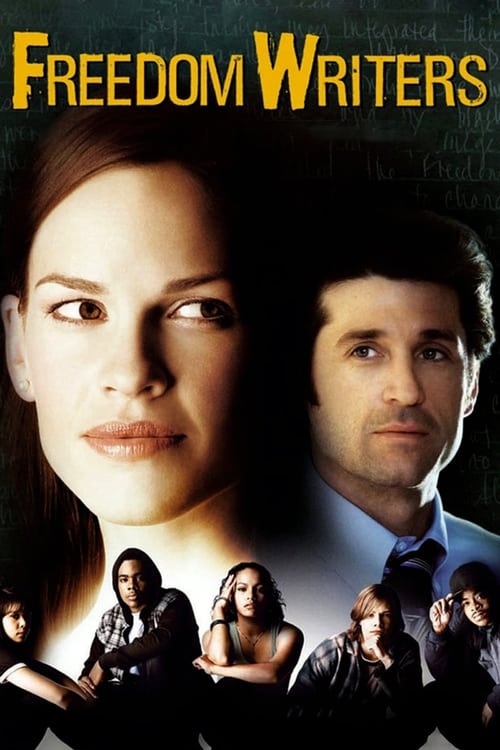
"Their story. Their world. Their future."
Freedom Writers - Symbolism & Philosophy
Symbols & Motifs
The Journals (Composition Books)
The journals symbolize a voice for the voiceless and the power of self-expression. They represent a safe space for the students to articulate their deepest fears, pains, and dreams without judgment. Ultimately, they become a testament to their transformation and a symbol of their collective identity as the "Freedom Writers."
Erin Gruwell distributes the composition books to her students after realizing they feel no one listens to them. The students initially hesitate but soon begin to fill the pages with their raw and honest stories. The film frequently uses voice-overs of the students reading their journal entries, which provides insight into their personal lives and struggles.
The "Line Game"
This activity serves as a powerful symbol of shared experience and the breaking down of barriers. It visually demonstrates that despite their different racial and gang affiliations, the students are united by common hardships and traumas.
Erin has her students play a game where she asks a series of personal questions about their experiences with violence, loss, and imprisonment. Students step forward to a line if the question applies to them. As more and more students from different groups step up to the line, they begin to see their commonalities for the first time, fostering a sense of unity and empathy within the classroom.
The Pearl Necklace
The pearl necklace Erin wears initially symbolizes her naivety and her status as an outsider from a privileged background. It represents the cultural and socio-economic gap between her and her students.
On her first day, Erin wears a pearl necklace given to her by her father. A colleague warns her not to wear it to class, implying it will be stolen. The necklace is a visual cue of her disconnect from the students' world. As she begins to understand her students and invests herself more in their lives, her appearance becomes less formal, and the focus shifts from her external symbols of status to her genuine connection with the students.
Philosophical Questions
Can one person truly make a difference against a broken system?
The film champions the idea that an individual's passion and dedication can create profound change. Erin Gruwell's relentless efforts to reach her students, despite opposition from the school's administration and the personal cost to her life, suggest that one person can indeed be a powerful catalyst. However, the film also implicitly raises the question of sustainability. While Erin is successful with her 150 students, the systemic problems of poverty, racism, and underfunding in the education system remain. The film leaves the viewer to ponder whether individual heroism is a sufficient solution to systemic failure, or if it is simply a feel-good story that masks the need for larger, structural reforms.
What is the nature of identity and is it possible to rewrite it?
The students in "Freedom Writers" initially define themselves by their race and gang affiliation. Their identities are shaped by the "us vs. them" mentality of the streets. The film explores whether this identity is fixed or fluid. Through the process of writing and sharing their stories, the students begin to see themselves and each other differently. They discover a shared identity as "writers" and as survivors, which transcends their previously held allegiances. The film suggests that while our past and environment shape who we are, we have the agency to redefine ourselves and choose a different path, essentially rewriting our own life stories.
Where does true loyalty lie?
This question is central to Eva's character arc. She is torn between her loyalty to her gang, which she considers her family, and her burgeoning sense of justice and what is morally right. Her decision to testify against one of her own is a profound betrayal in the eyes of her community, but it is also an act of immense courage and personal integrity. The film forces the audience to consider the complexities of loyalty. Is it owed to a group, a code, or to a higher principle like truth and justice? "Freedom Writers" suggests that true loyalty is ultimately to one's own conscience.
Core Meaning
The core meaning of "Freedom Writers" lies in the transformative power of education, empathy, and finding one's voice. The film posits that education is not merely the transmission of information but a tool for empowerment that can help individuals rise above their circumstances. Director Richard LaGravenese wanted to convey the message that every individual's story matters and that by sharing these stories, we can bridge even the most profound divides. The film carries a powerful message of hope, illustrating that with dedication, respect, and understanding, it is possible to overcome deeply ingrained prejudice and societal barriers. It champions the idea that a single person can be a catalyst for change, inspiring others to believe in their own self-worth and potential.