"In Vietnam, the wind doesn't blow. It sucks."
Full Metal Jacket - Symbolism & Philosophy
Symbols & Motifs
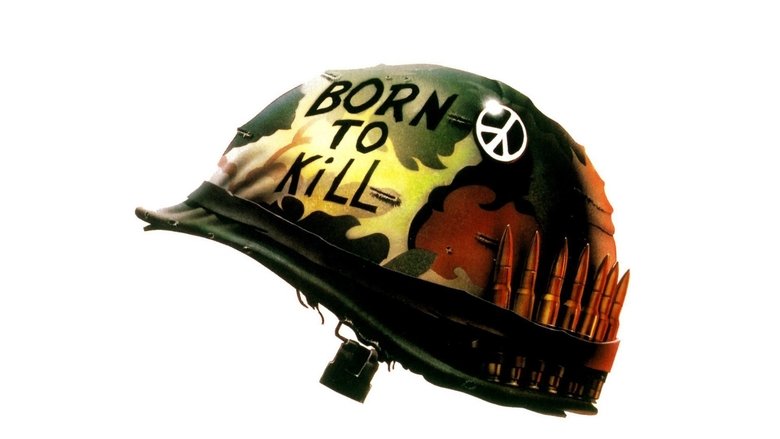
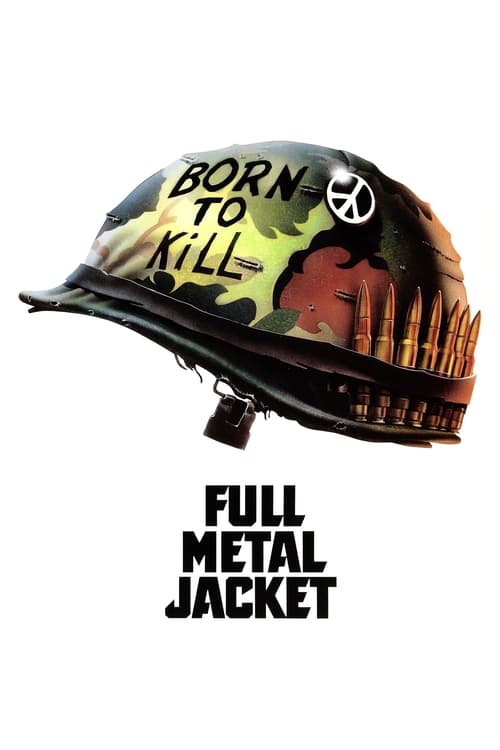
Joker's Helmet and Peace Button
This combination is the film's central symbol, representing the "duality of man." The "Born to Kill" inscription signifies the killer identity the Marine Corps has imposed on him, while the peace symbol represents his lingering humanity, individuality, and perhaps a repressed pacifist nature. It's a visual manifestation of the internal conflict that defines his character and the film's core theme.
Joker wears this combination throughout his time in Vietnam. It becomes a point of contention when a colonel questions him about it, leading to Joker's famous line about Jungian duality. Symbolically, as Joker prepares to execute the wounded sniper at the end of the film, his peace button is hidden from view, suggesting that the "killer" side has finally won out in that moment.
The Rifle
The rifle is depicted as an extension of the Marine's identity and a phallic symbol of power and masculinity. The recruits are forced to name their rifles and sleep with them, treating them as their only companions. The infamous chant, "This is my rifle, this is my gun. This is for fighting, this is for fun," explicitly links the weapon to male genitalia and the acts of killing and sex.
This symbolism is established in boot camp, most notably through the Rifleman's Creed, which Private Pyle recites manically before his murder-suicide. For Pyle, the rifle becomes a source of empowerment and, ultimately, the instrument of his complete mental breakdown. In the final confrontation, Joker's rifle jams, symbolizing his impotence and hesitation at the moment of truth.
The Mickey Mouse March
The song symbolizes the soldiers' loss of innocence and their psychological regression. By singing a children's song while marching through a hellish landscape, they reveal how the dehumanizing process of war has infantilized them, turning them into obedient children following orders in a macabre parody of their former selves. It's a deeply ironic and unsettling conclusion, suggesting they have found a twisted form of camaraderie and acceptance in their shared trauma.
The film ends with the surviving members of the Lusthog Squad marching through the fiery ruins of Huế at dusk, singing the theme song from "The Mickey Mouse Club." This happens immediately after Joker has killed the young female sniper, completing his transformation into a killer.
The Latrine (The Head)
The latrine, or "head," in military parlance, serves as a stage for critical turning points and confessions. In the sterile, ordered world of the barracks, it is a place of relative privacy where the psychological pressure of boot camp boils over. It symbolizes a space of both ritual cleansing and profane violence, where the film's illusions of order and control are shattered.
Private Joker is ordered to clean the head with Cowboy, where Hartman demands it be so clean "the Virgin Mary herself would be proud to go in and take a dump." The first act culminates in the latrine, a pristine, white-tiled space that becomes the setting for Private Pyle's mental breakdown, his murder of Sergeant Hartman, and his own suicide. The stark white is violated by the bright red of blood, marking the violent end of their training and innocence.
Philosophical Questions
What is the true nature of humanity: are we inherently violent or peaceful?
The film delves into this question through the "duality of man" theme. The boot camp sequence suggests that extreme violence is not natural but must be brutally conditioned into men. Sergeant Hartman's job is to suppress compassion and elevate a latent killer instinct. Joker's internal struggle, symbolized by his helmet and peace button, embodies this philosophical conflict. The film doesn't provide a definitive answer but suggests that civilization is a thin veneer over a primal capacity for violence, a capacity the military exists to exploit and weaponize.
Can individuality survive within a system designed to eradicate it?
"Full Metal Jacket" presents a grim outlook on this question. The entire first half is dedicated to showing the systematic destruction of individuality. Joker, the most individualistic character, struggles to maintain his identity through wit and irony. However, by the end, his act of killing the sniper suggests his individuality has been subsumed by his training. The final scene, with the soldiers marching in unison singing a childish song, implies that the collective has triumphed over the individual. Pyle's story offers an even darker answer: his attempt to conform while retaining a piece of himself results not in survival, but in a complete psychotic break.
Where is the line between sanity and insanity in the context of war?
The film continually blurs this line. Hartman's methods are sociopathic, yet they are the sanctioned procedure for creating a soldier. Private Pyle is driven insane by this process, but his resulting marksmanship skills are praised. In Vietnam, the soldiers engage in gallows humor and collect souvenirs from corpses (like Crazy Earl), behaviors that would be considered insane in civilian life but are coping mechanisms in war. The film suggests that war itself is an insane environment and that to survive it, one must adopt a form of madness. The ultimate question is whether characters like Animal Mother are sane for adapting perfectly to an insane world, or if Joker is the sane one for struggling against it.
Core Meaning
"Full Metal Jacket" is a profound critique of the military's process of dehumanization and the psychological devastation of war. Director Stanley Kubrick explores the idea that to create a soldier capable of killing, one must first destroy the individual. The film's bifurcated structure starkly contrasts the systematic stripping away of humanity in training with the chaotic and absurd reality of war itself. The core message revolves around the "duality of man," a concept explicitly mentioned by Private Joker. It suggests that within every person, there's a capacity for both good and evil, peace and violence, and that the crucible of war forces these contradictory elements into a volatile and often tragic confrontation.
The film argues that the 'masculinity' forged in boot camp is a brittle, performative construct that shatters when faced with the genuine horrors of combat. Ultimately, the movie posits that war is a fundamentally insane endeavor that corrupts innocence, obliterates individuality, and leaves survivors in a psychological "world of shit," forever changed and disconnected from the world they once knew.