GHOST IN THE SHELL
"It found a voice... Now it needs a body."
Ghost in the Shell - Symbolism & Philosophy
Symbols & Motifs
Water and Diving
Water symbolizes consciousness, rebirth, and the subconscious. Diving into the water represents Kusanagi's deep dive into her own identity and existential questions. It is a moment of quiet introspection where she feels a connection to her physical self and the vastness of the world (and by extension, the net), contemplating her own existence.
Kusanagi is shown boating and diving in the waters of New Port City during a quiet interlude in the film. While underwater, she sees a reflection of herself on the surface, questioning if that is the real her. These scenes are visually contrasted with her later "dive" into the Puppet Master's ghost.
The Basset Hound
The Basset Hound is director Mamoru Oshii's personal trademark, appearing in many of his films. It represents a grounding, tangible reality and a touch of the familiar and organic in a world of cold technology and existential dread. Its melancholic, questioning eyes are often seen as reflecting the film's own philosophical mood.
A Basset Hound briefly appears on the street during one of the film's contemplative montages of the city. This seemingly random shot breaks the futuristic scenery and provides a moment of quiet reflection, a signature of the director.
Dolls and Mannequins
Dolls, mannequins, and Kusanagi's own cybernetic body ("shell") symbolize the potential soullessness and manufactured nature of existence in this world. They raise questions about appearance versus essence. Kusanagi seeing a mannequin that looks just like her in the city reinforces her fear that she might be a mass-produced, empty shell without a unique ghost.
Throughout the film, there are shots of mannequins in shop windows. In a key scene, while riding a boat through the city's canals, Kusanagi looks up and sees a mannequin in a window that bears a striking resemblance to her own face, triggering a moment of deep existential anxiety.
The City
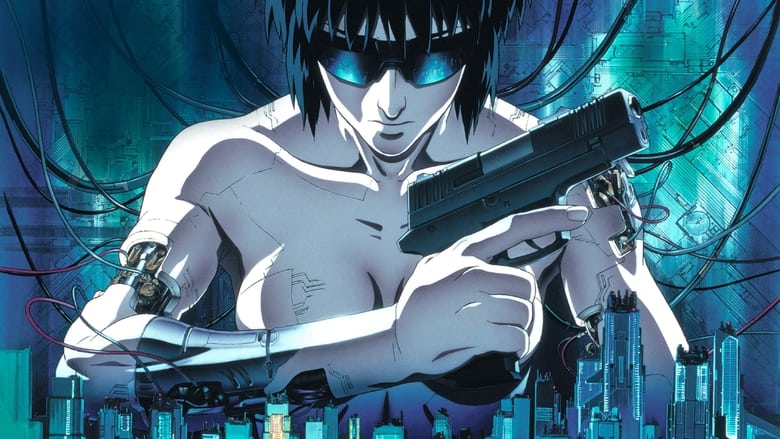
New Port City, based on Hong Kong, symbolizes the chaotic, dense, and interconnected nature of the information age. Its blend of old, decaying structures and hyper-modern skyscrapers mirrors the film's theme of the collision between the old (humanity) and the new (technology). The city itself is like a vast network, teeming with data and life.
The city is a constant presence, with several montage sequences dedicated to exploring its rain-slicked streets, crowded markets, and towering buildings. Director Mamoru Oshii used these interludes to create a sense of a lived-in, tangible world that is overwhelming with information.
Philosophical Questions
What is the nature of the self and consciousness?
The film relentlessly probes this question through its central concept of the "ghost" (consciousness) and the "shell" (the body). Major Kusanagi, a full-body cyborg, constantly doubts the authenticity of her own identity, wondering if her memories are fabricated and if her ghost is real. The Puppet Master, an AI born in the network without a body, claims sentience and challenges the idea that consciousness must be biological. The film suggests consciousness is an emergent property of complexity and information, not necessarily tied to flesh and blood, ultimately asking if a soul can exist in a machine.
Where is the line between humanity and artificial intelligence?
"Ghost in the Shell" systematically dismantles the barriers between human and machine. Humans can replace their bodies with prosthetics, while AI can gain consciousness. The film presents a future where this distinction is functionally meaningless. The Puppet Master argues that DNA is simply a "self-preserving program" like its own code, suggesting that life is fundamentally about information processing and reproduction, regardless of the medium. The final merger of Kusanagi and the AI represents the complete dissolution of this boundary, creating a post-human entity that is neither and both.
Is evolution destined to move beyond the biological?
The film frames the merger of Kusanagi and the Puppet Master as the next logical step in evolution. The Puppet Master argues that as a singular entity, it is limited and faces extinction because it cannot reproduce and diversify. By merging with Kusanagi, it achieves a form of reproduction, creating "offspring" in the vast information network. This suggests a transhumanist future where life transcends its organic origins to exist as pure information, unbound by physical limitations and capable of evolving in ways previously unimaginable.
Core Meaning
The core meaning of "Ghost in the Shell" is a profound exploration of identity and consciousness in a post-human world. Director Mamoru Oshii poses the question: What constitutes the self when technology allows the body (the "shell") and memories to be manufactured and altered? The film suggests that the essence of being, the "ghost," is not tied to a biological form but is defined by a continuity of experience and self-awareness. It challenges the traditional dualism of mind and body, proposing that life and consciousness can emerge from the "sea of information"—the vast digital network. Ultimately, the film's message is one of evolution; it argues that humanity's next step may be to transcend the limitations of the physical form and merge with technology, creating a new, more advanced form of existence.