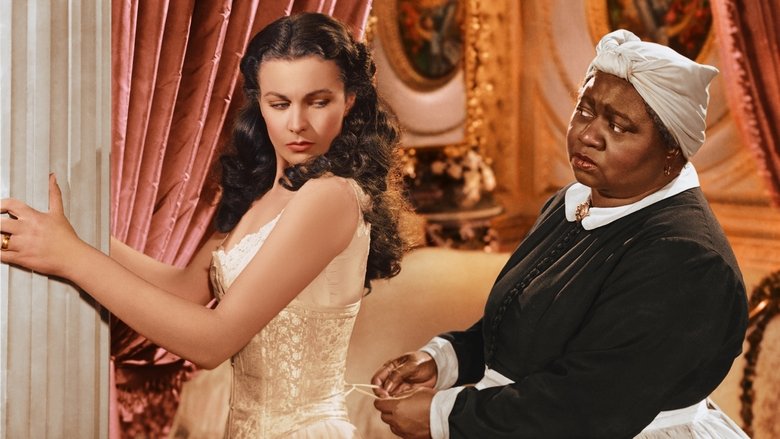

"The greatest romance of all time!"
Director: Victor Fleming
Cast: Vivien Leigh, Clark Gable, Olivia de Havilland, Leslie Howard, Hattie McDaniel
Gone with the Wind — Characters & Cast
Character Analysis
Scarlett O'Hara
Vivien Leigh
Motivation
Her primary motivation is survival, encapsulated in her vow to "never be hungry again." This evolves into a relentless ambition to acquire wealth and security to protect herself and her home, Tara. Underlying this is a deep-seated, obsessive desire to win the love of Ashley Wilkes, which she mistakenly believes is the key to her happiness.
Character Arc
Scarlett begins as a spoiled, vain, and self-centered Southern belle concerned only with social standing and winning the affection of Ashley Wilkes. The Civil War shatters her world, forcing her to evolve. After her mother's death and her father's mental collapse, she becomes the pragmatic and determined head of her family, vowing to do whatever it takes to survive. She becomes a ruthless businesswoman, sacrificing her reputation and manipulating others, including marrying her sister's fiancé for his money. Her arc is one of hardening resilience, but also of profound emotional immaturity. She spends the entire film chasing an illusion (Ashley) and fails to recognize her true love (Rhett) until it's too late. In the end, though she has achieved material survival, she is emotionally desolate, having lost the one man who truly understood her.
Rhett Butler
Clark Gable
Motivation
Rhett is motivated by a desire for wealth and pleasure, and a cynical disdain for the hypocrisy of the Old South. However, his deepest motivation is his profound and enduring love for Scarlett. He constantly challenges her and tries to make her see the world realistically, hoping she will eventually mature and choose him freely. His actions are often driven by a desire to both protect and possess her.
Character Arc
Rhett is introduced as a cynical, scandalous, and pragmatic outsider who sees the Old South's impending doom with clear eyes. A war profiteer and blockade runner, he represents the opportunistic New South. He is immediately drawn to Scarlett, recognizing her as a kindred spirit who rejects societal norms. Throughout the film, his cynical exterior is pierced by moments of vulnerability, genuine love for Scarlett, and unexpected patriotism when he joins the Confederate army at the last minute. His arc is tragic; he patiently waits for Scarlett to return his love, but her obsession with Ashley erodes his affection. The death of their daughter, Bonnie, is the final blow. By the end, his love for Scarlett is exhausted, and he walks away, a man defeated by the very passion he once pursued.
Ashley Wilkes
Leslie Howard
Motivation
Ashley is motivated by a deep-seated sense of honor and duty to his family, his wife Melanie, and the traditions of the Old South. He is haunted by the past and wants to preserve the "calm dignity" of the world he once knew. This loyalty and nostalgia prevent him from fully embracing the future or returning Scarlett's passionate feelings, trapping him in a state of perpetual melancholy.
Character Arc
Ashley represents the honor, chivalry, and romanticism of the Old South that is destined to perish. He is a contemplative, gentle man who is ill-equipped for the harsh realities of the post-war world. He admits his love for Scarlett but marries Melanie because they share the same values. Throughout the war and Reconstruction, he remains trapped by his code of honor and his nostalgia for a lost world. He is unable to adapt and relies on others, primarily Scarlett and Melanie, for survival. His arc is one of decline; he is a living ghost, a relic of a bygone era who cannot find his place in the new order and ultimately acknowledges his own weakness and failure.
Melanie Hamilton Wilkes
Olivia de Havilland
Motivation
Melanie is motivated by an unwavering love for her family and an unshakable belief in the goodness of others. Her primary drive is to support her husband, Ashley, and to maintain a sense of grace, community, and compassion amidst the chaos of war and its aftermath. She lives by a code of kindness and forgiveness, often at her own expense.
Character Arc
Melanie is the embodiment of the grace, compassion, and inner strength of the ideal Southern lady. She is selfless, kind, and sees the good in everyone, especially Scarlett, whom she loves as a sister despite Scarlett's barely concealed contempt. Her arc is not one of transformation but of steadfastness. She remains the moral center of the story, a source of unwavering love and support for those around her. Her physical frailty belies an incredible emotional and spiritual strength that sustains Ashley and even Scarlett. Her death near the end of the film is a major catalyst, forcing Scarlett to finally confront her own feelings and realize the value of Melanie's friendship and Rhett's love.
Cast
Explore More About This Movie
Dive deeper into specific aspects of the movie with our detailed analysis pages