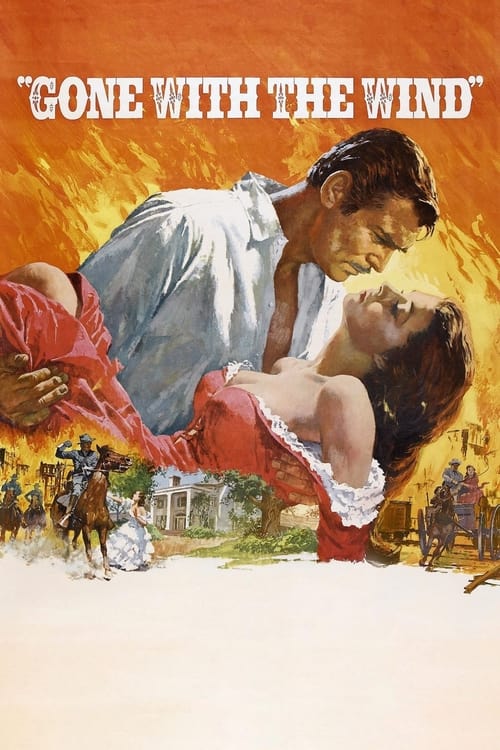
Gone with the Wind
A tumultuous Civil War epic where Southern defiance bleeds into a fiery romance, painting a portrait of survival against the fading crimson skies of a lost era.
Gone with the Wind
Gone with the Wind

"The greatest romance of all time!"

15 December 1939 United States of America 233 min ⭐ 7.9 (4,209)
Director: Victor Fleming
Cast: Vivien Leigh, Clark Gable, Olivia de Havilland, Leslie Howard, Hattie McDaniel
Drama War Romance
Survival and Resilience The End of an Era and Social Transformation Love, Obsession, and Self-Deception Land and Legacy
Budget: $4,000,000
Box Office: $402,352,579

Gone with the Wind - Ending Explained

⚠️ Spoiler Analysis

"Gone with the Wind" follows Scarlett O'Hara through three marriages, all driven by ulterior motives. Her first, to Charles Hamilton, is a spiteful act against Ashley Wilkes, who has just married Melanie. Charles dies of disease early in the war, making Scarlett a young widow. Her second marriage is to Frank Kennedy, her own sister's fiancé, whom she deceives and marries solely to use his money to pay the taxes on Tara. Frank is killed during a Ku Klux Klan raid undertaken to avenge an attack on Scarlett.

Her third and final marriage is to Rhett Butler. They have a daughter, Bonnie Blue, but the marriage is tumultuous, poisoned by Scarlett's lingering obsession with Ashley. A key turning point occurs when Scarlett and Ashley are seen embracing, causing a scandal. In a drunken rage, Rhett forces himself on Scarlett. The next morning, she seems happy, suggesting a complex and troubling dynamic between them. The ultimate tragedy strikes when their beloved daughter Bonnie dies in a pony-riding accident, breaking the last bond between them.

The climax of the film comes with Melanie's death. On her deathbed, Melanie asks Scarlett to look after Ashley, finally making Scarlett realize that Ashley has only ever truly loved Melanie. This shatters her long-held fantasy. She runs home to tell Rhett she finally understands she loves him, but it is too late. Worn down by her emotional cruelty and heartbroken over Bonnie's death, Rhett declares his love for her is gone. His iconic departure—"Frankly, my dear, I don't give a damn"—is the film's ultimate plot twist, subverting the expectation of a happy romantic ending. Scarlett is left completely alone. Her final realization is that she can return to Tara, her source of strength, to figure out how to win him back, ending the film on a note of ambiguous, desperate hope.

Alternative Interpretations

One significant alternative interpretation views Scarlett O'Hara not just as a survivor, but as an early feminist icon. In a rigidly patriarchal society, she defies gender roles by taking charge of her family, running a business, and prioritizing her own financial independence over social propriety. From this perspective, her ruthlessness is not just selfishness, but a necessary tactic for a woman to gain power and agency in a world designed to suppress her.

Another interpretation posits that the film can be read as a critique of nostalgia. Ashley Wilkes, who embodies the romanticized Old South, is portrayed as weak, ineffectual, and unable to cope with reality. His story serves as a cautionary tale about the dangers of clinging to an idealized past. In contrast, Rhett and Scarlett, the ultimate pragmatists, are the ones who thrive in the new, harsh world. In this reading, the film's message is that looking forward, however painful, is essential for survival, while looking backward leads to ruin.

Finally, some critics view the film's ending not as a promise of hope but as the ultimate tragedy of self-delusion. Scarlett's final line, "Tomorrow is another day," is seen not as a sign of strength, but as her perpetual refusal to face consequences and learn from her mistakes. She believes she can win Rhett back, but the audience knows his love is gone. Therefore, the ending suggests she is doomed to repeat her patterns of self-absorption, forever chasing something she has already irrevocably lost, making her material survival a hollow victory.