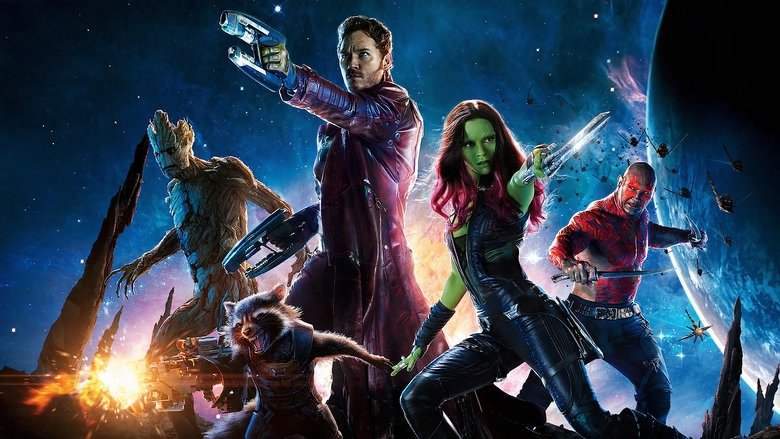
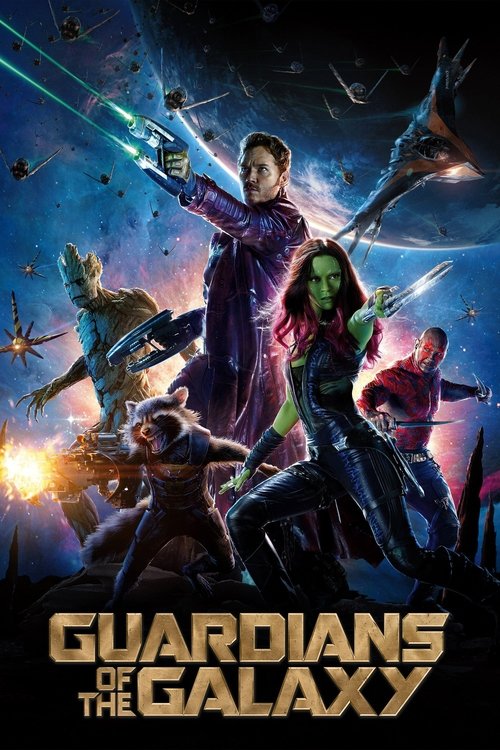
"When things get bad, they'll do their worst."
Guardians of the Galaxy - Symbolism & Philosophy
Symbols & Motifs
Peter Quill's Walkman and 'Awesome Mix Vol. 1'
The Walkman and the mixtape are Peter's last tangible connection to his mother, his childhood, and his home planet, Earth. The music itself symbolizes the emotional heart of the film, providing a nostalgic and ironic counterpoint to the cosmic action. It represents the love and humanity that Peter tries to protect and hide beneath his roguish exterior. By the end of the film, he finally opens his mother's last gift, "Awesome Mix Vol. 2," symbolizing his readiness to move forward from his grief while still holding onto his past.
Peter is introduced listening to the Walkman on Morag. He risks his life to retrieve it in the Kyln prison. The music is diegetic, playing a key role in many scenes, most notably the final confrontation where Peter distracts Ronan by singing and dancing to "O-o-h Child," weaponizing his mother's music to save the galaxy.
The Orb / Power Stone
The Orb is the film's MacGuffin, but as the container for the Power Stone, it symbolizes immense, destructive power and the corrupting influence of that power. Ronan seeks it for vengeance and genocide, while Thanos desires it for ultimate control. For the Guardians, it represents a responsibility they are initially unwilling to accept. Their ability to collectively withstand its energy symbolizes the strength they find in their unity and friendship, turning a weapon of destruction into a tool of salvation.
The entire plot is driven by the theft and pursuit of the Orb. Its power is demonstrated by the Collector, who explains the origin of the Infinity Stones. The climax revolves around the Guardians wresting control of the Stone from Ronan and containing its power by joining hands.
Groot's Sacrifice and Rebirth
Groot's transformation from a full-grown being to a sapling symbolizes sacrifice, hope, and the cyclical nature of life. His selfless act of creating a protective cocoon around his friends, declaring "We are Groot," signifies the team's final unification into a single entity—a family. His rebirth as a dancing sapling represents new beginnings and the enduring spirit of the Guardians. It ensures that even in the face of death and destruction, life and joy can find a way to grow again.
During the crash of Ronan's ship, the Dark Aster, Groot extends his limbs to form a protective sphere around the team, sacrificing himself in the process. Later, Rocket pots a single surviving twig, which begins to grow into a new Groot, seen dancing in a pot during the film's closing scenes.
Philosophical Questions
Can a new family be forged from shared trauma and loss?
The film deeply explores this question by assembling a team of individuals who are all, as Peter Quill says, "losers" who have "lost stuff." Each character is fundamentally broken by their past: Quill by the loss of his mother, Drax by the murder of his family, Gamora by her abusive upbringing, and Rocket by the torturous experiments that created him. The film argues that this shared experience of loss, rather than being a permanent weakness, can become the foundation for a profound and powerful bond. Their healing process begins not in isolation but when they start to rely on and care for one another. Their ability to form a family is not in spite of their trauma but because of it, as it gives them a unique empathy for each other's pain. The moment they join hands to share the power of the Infinity Stone is the physical manifestation of this idea: their collective pain and shared connection allows them to withstand a force that would destroy them individually.
What is the nature of good and evil, and can one escape a 'bad' past?
"Guardians of the Galaxy" presents a morally ambiguous universe where its heroes are thieves, assassins, and bounty hunters. The film challenges simplistic notions of good and evil by demonstrating that heroic actions can come from flawed individuals. Gamora, raised by Thanos to be a living weapon, chooses to betray her dark past to save countless lives. Peter Quill, a self-proclaimed outlaw, chooses self-sacrifice over personal gain. The film suggests that morality is not a fixed state but a series of choices. It rejects the idea that a person is defined forever by their past crimes, instead championing the possibility of redemption. The final scene, where Peter suggests they do "something good, something bad, a bit of both," reinforces this theme, portraying them as complex beings who have chosen the side of good but haven't lost their roguish nature.
Does identity come from nature (lineage) or nurture (experience)?
The film explores this through Peter Quill. For most of the story, he is defined by his experiences: abducted from Earth, raised by Ravagers, and shaped by his mother's memory and music. His identity is that of a roguish but charming human surviving in a hostile galaxy. However, the ending reveals a crucial part of his nature: he is only half-human, the son of an ancient, powerful celestial being. This explains his ability to hold the Infinity Stone without immediately disintegrating. The film doesn't choose one side over the other. His innate power (nature) allowed him to survive the climax, but it was his experiences and the family he nurtured (nurture) that put him in the position to save the galaxy in the first place. His heroism is a product of both his unique heritage and the relationships he forged.
Core Meaning
At its heart, "Guardians of the Galaxy" is a story about the formation of a non-traditional family among a group of broken individuals. Each character is a "loser," defined by a profound sense of loss: Peter Quill lost his mother, Gamora her family, Drax his wife and daughter, and Rocket his sense of identity. The film posits that people who have experienced deep loss can find solace and strength in one another, creating new, powerful bonds. It champions the idea that heroism isn't about perfection but about flawed individuals choosing to stand together for something greater than themselves. Director James Gunn framed the trilogy as being about the mother, the father, and the self, with this first installment focusing on the impact of Quill's mother and the creation of a new family unit. Ultimately, the film's core message is that connection, friendship, and shared purpose can heal deep wounds and empower outcasts to become saviors.