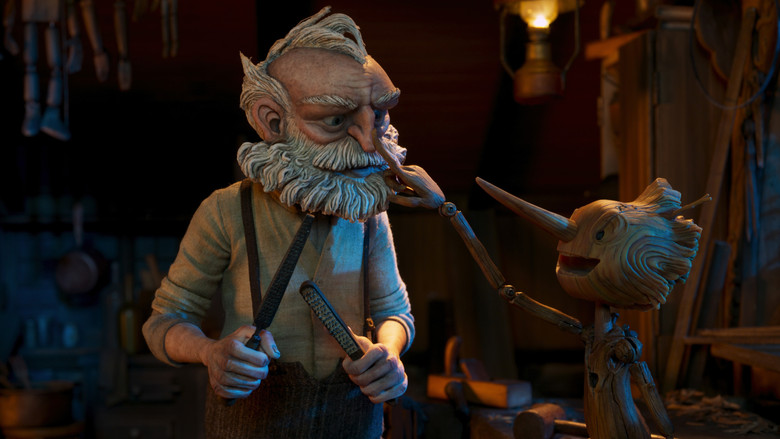

The plot begins with Geppetto losing his son Carlo in a WWI bombing. Years later, a drunken Geppetto carves Pinocchio from the pine tree by Carlo's grave, and a Wood Sprite gives him life. Pinocchio's untamed nature leads him to be sold to the circus owner Count Volpe. During a struggle between Geppetto and Volpe, Pinocchio is fatally hit by a truck. He awakens in the afterlife and meets Death, the Wood Sprite's sister, who explains he is immortal but will have to spend progressively longer in her realm each time he dies.
Upon returning, Pinocchio is coveted by the fascist Podestà as a potential supersoldier. To earn money for Geppetto, Pinocchio rejoins Volpe's circus, where he mocks Mussolini during a performance, leading to his execution and a second death. He is then sent to a military youth training camp with the Podestà's son, Candlewick, whom he befriends. When the camp is bombed, the Podestà is killed, and Pinocchio is thrown into the sea, where he is captured again by Volpe. Spazzatura, Volpe's monkey, finally rebels, sending Volpe falling to his death off a cliff while Pinocchio and Spazzatura fall into the water.
They are promptly swallowed by the Terrible Dogfish, where they are miraculously reunited with Geppetto and Sebastian, who were also swallowed while searching for him. Pinocchio causes his nose to grow by lying, creating a bridge to escape the beast's blowhole. As they flee, Pinocchio detonates a naval mine to kill the monster, sacrificing himself for a third time. In the afterlife, he demands to be sent back immediately to save the drowning Geppetto. Death warns him that breaking the hourglass to return early will make him mortal. Pinocchio agrees, saves Geppetto, but dies on the shore. As Geppetto weeps over him, Sebastian uses his one wish to bring Pinocchio back to life. The ending montage shows them living a happy life together, but as a mortal, Pinocchio does not age. The narrator, Sebastian, reveals that Geppetto, Sebastian, and Spazzatura all eventually die of old age, leaving a lonely Pinocchio to wander off into the world alone.