Guillermo del Toro's Pinocchio
"Love will give you life."
Overview
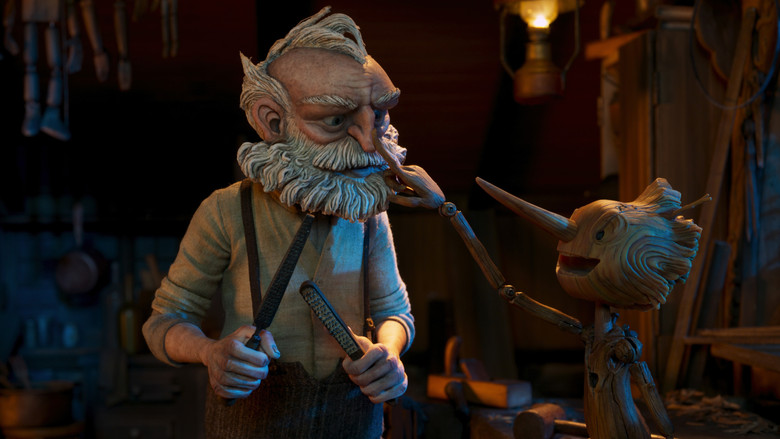
Set in 1930s Fascist Italy, Guillermo del Toro's reimagining of the classic tale begins with tragedy. Grieving woodcarver Geppetto loses his young son, Carlo, during a World War I aerial bombardment. Consumed by sorrow for years, in a drunken despair, he carves a crude wooden puppet from a pine tree that grew by his son's grave. A mystical Wood Sprite brings the puppet to life, naming him Pinocchio and assigning a worldly cricket, Sebastian J. Cricket, to be his conscience in exchange for a wish.
Pinocchio's arrival is chaotic. He is not the obedient boy Geppetto lost, but a boisterous, unruly, and curious being. His journey takes him away from his grieving father and into the hands of the manipulative circus ringmaster Count Volpe and his abused monkey, Spazzatura. Pinocchio also catches the eye of a local Fascist official, the Podestà, who sees the immortal puppet as the perfect soldier for Mussolini's army. Pinocchio's adventures become a profound exploration of life, death, love, and the struggle for identity against a backdrop of war and authoritarianism.
Core Meaning
Guillermo del Toro's central message subverts the traditional moral of Pinocchio. Instead of a tale about a puppet who must be obedient to become a 'real boy', this film posits that disobedience, questioning authority, and embracing imperfection are the very qualities that define humanity. The film argues that life's meaning is found not in conformity but in the messy, finite, and precious connections we forge. It's a story about an 'imperfect son and an imperfect father' finding acceptance and love. Del Toro rejects the idea that Pinocchio needs to physically change to be worthy of love; instead, it is Geppetto who must transform, learning to love the son he has, not the one he lost. Ultimately, the film is a meditation on mortality, suggesting that the very brevity of human life is what makes it meaningful and precious.
Thematic DNA
Mortality, Grief, and Love
The film is fundamentally a story about dealing with loss. Geppetto's creation of Pinocchio is an act of desperate, grief-fueled madness. The narrative contrasts Pinocchio's immortality with the fleeting lives of those he loves. He repeatedly visits the afterlife, where Death, the Wood Sprite's sister, teaches him that human life is precious precisely because it is brief. The film's poignant ending, where Pinocchio outlives his entire family, powerfully underscores this theme, transforming the gift of eternal life into a solitary burden.
Fascism, Conformity, and Disobedience
Set during Mussolini's rule, the film uses Fascist Italy as a backdrop where obedience and conformity are demanded. Pinocchio, in his inherent rebelliousness and inability to conform, becomes a symbol of individuality and dissent. The local Podestà wants to turn him into an ideal soldier, a perfect puppet for the state, while the circus uses him for propaganda. Del Toro reframes the story to celebrate disobedience not as a flaw, but as a virtue necessary to resist authoritarian control and question dogma.
Father-Son Relationships
The emotional core of the film is the complex relationship between Geppetto and Pinocchio. Geppetto initially sees Pinocchio as a poor replacement for his deceased son, Carlo, and struggles to accept the puppet's chaotic nature. Pinocchio, in turn, yearns for his father's love while feeling like a 'burden'. Their journey is about moving past the shadow of grief to love each other for who they are. Pinocchio teaches Geppetto how to live and love again, while Geppetto learns to be a father to the son he has, not the one he lost.
The Nature of Humanity
The film constantly questions what it means to be 'real'. Unlike other versions, Pinocchio's goal isn't to become a flesh-and-blood boy. His journey reveals that humanity is defined by actions, choices, and love, not by physical composition. He demonstrates more empathy and courage than many of the human characters, ultimately sacrificing his immortality to save Geppetto. This act, according to Death, is what makes him truly human. The film suggests that being 'real' is about love, sacrifice, and the acceptance of life's imperfections.
Character Analysis
Pinocchio / Carlo
Gregory Mann
Motivation
Initially, Pinocchio is driven by pure id and a desire for new experiences. His core motivation evolves into a deep yearning for his father's love and acceptance, and to no longer be seen as a 'burden'.
Character Arc
Pinocchio begins as a chaotic, almost feral, force of nature born from grief. He is selfish and naive, easily manipulated by Count Volpe. Through his repeated deaths and experiences with war, exploitation, and friendship, he develops empathy and a profound understanding of life's value. His arc is not about becoming an obedient 'real boy,' but about becoming his own person, capable of love and sacrifice. He ultimately gives up his immortality to save Geppetto, the peak of his transformation from a 'borrowed soul' to a truly loving son.
Geppetto
David Bradley
Motivation
His primary motivation is to overcome the all-consuming grief of his son's death. At first, this manifests as a desperate attempt to recreate Carlo, but it transforms into a desire to protect and unconditionally love Pinocchio.
Character Arc
Geppetto starts the film broken by the loss of his son, Carlo. He is consumed by grief, turning to alcohol and isolating himself. When Pinocchio comes to life, Geppetto initially rejects him, seeing only a poor and disobedient substitute for the idealized son he lost. Through their shared journey and perils, Geppetto's heart slowly mends. He learns to see Pinocchio not as a replacement for Carlo, but as his own son, loving him for his unique, imperfect self. His final acceptance marks his emergence from the depths of his despair.
Sebastian J. Cricket
Ewan McGregor
Motivation
Initially, his motivation is selfish: to get his wish granted so he can become famous. This shifts to a genuine desire to guide Pinocchio and protect his newfound family.
Character Arc
Sebastian begins as a pompous, self-interested writer who takes on the role of Pinocchio's conscience only to earn a wish from the Wood Sprite. He is frequently frustrated by Pinocchio's disobedience. Over time, a genuine affection and sense of responsibility develop. He becomes a true friend and guide to Pinocchio, culminating in him selflessly using his long-awaited wish to bring Pinocchio back to life, completing his transformation from an opportunist to a loving guardian.
Count Volpe
Christoph Waltz
Motivation
His motivations are greed and a desperate desire to reclaim his lost status and wealth. He exploits anyone and anything he can to achieve this, embodying selfish capitalism.
Character Arc
Count Volpe is a disgraced aristocrat turned manipulative puppeteer. He remains a villain throughout, seeing Pinocchio only as a meal ticket and a tool for profit. His abuse of Spazzatura and his cruelty towards Pinocchio never waver. His arc is a downward spiral, leading to his eventual demise when his abused monkey, Spazzatura, finally turns against him.
The Wood Sprite / Death
Tilda Swinton
Motivation
The Wood Sprite is motivated by compassion for Geppetto's sorrow. Death is motivated by the natural order, teaching Pinocchio the rules of existence and the preciousness of mortality.
Character Arc
As twin cosmic entities, the sisters do not have a traditional character arc but serve as the story's mythological pillars. The Wood Sprite initiates the story by granting life, embodying creation and possibility. Death provides the crucial lessons about life's value through its finality. She is not presented as evil, but as a fundamental, knowledgeable force of nature. Together, they represent the inseparable cycle of life and death that Pinocchio must learn to navigate.
Symbols & Motifs
The Pinecone
The pinecone symbolizes the cycle of life, death, and legacy. It represents the connection between Geppetto's lost son, Carlo, and Pinocchio, bridging the gap between grief and new life.
Carlo finds a perfect pinecone just before he is killed, which Geppetto cherishes. Geppetto plants a pine tree over Carlo's grave, and it's the wood from this very tree that he uses to carve Pinocchio. The film opens and closes with the image of a pinecone, framing the entire story as a reflection on the brief, cyclical nature of life.
The Hourglass
The hourglass in the afterlife symbolizes Pinocchio's immortality and the finite nature of time for mortals. It's a visual representation of the time he must wait before returning to the world of the living after each death.
Each time Pinocchio dies, he meets Death, who stands before a set of hourglasses. She explains that he cannot truly die but must wait for the sand in an hourglass to run out before he can return. He ultimately chooses to break an hourglass, sacrificing his immortality to return to life quickly and save Geppetto, signifying his understanding of the value of precious, limited time.
Crucifix vs. Pinocchio
The large wooden crucifix in the village church represents rigid, dogmatic belief and an idealized form of sacrifice. Pinocchio, also made of wood, is presented as a contrasting figure—a messy, imperfect, but living and loving being. The comparison raises questions about organized religion versus innate goodness.
Geppetto is the carver of the church's crucifix. When Pinocchio first enters the church, the priest and villagers react with fear, calling him a demon. Pinocchio observes the crucifix and says, “He's made of wood too. Why do they like him and not me?”. This directly contrasts the villagers' reverence for a static wooden icon with their rejection of a living, albeit chaotic, wooden boy.
Memorable Quotes
The one thing that makes human life precious and meaningful, you see, is how brief it is.
— Death
Context:
This is said by Death to Pinocchio during one of his visits to the afterlife. She explains to him that while he has eternal life, his loved ones do not, and every moment with them is therefore precious.
Meaning:
This line encapsulates the film's core philosophical message. It reframes death not as a tragedy to be feared, but as the very element that gives life its value and urgency. It is the central lesson Pinocchio learns on his journey from immortal puppet to understanding humanity.
When he called me a burden, his nose didn't grow.
— Pinocchio
Context:
Pinocchio says this to Sebastian J. Cricket after an angry Geppetto, in a moment of despair, calls him a burden. Pinocchio realizes that, in that moment, Geppetto was speaking his true, painful feelings, a truth more hurtful than any lie.
Meaning:
A heartbreaking line that demonstrates Pinocchio's growing emotional intelligence. He understands that lies are not just factual inaccuracies but can be truths people tell themselves. It's the moment he realizes the depth of Geppetto's pain and his own place within it.
What happens, happens. And then we are gone.
— Sebastian J. Cricket
Context:
Sebastian delivers this line as the narrator at the very end of the film. After explaining that Geppetto, Spazzatura, and he himself have all died of old age, leaving Pinocchio alone, this is his final reflection as Pinocchio walks away to a new, unknown adventure.
Meaning:
These are the film's final words, serving as a simple, profound, and melancholy summary of its themes of acceptance and mortality. It is a peaceful, if sad, acknowledgment of the natural course of life and death, leaving the audience to ponder the beauty of a finite existence.
Don't be Carlo or anyone else, be exactly who you are.
— Geppetto
Context:
This is said by Geppetto towards the end of the film, likely after Pinocchio has been revived. It signifies the mending of their relationship and Geppetto's realization that he loves this new son, not as a replacement, but as himself.
Meaning:
This marks the climax of Geppetto's character arc. It is his ultimate expression of acceptance and unconditional love for Pinocchio. He finally lets go of the ghost of his dead son and embraces Pinocchio for the unique individual he is.
Philosophical Questions
What is the true meaning of being 'human' or 'real'?
The film challenges the traditional idea that being human is a physical state. Pinocchio remains a wooden puppet, yet he arguably becomes the most 'human' character. The film suggests humanity is defined by the capacity for love, empathy, making mistakes, feeling grief, and ultimately, the choice to sacrifice for others. Pinocchio achieves this not by changing his body, but by developing his soul.
Is disobedience a virtue?
In the context of the film's Fascist setting, disobedience is framed as a moral necessity. Pinocchio's inability to blindly obey orders, from Geppetto's simple rules to the Podestà's military commands, is presented as his greatest strength. It is his innate rebelliousness that allows him to see the truth and resist the dehumanizing conformity demanded by authoritarian figures, suggesting that true morality requires questioning authority, not simply following it.
Does immortality have value without shared experience?
The film presents immortality not as a gift, but as a potential curse. Death explains to Pinocchio that life is precious *because* it is brief. His immortality alienates him, as he must watch everyone he loves grow old and die. The poignant ending, where he is left utterly alone, forces the audience to consider that a finite life, rich with shared moments, is more meaningful than an eternal one spent in solitude.
Alternative Interpretations
While the film's primary message is quite direct, some alternative readings exist. One interpretation focuses on the religious allegory, viewing Pinocchio as a Christ-like figure. He is made of wood by a carpenter, is rejected by the established church, performs 'miracles' (surviving death), is cruelly tied to a wooden cross and set on fire by Count Volpe, and ultimately sacrifices himself to save his father. His repeated resurrections further play into this interpretation of a flawed, chaotic, but ultimately selfless savior figure.
Another perspective could view the film through a purely existential lens. Pinocchio's immortality forces him to confront the meaninglessness of an eternal life without loved ones. His final state, wandering the world alone after everyone he loves has died, is not a happy ending but a poignant depiction of existential solitude. The final line, 'What happens, happens. And then we are gone,' can be interpreted not just as an acceptance of mortality, but as a statement on the indifferent, transient nature of existence itself.
Cultural Impact
Released in a year with two other 'Pinocchio' adaptations, Guillermo del Toro's version was critically lauded for its artistic ambition and thematic depth, distinguishing itself from the more traditional Disney versions. It won the Academy Award for Best Animated Feature, a significant achievement that reinforced the argument that animation is a medium for complex, mature storytelling, not just a genre for children.
By setting the story in Mussolini's Italy, del Toro infused a classic fairy tale with a potent anti-fascist message, using the puppet's journey to comment on individualism, obedience, and authoritarianism. This resonated with contemporary audiences and critics, who saw parallels in the film's themes to modern political climates. The film was praised for its masterful use of stop-motion animation, with many seeing it as a triumph for the art form. It championed a handcrafted, tangible aesthetic that felt distinct from the slickness of mainstream computer-generated animation, celebrating the 'imperfections' of the medium as part of its charm.
Ultimately, the film's most significant impact was in its emotional and philosophical reimagining of the source material. It shifted the story's focus from a moralistic tale about becoming a 'real boy' to a profound meditation on grief, mortality, and the enduring power of a father's love, leaving a lasting impression on audiences and critics alike.
Audience Reception
Audience reception for 'Guillermo del Toro's Pinocchio' was overwhelmingly positive. Viewers widely praised the film's stunning and meticulous stop-motion animation, often describing it as a visual masterpiece. The emotional depth and mature themes were frequently highlighted as a major strength, with many viewers finding the story's exploration of grief, death, and fatherly love to be profoundly moving and tear-jerking.
The darker, more complex tone and the setting in Fascist Italy were seen as a bold and successful reimagining of the classic story, offering a narrative with far more substance than previous adaptations. Ewan McGregor's performance as Sebastian J. Cricket and Christoph Waltz's as Count Volpe were often singled out for praise.
The main point of criticism, though minor, was from some viewers who felt the musical numbers were sporadic and not as strong as the narrative elements. A few also found the tone occasionally uneven, shifting between whimsical moments and grim subject matter. However, the most controversial aspect for some parents was the film's darkness, with themes of death, war, and grief making it too intense for very young children who might be expecting a lighthearted Disney-style fairy tale. Overall, the consensus was that it was a triumphant, beautiful, and heartbreaking piece of cinema.
Interesting Facts
- The film was a passion project for Guillermo del Toro, taking about 15 years to finally get made.
- This is del Toro's first feature-length animated film.
- The film is considered the third movie in a thematic trilogy, along with 'The Devil's Backbone' and 'Pan's Labyrinth', which all deal with childhood against the backdrop of war and fascism.
- The character designs are heavily inspired by the grim, spindly illustrations of artist Gris Grimly for a 2002 edition of the book.
- The stop-motion puppets were fabricated by Mackinnon & Saunders, famous for their work on films like 'Corpse Bride'.
- While most puppets had mechanical heads for expressions, the Pinocchio puppet used over 3,000 3D-printed replacement faces to capture his emotions.
- At the peak of production, there were 60 separate stages shooting simultaneously to complete the film.
- Del Toro's mother, who was a huge supporter of the project, passed away the day before the film's world premiere at the BFI London Film Festival.
- The film's animators were credited alongside the voice actors in the opening credits, a deliberate choice by del Toro to emphasize their equal importance as performers.
Easter Eggs
The Faun from 'Pan's Labyrinth' can be seen in a stained-glass window.
A direct visual nod to del Toro's most famous film, 'Pan's Labyrinth'. This easter egg reinforces the thematic connection between the two movies, both of which are dark fairy tales set against the backdrop of a fascist regime.
A window in Geppetto's workshop resembles the distinctive window from 'The Shape of Water'.
Another self-reference to one of del Toro's other Best Picture-winning films. It's a signature visual flourish that connects his cinematic universe.
The bomb that kills Carlo has 'a little gesture' referencing 'The Devil's Backbone'.
This connects the film to the first installment in del Toro's 'childhood and war' trilogy. The bomb is a recurring motif in both films, representing the random, senseless violence of war that irrevocably shatters innocent lives.
⚠️ Spoiler Analysis
Click to reveal detailed analysis with spoilers
Frequently Asked Questions
Explore More About This Movie
Dive deeper into specific aspects of the movie with our detailed analysis pages
Comments (0)
No comments yet. Be the first to share your thoughts!