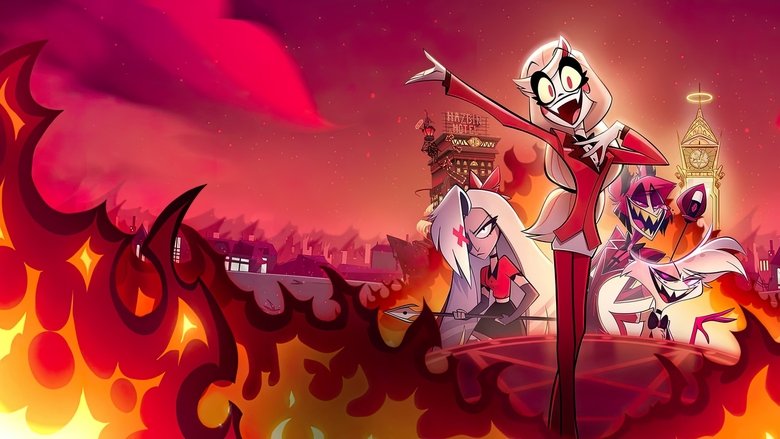
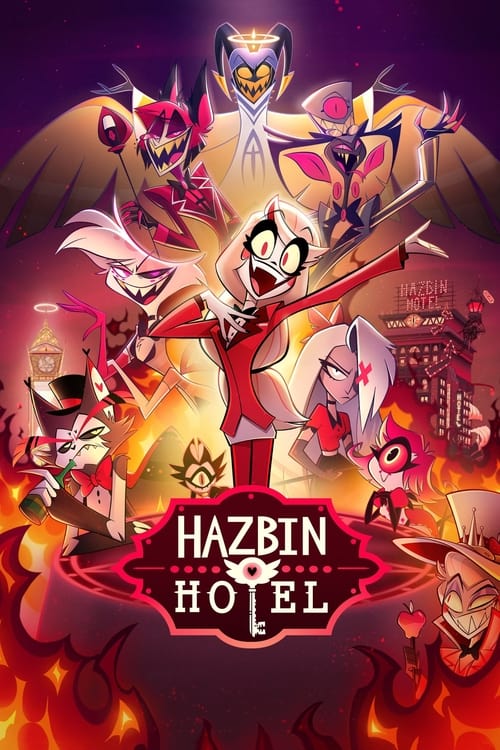
"It's a beautiful day in Hell."
Hazbin Hotel - Symbolism & Philosophy
Symbols & Motifs
The Hazbin Hotel
The hotel symbolizes hope, second chances, and the possibility of change in a world steeped in cynicism and despair. It is a physical manifestation of Charlie's radical belief in redemption.
Throughout the first season, the hotel is a fledgling, often chaotic project. It is literally destroyed by Adam in the season finale but is rebuilt bigger and better, symbolizing the resilience of hope and the renewed commitment of its residents to Charlie's dream after they successfully defended their home.
Radio vs. Television
This symbolizes the conflict between old and new forms of power and entertainment. Alastor, the "Radio Demon," represents an older, more personal and charismatic form of influence, while Vox, his rival, represents the modern, impersonal, and ever-present nature of television and digital media.
The rivalry between Alastor and the "Vees" (Vox, Valentino, and Velvette) is a recurring subplot. Alastor's refusal to be filmed and his disdain for modern technology highlight this clash of eras and ideologies within Hell's power structure.
Angelic Weapons
Angelic steel weapons represent the perceived invincibility and absolute authority of Heaven. They are the tools of the extermination and the one thing that can permanently kill a demon.
A major turning point in the season is the discovery by Carmilla Carmine that angels are not invincible and can be killed by their own weapons. This knowledge shatters the illusion of Heaven's omnipotence and empowers the denizens of Hell to fight back, symbolizing a shift in the cosmic power balance.
Philosophical Questions
What is the nature of redemption, and is anyone truly irredeemable?
This is the central question of the series. "Hazbin Hotel" explores this by challenging the celestial status quo, which dictates that sinners are damned for eternity. Charlie's hotel is a grand experiment to prove this wrong. The show posits that redemption isn't about erasing past sins but about the capacity for change, growth, and empathy. The successful redemption of Sir Pentious proves that the system, not the soul, might be the problem, suggesting that circumstance, support, and choice are the true arbiters of one's ultimate fate.
Does morality depend on one's identity or one's actions?
The series consistently blurs the lines between 'good' angels and 'evil' demons. The angels, particularly Adam and the exorcists, are portrayed as violent, cruel, and arrogant, while many of the demon protagonists display loyalty, love, and the capacity for self-sacrifice. This forces the audience to question whether inherent labels (angel, demon) define morality. The show argues that actions, intentions, and the capacity for empathy are more important than one's origins or cosmic designation, suggesting that true evil is the refusal to allow for change and compassion.
Can a system be fundamentally unjust, even if it is ordained by a higher power?
"Hazbin Hotel" critiques the divine order of its universe. Heaven's system of eternal damnation and violent population control is presented as cruel and arbitrary. Charlie's quest is not just about saving individuals but about challenging the very foundations of this system. The revelation that Heaven's leadership is ignorant or deceitful about its own rules suggests a broken, bureaucratic, and morally bankrupt cosmic government. The series explores the philosophical idea of fighting against a flawed, seemingly absolute authority for a more just and compassionate world.
Core Meaning
At its core, "Hazbin Hotel" is a story about the radical possibility of redemption and the power of empathy in a seemingly hopeless world. The series challenges preconceived notions of good and evil, heaven and hell, suggesting that no one is beyond saving if given a genuine chance and support. It argues that true change comes not from divine judgment or punishment, but from found family, genuine connection, and the difficult choice to be better, even when every system in place is designed to keep you down. The show posits that kindness and love are transformative forces capable of healing deep-seated trauma and defying a rigged cosmic game.