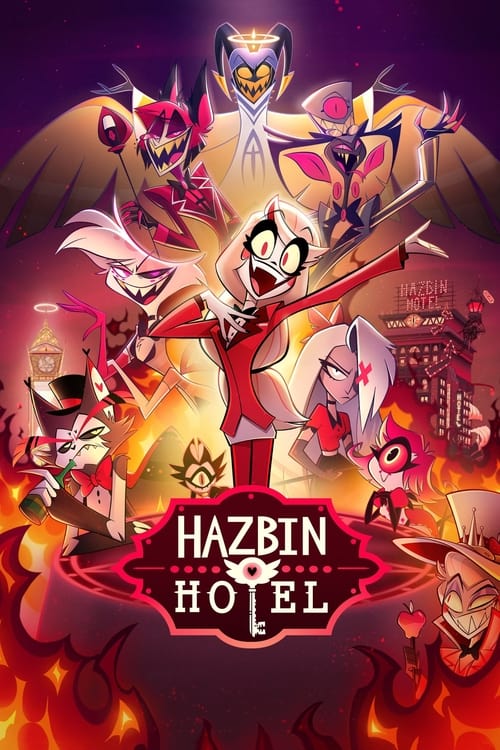
Hazbin Hotel
"It's a beautiful day in Hell."
Overview
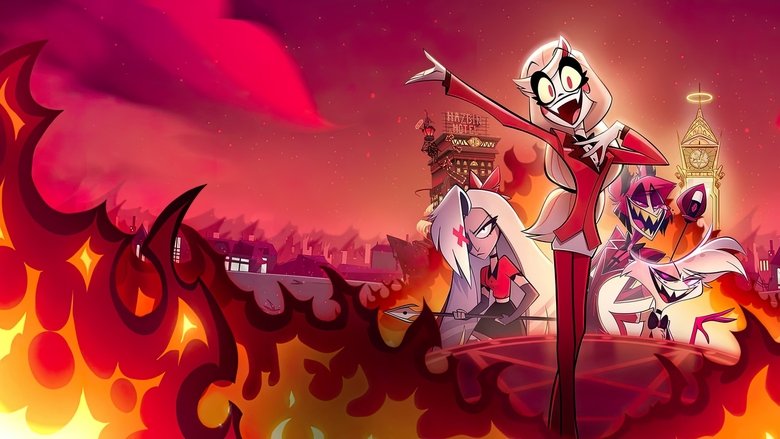
"Hazbin Hotel" follows the relentlessly optimistic Charlie Morningstar, the princess of Hell, who opens a hotel to rehabilitate sinners. Her seemingly impossible dream is to offer demons a chance at redemption to peacefully solve Hell's overpopulation, which Heaven currently manages through an annual, brutal extermination led by Adam, the first man. With the help of her devoted girlfriend Vaggie, their first and reluctant patron—the adult film star Angel Dust—and the powerful yet enigmatic "Radio Demon" Alastor, Charlie must navigate the treacherous politics of Hell and the rigid skepticism of Heaven.
The first season chronicles the hotel's chaotic beginnings as this motley crew of misfits attempts to prove that souls can change. Their efforts are met with mockery from Hell's powerful overlords and outright hostility from Heaven. Charlie's journey forces her to confront harsh truths about the celestial order, her own family's history, and the very nature of good and evil, culminating in a desperate battle to defend her dream and everyone in it from the next extermination.
Core Meaning
At its core, "Hazbin Hotel" is a story about the radical possibility of redemption and the power of empathy in a seemingly hopeless world. The series challenges preconceived notions of good and evil, heaven and hell, suggesting that no one is beyond saving if given a genuine chance and support. It argues that true change comes not from divine judgment or punishment, but from found family, genuine connection, and the difficult choice to be better, even when every system in place is designed to keep you down. The show posits that kindness and love are transformative forces capable of healing deep-seated trauma and defying a rigged cosmic game.
Thematic DNA
Redemption and Second Chances
This is the central theme of the entire series. Charlie's hotel is founded on the belief that sinners can be redeemed, a concept mocked by both demons and angels. The first season explores this through its residents, particularly Angel Dust, who struggles with his abusive past while taking hesitant steps toward vulnerability and trust. The season finale provides definitive proof that redemption is possible when Sir Pentious, after sacrificing himself for his friends, appears in Heaven as an angel. This confirms Charlie's hypothesis and sets the stage for a fundamental conflict with Heaven's established order in future seasons.
Found Family and Belonging
The residents of the Hazbin Hotel form a dysfunctional but deeply loyal found family. Each character is an outcast, burdened by their past sins and traumas. Characters like Angel Dust and Husk, who initially push everyone away, slowly begin to form genuine bonds based on shared vulnerability. The hotel itself becomes a symbol of refuge and acceptance in a world defined by cruelty and transactional relationships. The narrative emphasizes that these connections are the true catalyst for change, providing the support necessary for individuals to confront their demons, both literal and metaphorical.
Hypocrisy and Questioning Authority
The series heavily criticizes the hypocrisy of established power structures, particularly Heaven. The angels, led by Adam, are depicted as cruel, prejudiced, and violent, enjoying the annual extermination of sinners. When Charlie presents her case in Heaven, she discovers that the angelic court is unaware of how souls are judged and that the exterminations are a secret kept by the highest echelons. This theme questions the moral authority of those in power and suggests that the labels of 'good' and 'evil' are often arbitrary and self-serving.
Abuse and Trauma
"Hazbin Hotel" delves into the lasting effects of abuse and trauma through its characters. Angel Dust's storyline is a prominent example, as he is contractually bound to and emotionally, physically, and sexually abused by the overlord Valentino. His flamboyant and reckless behavior is shown to be a coping mechanism for his deep-seated pain and self-loathing. The song "Poison" explicitly details his suffering and feelings of being trapped. The show treats this subject with gravity, exploring how trauma shapes behavior and the difficult path to healing through trust and friendship.
Character Analysis
Charlie Morningstar
Erika Henningsen
Motivation
Charlie is driven by a deep love for her people and a desire to find a peaceful, compassionate solution to Hell's overpopulation, in stark contrast to Heaven's violent exterminations. Her motivation evolves from a general desire to 'do good' to a fierce determination to protect her friends and prove that everyone deserves a chance at redemption.
Character Arc
Charlie begins as a naively optimistic princess whose ideas are dismissed by everyone. Throughout Season 1, her idealism is severely tested by the cruelty of Heaven and the cynicism of Hell. She learns that passion alone is not enough and is forced to make difficult decisions, including making a deal with Alastor and leading her friends into battle. By the end of the season, she transforms from a hopeful dreamer into a determined leader, her optimism now tempered with the resolve of a warrior. She proves her core belief correct but understands the fight is far from over.
Alastor (The Radio Demon)
Amir Talai
Motivation
Alastor's stated motivation is to be entertained by the failure of the hotel. However, his deeper, true motivation is to break a deal that binds his soul and to gain ultimate freedom and power. He sees an opportunity in Charlie's proximity to Hell's throne and is playing a long game, manipulating events to serve his own liberation.
Character Arc
Alastor is introduced as an immensely powerful and feared overlord who offers to help Charlie's hotel purely for his own amusement, finding her goal of redemption laughable. He maintains a charismatic but menacing presence, his true motives shrouded in mystery. A key reveal is that Alastor himself is bound by a deal to an unknown entity, which curtails his own freedom. During the final battle against Adam, he is seriously injured and forced to retreat, a rare moment of vulnerability that shatters his invincible facade. His final song reveals his frustration and a renewed desire to break free from his leash, suggesting his arc is about reclaiming his own agency, using Charlie's project as a means to an end.
Angel Dust
Blake Roman
Motivation
Initially, Angel's motivation is survival and escapism, using his work and persona to cope with his trauma. As the season progresses, his motivation shifts towards seeking genuine connection and freedom from his abuser, Valentino. He is driven by a burgeoning hope that he might be worthy of redemption and friendship.
Character Arc
Angel Dust starts as the hotel's sarcastic and promiscuous first resident, seemingly uncommitted to the idea of redemption. His arc in Season 1 is the most pronounced, revealing the deep trauma and self-hatred hidden beneath his flamboyant exterior. He is owned and abused by Valentino, which is the source of his self-destructive behavior. Through his growing friendships, particularly with Husk and Cherri Bomb, and Charlie's unwavering support, he begins to show vulnerability and a genuine desire for change. He learns to stand up for his friends and himself, demonstrating significant growth from a cynical hedonist to someone fighting for a better life.
Vaggie
Stephanie Beatriz
Motivation
Vaggie's primary motivation is her love for Charlie and her belief in Charlie's mission. She is driven by a fierce need to protect Charlie from the dangers of Hell and the heartbreak of failure. Her past as an angel adds a layer of personal redemption to her quest; helping Charlie succeed is also a way for her to atone for her past and forge a new identity.
Character Arc
Vaggie begins as Charlie's fiercely protective girlfriend and hotel manager, pragmatic and skeptical of outsiders like Alastor. Her primary focus is protecting Charlie and her dream. A major turning point is the revelation that Vaggie was once an angel, an exorcist who was cast out of Heaven for showing mercy to a demon. This secret being exposed creates a rift with Charlie but also forces Vaggie to confront her past. She ultimately embraces her identity, seeks training from a fellow fallen angel to fight Heaven's forces, and proves her loyalty lies with Charlie and the hotel, solidifying her path of redemption through action and love.
Symbols & Motifs
The Hazbin Hotel
The hotel symbolizes hope, second chances, and the possibility of change in a world steeped in cynicism and despair. It is a physical manifestation of Charlie's radical belief in redemption.
Throughout the first season, the hotel is a fledgling, often chaotic project. It is literally destroyed by Adam in the season finale but is rebuilt bigger and better, symbolizing the resilience of hope and the renewed commitment of its residents to Charlie's dream after they successfully defended their home.
Radio vs. Television
This symbolizes the conflict between old and new forms of power and entertainment. Alastor, the "Radio Demon," represents an older, more personal and charismatic form of influence, while Vox, his rival, represents the modern, impersonal, and ever-present nature of television and digital media.
The rivalry between Alastor and the "Vees" (Vox, Valentino, and Velvette) is a recurring subplot. Alastor's refusal to be filmed and his disdain for modern technology highlight this clash of eras and ideologies within Hell's power structure.
Angelic Weapons
Angelic steel weapons represent the perceived invincibility and absolute authority of Heaven. They are the tools of the extermination and the one thing that can permanently kill a demon.
A major turning point in the season is the discovery by Carmilla Carmine that angels are not invincible and can be killed by their own weapons. This knowledge shatters the illusion of Heaven's omnipotence and empowers the denizens of Hell to fight back, symbolizing a shift in the cosmic power balance.
Memorable Quotes
You're a loser, baby. A loser, God knows, but you're a loser just like me.
— Husk
Context:
In Season 1, Episode 4 ("Masquerade"), after Angel Dust has a traumatic experience with his abusive boss, Valentino, he is spiraling into self-loathing. Husk finds him at a bar and, instead of offering platitudes, starts a song that validates Angel's feelings of being a 'loser' while revealing his own painful past, forging the foundation of their friendship.
Meaning:
This quote is the core of the song "Loser, Baby" and encapsulates a key theme of the show: finding solidarity in shared brokenness. It's a moment of profound, albeit crass, empathy. Husk isn't insulting Angel Dust; he's telling him that his pain and failures don't isolate him. It's an anthem of acceptance, suggesting that connection can be found not in perfection, but in mutual imperfection.
So I'll be the one to show them a better way, and I'll be the one to save them all, 'cause this is my home and these are my people!
— Charlie Morningstar
Context:
This is from Season 1, Episode 1 ("Overture"). Charlie sings this after the annual extermination, expressing her grief and resolving to launch her rehabilitation project, the Hazbin Hotel, despite the widespread mockery she faces.
Meaning:
This quote, from the opening song "Happy Day in Hell," establishes Charlie's unwavering determination and her core motivation. It highlights her profound empathy for the inhabitants of Hell, whom she considers her people, not just damned souls. It's her mission statement and the driving force of the entire series.
This hotel is a memorial to a dear friend I lost in the fight. We will not let his sacrifice be in vain. This is just the beginning.
— Charlie Morningstar
Context:
Spoken in the finale of Season 1, Episode 8 ("The Show Must Go On"), after the battle with Adam's forces. Charlie addresses her friends amidst the rubble of the hotel, honoring Sir Pentious's sacrifice and declaring her renewed commitment to rebuilding and continuing her mission.
Meaning:
This quote signifies a major shift in Charlie's perspective. After the battle that destroyed her original hotel, her dream is no longer just a hopeful idea but a cause consecrated by sacrifice. It marks her transition from an idealist to a resolute leader, aware of the real costs of her fight.
Episode Highlights
Masquerade
This episode provides a deep dive into Angel Dust's character, revealing the abusive relationship he has with his boss, Valentino, through the powerful song "Poison." It culminates in the musical number "Loser, Baby," a duet between Angel and Husk that establishes their friendship through shared pain and cynical acceptance. It's a pivotal moment for character development and establishes the show's ability to handle dark themes with emotional depth.
This episode is critically significant for establishing the emotional core of the series beyond its comedic premise. It provides the first concrete evidence of the deep trauma affecting the hotel's residents and demonstrates how genuine connection, rather than forced positivity, is the first step toward healing.
Dad Beat Dad
Charlie's father, Lucifer Morningstar, makes his grand entrance. Rather than a terrifying ruler, he is portrayed as a quirky, depressed, and overprotective father who loves making rubber ducks. The episode features a brilliant musical clash, "Hell's Greatest Dad," between Lucifer and Alastor as they vie for Charlie's affection and influence. It also contains the heartfelt duet "More Than Anything," where Lucifer expresses his fears for Charlie's safety.
This episode expands the show's lore significantly by introducing the ruler of Hell and exploring the complex family dynamics of the Morningstars. It humanizes Lucifer and establishes the complicated relationship he has with Charlie, while also escalating the mysterious tension between him and Alastor.
Welcome to Heaven
Charlie and Vaggie travel to Heaven to plead their case before the angelic court. The episode reveals Heaven to be a place with its own rigid bureaucracy and secrets. The major twist occurs when Adam reveals that Vaggie was once an exterminator angel who was cast out for showing mercy, a secret she had kept from Charlie. It also becomes clear that no one in Heaven, except for the highest-ranking angels, knows how souls are judged or even that the exterminations happen.
This episode is crucial for world-building and plot advancement. It shatters the simplistic good vs. evil dichotomy by showing the moral failings of Heaven. Vaggie's backstory is revealed, creating significant character conflict and setting the stage for the season's final confrontation with Adam and his forces.
The Show Must Go On
The season finale depicts the all-out battle between the Hazbin Hotel residents and Adam's exorcist army. The episode is packed with action and emotional moments, including Alastor's near-defeat by Adam, Sir Pentious's heroic sacrifice, and Lucifer's arrival to defend Charlie. The battle concludes with Adam's death at the hands of Niffty.
This episode is the climax of the season's entire arc. It proves that Hell can successfully fight back against Heaven. Most importantly, a final scene reveals that Sir Pentious has been redeemed and ascended to Heaven, validating Charlie's entire mission and proving that redemption is possible. The episode ends with a cliffhanger showing that Charlie's mother, Lilith, has been residing in Heaven and is now being tasked with stopping Charlie.
Philosophical Questions
What is the nature of redemption, and is anyone truly irredeemable?
This is the central question of the series. "Hazbin Hotel" explores this by challenging the celestial status quo, which dictates that sinners are damned for eternity. Charlie's hotel is a grand experiment to prove this wrong. The show posits that redemption isn't about erasing past sins but about the capacity for change, growth, and empathy. The successful redemption of Sir Pentious proves that the system, not the soul, might be the problem, suggesting that circumstance, support, and choice are the true arbiters of one's ultimate fate.
Does morality depend on one's identity or one's actions?
The series consistently blurs the lines between 'good' angels and 'evil' demons. The angels, particularly Adam and the exorcists, are portrayed as violent, cruel, and arrogant, while many of the demon protagonists display loyalty, love, and the capacity for self-sacrifice. This forces the audience to question whether inherent labels (angel, demon) define morality. The show argues that actions, intentions, and the capacity for empathy are more important than one's origins or cosmic designation, suggesting that true evil is the refusal to allow for change and compassion.
Can a system be fundamentally unjust, even if it is ordained by a higher power?
"Hazbin Hotel" critiques the divine order of its universe. Heaven's system of eternal damnation and violent population control is presented as cruel and arbitrary. Charlie's quest is not just about saving individuals but about challenging the very foundations of this system. The revelation that Heaven's leadership is ignorant or deceitful about its own rules suggests a broken, bureaucratic, and morally bankrupt cosmic government. The series explores the philosophical idea of fighting against a flawed, seemingly absolute authority for a more just and compassionate world.
Alternative Interpretations
One significant area of alternate interpretation revolves around the character of Alastor and his true motivations. While the series presents his primary goal as breaking free from a deal that binds his soul, some fans theorize his interest in Charlie and the hotel runs deeper. One perspective suggests that Alastor may be genuinely, if begrudgingly, growing fond of the hotel's residents and that his protective actions are not purely self-serving. Another popular theory posits that he made a deal with Charlie's mother, Lilith, and his presence at the hotel is on her orders, making him a pawn in a much larger game between the rulers of Hell.
Another interpretation concerns the nature of redemption itself. While the show presents Sir Pentious's selfless sacrifice as the trigger for his ascension, it leaves the exact mechanics ambiguous. Some viewers debate whether it was the act of self-sacrifice alone, or his cumulative emotional growth and goodness at the hotel that qualified him. This raises questions about whether redemption is a single, dramatic act or a gradual process of change, a question the series will likely explore further.
Cultural Impact
"Hazbin Hotel" represents a significant success story for independent, creator-driven animation. Originating as a crowdfunded YouTube pilot by Vivienne Medrano, its viral popularity demonstrated a massive audience for adult animation that combines mature themes, complex characters, and a Broadway-style musical format. Its transition to a mainstream streaming service, backed by A24 and Amazon, marked a major validation of internet-based animation projects bypassing traditional studio systems.
The series has been praised for its overt and diverse queer representation, with the central romance being between two female characters, Charlie and Vaggie, and several other main characters identifying as part of the LGBTQ+ community. This has resonated strongly with audiences, contributing to a large and passionate online fandom. The show's influence is seen in its vibrant fan community, which produces extensive fan art, theories, and discussions, solidifying its place in pop culture. Critically, the show has received generally positive reviews, with particular praise for its unique animation style, ambitious musical numbers, and compelling character arcs, though some critics noted pacing issues in the first season.
Audience Reception
"Hazbin Hotel" has garnered a massively positive and highly engaged audience reception, particularly from its pre-existing online fanbase. The series was met with widespread praise for its vibrant animation, creative character designs, and ambitious Broadway-style musical numbers. The complex character arcs, especially that of Angel Dust, and the show's unapologetic queer representation were frequently highlighted as major strengths by viewers.
Points of criticism among some viewers and critics included the rushed pacing of the first season, with some feeling that the eight-episode run didn't allow enough time for certain plot points and character relationships to develop fully. The dialogue, which is heavy with profanity, was seen as trying too hard to be edgy by some, while others found it fitting for the hellish setting. Despite these criticisms, the overall verdict from the audience has been overwhelmingly favorable, leading to massive online discussion, fan content creation, and high anticipation for its already-confirmed second season.
Interesting Facts
- The show's creator, Vivienne "VivziePop" Medrano, first developed the concept and characters for "Hazbin Hotel" while in middle school and later as part of her webcomic series "ZooPhobia".
- The original 2019 pilot episode was produced independently, funded primarily through Medrano's Patreon supporters, and was animated by freelance artists from around the world.
- The 2019 pilot, released on YouTube, became a viral sensation, gaining over 100 million views and a massive fanbase, which led to the series being picked up by production company A24.
- For the official Prime Video series, the entire main voice cast was recast from the pilot, though many of the original actors expressed support for the new production.
- "Hazbin Hotel" set a record for the largest global debut for a new animated series on Prime Video upon its release.
- The series exists in the same universe as Medrano's spin-off web series, "Helluva Boss," which follows the antics of a different set of characters in Hell.
- Many of the main cast members are seasoned Broadway performers, including Erika Henningsen (Charlie), Alex Brightman (Sir Pentious/Adam), Jeremy Jordan (Lucifer), and Stephanie Beatriz (Vaggie), which contributes to the show's strong musical theater identity.
Easter Eggs
In the pilot episode, a demon resembling Bill Cipher from Disney's "Gravity Falls" can be seen on a television screen in the background.
This is a fun nod to another popular animated series known for its mystery and supernatural elements. It's a common practice in animation for artists to pay homage to shows that have inspired them.
Alastor briefly hums the song "You're Never Fully Dressed Without a Smile" from the musical "Annie."
This is a subtle character detail that aligns with Alastor's 1930s radio-era persona and his constant, unsettling smile. It reinforces his thematic connection to that time period and the sinister cheerfulness he exudes.
Throughout the series, background characters from Vivienne Medrano's other works, like "ZooPhobia" and the spin-off "Helluva Boss," make cameo appearances.
These cameos serve as fun easter eggs for long-time fans of Medrano's work, reinforcing the idea of a shared universe (the "Hellaverse") and rewarding viewers who have followed her creative journey from the beginning.
⚠️ Spoiler Analysis
Click to reveal detailed analysis with spoilers
Frequently Asked Questions
Explore More About This Movie
Dive deeper into specific aspects of the movie with our detailed analysis pages
Comments (0)
No comments yet. Be the first to share your thoughts!