Hiroshima Mon Amour
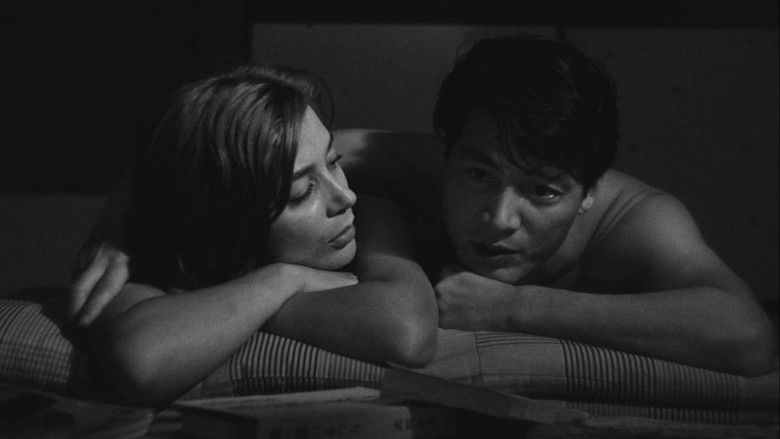
A haunting French New Wave masterpiece blending romance and historical trauma. Through a fragmented, poetic narrative, it explores the paradox of memory as a French actress and a Japanese architect grapple with the ghosts of Hiroshima and Nevers. Atmospheric, cerebral, and devastatingly beautiful.
Hiroshima Mon Amour
Hiroshima Mon Amour

Hiroshima mon amour

"From the measureless depths of a woman's emotions..."

10 June 1959 France 92 min ⭐ 7.7 (898)
Director: Alain Resnais
Cast: Emmanuelle Riva, Eiji Okada, Stella Dassas, Pierre Barbaud, Bernard Fresson
Drama History Romance
Memory vs. Forgetting The Incommunicability of Trauma Past and Present Fluidity Personal vs. Collective History
Box Office: $3,193

Hiroshima Mon Amour - Ending Explained

⚠️ Spoiler Analysis

The Twist/Reveal: The central mystery of the film is 'Nevers.' Through the Japanese man's gentle prodding, the woman reveals that during the war, she fell in love with a German soldier occupying her town. On the day of liberation, he was shot by a sniper. She was traumatized, and as punishment for sleeping with the enemy, her head was shaved, and she was locked in a cellar by her parents, where she went mad, clawing at the walls and tasting the saltpeter. She was eventually released and sent to Paris on a bicycle, never to return.

The Ending: After spending the night wandering the city and confessing her story, she returns to her hotel. The Japanese man follows her. She yells that she will forget him, just as she forgot the German. He enters the room, and they stare at each other. She says, 'Hi-ro-shi-ma. That's your name.' He accepts this and replies, 'That's my name. Yes. Your name is Nevers. Ne-vers in France.' The film cuts to black. This signifies that they have accepted their roles as carriers of their respective histories—they are no longer just lovers, but embodiments of the places that defined their scars.

Alternative Interpretations

While the narrative seems straightforward, critics have debated several points:

  • The 'You Saw Nothing' Line: Some interpret this literally—she arrived years after the bomb, so she physically saw nothing. Others view it existentially—even if she saw the artifacts, she cannot know the suffering. A third interpretation is that the Japanese man is refusing to let her appropriate his culture's tragedy for her own emotional catharsis.
  • The German Lover: While presented as a memory, some analysis suggests he could be a screen memory or a symbol for the 'enemy' that exists in all wars—humanizing the 'other' to show the universal nature of suffering.
  • The Ending: Is the ending a moment of connection or total alienation? By calling each other 'Hiroshima' and 'Nevers', are they acknowledging a deep bond, or are they reducing each other to mere objects of history, permanently separated by their origins?