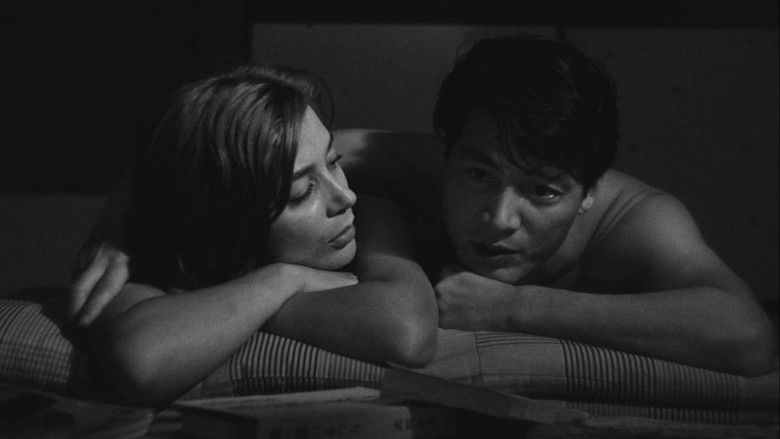
Hiroshima Mon Amour
Hiroshima mon amour
"From the measureless depths of a woman's emotions..."
Overview
In post-war Hiroshima, a French actress (known only as 'She') and a Japanese architect (known only as 'He') engage in a brief, intense affair while she is in the city to film an anti-war movie. Their encounter acts as a catalyst for suppressed memories, blurring the lines between the present and the past. As they wander through the rebuilt city, their conversations oscillate between the collective tragedy of the atomic bomb and the personal, hidden tragedy of her youth.
Throughout their time together, the woman is compelled to recount a traumatic secret she has kept buried for years: her illicit love affair with a German soldier in her hometown of Nevers, France, during World War II. She details the humiliation, madness, and grief she endured after his death on the day of liberation. The film intercuts these painful recollections with their present intimacy, creating a mosaic of time where the past is as vivid as the present.
As the hours pass and her departure approaches, the distinction between her dead German lover and her new Japanese lover begins to fade. The film culminates not in a traditional resolution, but in a profound acknowledgment of the link between their identities and their respective traumas, suggesting that to remember is to suffer, but to forget is the ultimate horror.
Core Meaning
Hiroshima Mon Amour is a profound meditation on the impossibility of truly knowing another's pain and the inevitability of forgetting. Director Alain Resnais and screenwriter Marguerite Duras suggest that while we have a moral duty to remember historical atrocities (like Hiroshima), the human mind survives trauma through the natural, yet terrifying, process of forgetting. The film posits that personal grief (Nevers) and collective tragedy (Hiroshima) are inextricably linked, yet ultimately incommunicable; we can only ever see the 'shell' of another's suffering, never the thing itself.
Thematic DNA
Memory vs. Forgetting
The central conflict of the film. The protagonist fights to keep the memory of her German lover alive to honor him, yet realizes that moving on requires forgetting. The film presents forgetting not as a relief, but as a 'horror'—a betrayal of the love and pain that once defined her existence.
The Incommunicability of Trauma
Encapsulated in the recurring line 'You saw nothing in Hiroshima,' the film argues that no amount of museums, films, or facts can allow an outsider to truly comprehend the lived experience of a catastrophe. Personal pain isolates the individual, just as historical tragedy isolates a city.
Past and Present Fluidity
Resnais treats time not as linear but as psychological. The past intrudes upon the present through sensory triggers (a hand twitching, a river), showing how trauma keeps the past perpetually alive in the mind, superimposed over current reality.
Personal vs. Collective History
The film juxtaposes the massive, public destruction of Hiroshima with the private, shameful tragedy of Nevers. It questions how a single human life and its petty love story can stand against the backdrop of world-altering devastation, ultimately according equal emotional weight to both.
Character Analysis
Elle (The Woman)
Emmanuelle Riva
Motivation
To remember her lost love so she doesn't betray him, while simultaneously seeking the human warmth that will cause her to forget him.
Character Arc
She begins as an observer claiming to understand Hiroshima, is challenged to face her own lack of understanding, and is then guided to confront and verbally exorcise her own repressed trauma from Nevers. She moves from denial to a painful catharsis, finally accepting the terrifying inevitability of forgetting.
Lui (The Man)
Eiji Okada
Motivation
To keep her in Hiroshima with him, and to understand the 'Nevers' part of her that prevents her from fully being with him.
Character Arc
He starts as a lover and guide to the city, but transforms into a psychoanalytic figure who probes her memories. By adopting the persona of her dead lover during their dialogue, he helps her relive and release the past.
Symbols & Motifs
Hiroshima and Nevers
The cities symbolize the identities of the characters themselves. Hiroshima represents collective suffering, destruction, and rebuilding. Nevers represents personal shame, youth, and the 'petrified' past that the woman cannot escape.
In the final scene, the characters explicitly name each other: 'Hi-ro-shi-ma. That's your name,' she says. 'That's my name. Yes. Your name is Nevers. Ne-vers in France,' he replies.
Ashes and Sweat
In the opening sequence, the lovers' intertwined bodies are covered first in what looks like radioactive ash, then glittering dew or sweat. This visually links the ecstasy of lovemaking with the horror of atomic fallout, suggesting the inseparable nature of creation and destruction.
The very first shot of the film shows this texture on their skin before their faces are revealed.
The Twitching Hand
A visual trigger that bridges the past and present. It symbolizes the persistence of the dead in the living.
While the Japanese lover sleeps, his hand twitches. This motion instantly transports the woman back to the moment she watched her German lover die, his hand twitching in his final moments.
The Cellar
Represents the subconscious, madness, and the physical space of repression.
Flashbacks show the woman locked in a cellar in Nevers by her parents to hide her shame and 'madness' after the liberation.
Memorable Quotes
Tu n'as rien vu à Hiroshima. Rien.
— Lui (The Man)
Context:
Spoken repeatedly in the opening sequence as the woman describes the artifacts and films she has seen in the Peace Museum.
Meaning:
'You saw nothing in Hiroshima. Nothing.' The film's most famous line, challenging the idea that visiting a museum or seeing a movie allows one to comprehend the horror of the atomic bomb. It establishes the theme of the incommunicability of trauma.
Hi-ro-shi-ma. C'est ton nom.
— Elle (The Woman)
Context:
The final line of the film, spoken in her hotel room.
Meaning:
She identifies him entirely with the city and its history, acknowledging that their connection is bound to this place and time.
C'est mon nom. Oui. Ton nom à toi est Nevers. Ne-vers-en-France.
— Lui (The Man)
Context:
The final response of the film, ending the narrative.
Meaning:
He reciprocates, identifying her by her trauma. It signifies that they have ceased to be individuals and have become symbols of their respective histories.
Je te rencontrerai. Je me souviendrai de toi. Qui es-tu ? Tu me tues. Tu me fais du bien.
— Elle (The Woman)
Context:
Spoken during their intimacy, blurring the line between her current lover and the memory of the German soldier.
Meaning:
'I meet you. I remember you. Who are you? You're destroying me. You're good for me.' Expresses the paradox of their relationship: it is healing because it allows her to feel again, but destructive because it forces her to relive the pain of the past and replace her old love.
J'ai oublié l'amour.
— Elle (The Woman)
Context:
Spoken in the context of her recovery from the madness in Nevers.
Meaning:
'I have forgotten love.' A confession that trauma has numbed her, and this affair is a reawakening.
Philosophical Questions
Is it possible to truly understand the suffering of another?
The film repeatedly asserts 'You saw nothing,' suggesting an unbridgeable gap between the observer and the victim. It questions the efficacy of empathy in the face of massive trauma.
Is forgetting a betrayal or a necessity?
The protagonist feels that forgetting her dead lover is a 'horror' because it erases his existence. However, the film suggests that life can only continue through the process of forgetting, presenting memory as a burden that must eventually be laid down.
How does individual trauma weigh against collective tragedy?
By placing a teenage romance gone wrong alongside the atomic bombing, the film asks if pain is relative. It concludes that for the individual, personal pain is absolute and world-shattering, regardless of the scale of external events.
Alternative Interpretations
While the narrative seems straightforward, critics have debated several points:
- The 'You Saw Nothing' Line: Some interpret this literally—she arrived years after the bomb, so she physically saw nothing. Others view it existentially—even if she saw the artifacts, she cannot know the suffering. A third interpretation is that the Japanese man is refusing to let her appropriate his culture's tragedy for her own emotional catharsis.
- The German Lover: While presented as a memory, some analysis suggests he could be a screen memory or a symbol for the 'enemy' that exists in all wars—humanizing the 'other' to show the universal nature of suffering.
- The Ending: Is the ending a moment of connection or total alienation? By calling each other 'Hiroshima' and 'Nevers', are they acknowledging a deep bond, or are they reducing each other to mere objects of history, permanently separated by their origins?
Cultural Impact
Hiroshima Mon Amour is considered a cornerstone of the French New Wave (specifically the 'Left Bank' group) and a landmark in cinematic modernism. Its release in 1959 revolutionized film grammar.
- Non-Linear Narrative: It was one of the first films to use flashbacks not as a storytelling device to explain the plot, but as a representation of human psychology—sudden, intrusive, and fluid. This influenced editors and directors for decades, from The Pawnbroker to Eternal Sunshine of the Spotless Mind.
- Literary Cinema: The collaboration between Resnais and Duras elevated the role of the screenwriter, proving that film could handle complex, novelistic interior monologues and poetic structures.
- Historical Reflection: It shifted the focus of war films from combat to the lingering psychological scars of survivors, influencing how trauma is depicted in visual media.
- Critical Acclaim: It won the FIPRESCI Prize at Cannes and is consistently ranked among the greatest films ever made by Sight & Sound and other critical polls.
Audience Reception
Review Aggregation: The film is widely regarded as a masterpiece by critics but can be polarizing for general audiences.
- Praised: Critics and cinephiles laud the innovative editing, the haunting score by Giovanni Fusco and Georges Delerue, the poetic script by Duras, and the emotional vulnerability of Emmanuelle Riva. It is celebrated for its intellectual depth and visual beauty.
- Criticized: Some viewers find the film 'pretentious,' 'slow,' or 'confusing' due to its lack of a conventional plot and its repetitive, incantatory dialogue. The non-linear structure can be difficult to follow for those expecting a traditional narrative.
- Verdict: A challenging but essential watch for those interested in film history, psychology, and the art of cinema.
Interesting Facts
- Alain Resnais was originally commissioned to make a documentary about the atomic bomb, but he felt he couldn't replicate the impact of his Holocaust film 'Night and Fog' (1956) or capture the horror directly. He decided a fictional story was the only way to approach the subject.
- The screenplay was written by famous novelist Marguerite Duras. Resnais told her he wanted a 'love story set in Hiroshima' that would encompass the tragedy.
- This was Emmanuelle Riva's feature film debut. She was a theater actress whom Resnais discovered on a poster.
- The film was shot by two different cinematographers: Sacha Vierny for the scenes in France (Nevers) to evoke a wintry, softer European look, and Michio Takahashi for the scenes in Japan to capture a sharper, harder contrast.
- The English word 'Never' is phonetically present in the city name 'Nevers'. While Duras wrote in French, critics have noted the irony that the woman is from a place that sounds like 'Never', reinforcing the theme of denial and nothingness.
- The film was nominated for an Academy Award for Best Screenplay Written Directly for the Screen.
- It was shown out of competition at the 1959 Cannes Film Festival because the American authorities were concerned about the film's sensitive subject matter regarding the atomic bomb.
Easter Eggs
The 'Casablanca' Nightclub
In the final act, the characters meet in a nightclub named 'Casablanca'. This is a direct reference to the 1942 film Casablanca, which also features a doomed romance during World War II where lovers must part. It ironically contrasts the Hollywood romanticism of Casablanca (where they 'always have Paris') with the bleak reality of Hiroshima Mon Amour (where she will 'never' have Nevers again).
The Film-Within-A-Film
The protagonist is an actress starring in a film about peace. The scenes of her filming a protest march with extras serve as a meta-commentary on the inability of cinema to truly capture the reality of Hiroshima, mirroring Resnais' own struggle to make the movie.
⚠️ Spoiler Analysis
Click to reveal detailed analysis with spoilers
Frequently Asked Questions
Explore More About This Movie
Dive deeper into specific aspects of the movie with our detailed analysis pages
Comments (0)
No comments yet. Be the first to share your thoughts!