The core meaning of "Hope" is not to dwell on the depravity of a crime, but to illuminate the resilience of the human spirit and the profound power of communal love in the process of healing. Director Lee Joon-ik stated he wanted to create a "happy movie that begins with a tragedy," focusing on the aftermath and the family's struggle to reclaim their lives. The film's message is that while trauma inflicts wounds that may never fully disappear, the unwavering support of family and community can provide the strength needed to move forward and find light in the darkness. It is a testament to the idea that recovery is a collective effort and that hope, even when seemingly lost, can be nurtured back to life through empathy and sacrifice.

A heart-wrenching drama that finds a fragile blossom of hope pushing through the concrete of an unspeakable tragedy, illuminated by the warmth of communal love.
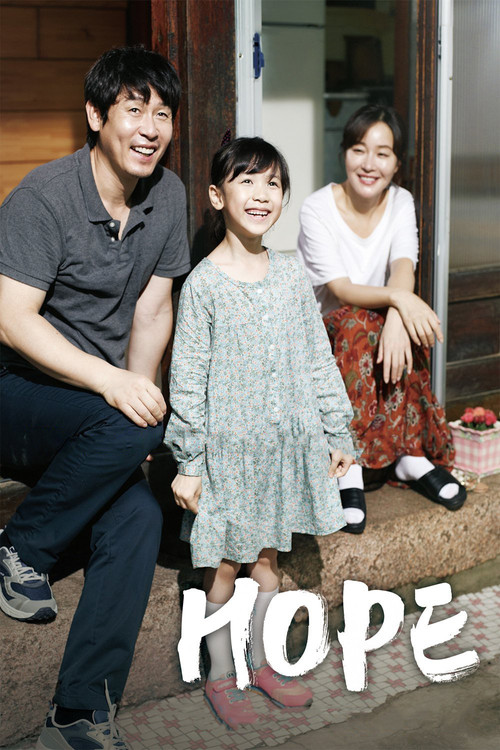
Hope
소원
"We won't let her shed tears again."
02 October 2013
South Korea
122 min
8.4
(801)
Director: Lee Joon-ik
Cast: Sul Kyung-gu, Uhm Ji-won, Lee Re, Kim Sang-ho, Kim Hae-sook
Drama
The Journey of Healing After Trauma
Familial Love and Sacrifice
The Power of Community Support
Inadequacy of the Justice System
Hope — Symbolism & Philosophy
Symbols & Motifs
The Cocomong Costume
Meaning:
The Cocomong (a popular Korean cartoon character) costume symbolizes the father's unconditional love, sacrifice, and his desperate attempt to bridge the emotional chasm created by So-won's trauma. Since she has developed a phobia of adult men, including him, the costume allows him to become a safe, non-threatening presence in her life, a guardian angel she can trust.
Context:
After So-won recoils from his touch in the hospital, a heartbroken Dong-hoon begins wearing the heavy character costume to accompany her to and from school and to simply be near her. He endures physical discomfort and exhaustion to provide a silent, comforting presence. The moment So-won realizes it is her father inside and takes off the mask signifies a monumental step in her healing and the mending of their relationship.
The Colostomy Bag
Meaning:
The colostomy bag is a stark, physical manifestation of the permanent damage inflicted upon So-won. It represents the lifelong scars, both visible and invisible, that she and her family must learn to live with. It symbolizes the harsh, practical realities of her new life and the constant reminder of the trauma. However, the family's eventual acceptance and management of the bag also symbolizes their resilience and adaptation in the face of irreversible change.
Context:
The bag is introduced by the doctors after So-won's life-saving surgery. A pivotal scene occurs in the hospital when the bag leaks, and her father's attempt to help her triggers a traumatic flashback, highlighting the psychological connection to her physical injuries. Her friends and family later find creative ways to make carrying it more comfortable, demonstrating their support and acceptance of her condition.
The Kite
Meaning:
The kite represents the fragility of childhood innocence and, ultimately, the enduring nature of hope. Its ability to soar despite being tethered to the ground mirrors So-won's own spirit, which, though battered, strives to rise again.
Context:
The film reportedly opens with the image of a kite flying freely. A review notes that the kite, which falls at the start of the film, is seen flying high again at the end, symbolizing a restoration of hope for So-won and other children who have suffered.
Philosophical Questions
What is the true nature of justice when legal systems fail?
The film powerfully explores this question through the family's devastating experience with the courts. The perpetrator receives a mere 12-year sentence, a legal outcome that feels like a profound injustice to the family and the audience. The film suggests that when formal justice is inadequate, a different kind of justice must be found—not in revenge, but in the act of survival, healing, and the community's collective condemnation of the crime. It posits that the ultimate triumph over evil is not a longer prison sentence, but the victim's ability to find hope and continue living.
How can hope exist in the aftermath of unimaginable suffering?
The film's very title poses this question. It explores how hope is not a passive feeling but an active, communal process. Hope is found in the father's selfless sacrifice inside the Cocomong costume, in the friends who raise money, in the classmates who protect So-won, and in the family's decision to welcome a new child. The film argues that hope is not the absence of pain, but the ability to find meaning and connection despite it. It is nurtured through acts of love, empathy, and the collective will of a community to help one of its own heal.
Can broken bonds of trust ever be fully mended?
The film delves into this question through the fractured relationship between So-won and her father, Dong-hoon. The trauma makes her terrified of the man who loves her most, creating a seemingly insurmountable barrier. The film explores the slow, painful, and unconventional path to rebuilding that trust. It shows that mending such a bond requires immense patience, empathy, and a willingness to communicate in a new language—in this case, through the anonymity of a cartoon character. The eventual reconciliation suggests that while scars remain, even the most deeply broken bonds can be repaired through persistent, selfless love.
Core Meaning
Explore More About This Movie
Dive deeper into specific aspects of the movie with our detailed analysis pages