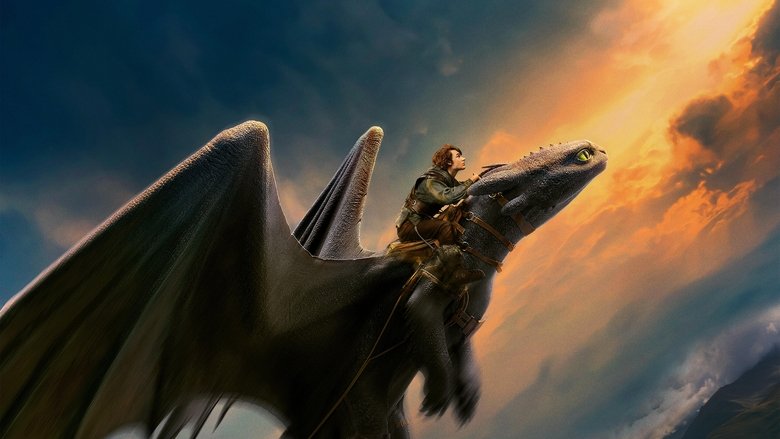

"The legend is real."
How to Train Your Dragon - Symbolism & Philosophy
Symbols & Motifs
Prosthetics (Toothless's Tail and Hiccup's Foot)
The prosthetics symbolize the deep, symbiotic bond between Hiccup and Toothless. They are both 'incomplete' without each other. The artificial tail fin requires Hiccup's guidance to function, physically linking them in flight and making their partnership a necessity. At the film's end, Hiccup loses his foot and receives a prosthetic of his own, cementing their shared experience of injury and recovery and making them equals who have both been changed by their bond.
Hiccup designs and builds the prosthetic tail for Toothless after his original is damaged by Hiccup's bolas. They must learn to fly together, with Hiccup controlling the prosthetic. Hiccup's own prosthetic foot is seen in the final scene of the film, after his battle with the Red Death, mirroring Toothless's own gear.
The Dragon's Nest
The nest represents the source of the conflict, a place of fear and misunderstanding for the Vikings. To them, it is the heart of the evil they must destroy. However, upon discovery, it is revealed to be a place of subjugation, where the smaller dragons are ruled by a tyrannical, parasitic queen (the Red Death). This reframes the dragons not as aggressors, but as victims themselves, forced to raid villages to survive. The nest symbolizes the hidden, complex truth behind a seemingly simple conflict.
Stoick leads his fleet on a desperate search for the nest to end the dragon raids once and for all. Hiccup and Astrid discover the nest during a flight with Toothless, witnessing the terrifying Red Death command the other dragons. The film's climax takes place as the Vikings attack the nest, only to unleash its monstrous ruler.
The Night Fury
The Night Fury, and Toothless specifically, symbolizes the unknown and the feared 'other.' It is a dragon no Viking has ever seen up close, spoken of only in whispers and terrified legends. Its mysterious nature makes it the ultimate prize for a dragon killer. By befriending Toothless, Hiccup is literally embracing the unknown and finding not a monster, but a kindred spirit. Toothless represents the dismantling of prejudice through personal connection.
Hiccup manages to shoot down a Night Fury during the opening raid, an unprecedented feat that no one believes. He later finds the trapped dragon in the woods and their relationship forms the core of the film's plot, transforming the ultimate symbol of fear into one of friendship.
Philosophical Questions
Can inherited hatred be unlearned within a single generation?
The film explores this question through Hiccup's defiance of centuries of Viking tradition. His entire society is built upon the war with dragons. Stoick represents the deeply ingrained, inherited worldview that dragons are implacable enemies. Hiccup's personal experience with Toothless proves this to be false, suggesting that direct, empathetic contact with a perceived 'enemy' is a powerful catalyst for breaking cycles of hatred. The film's optimistic conclusion, with Vikings and dragons living in harmony, argues that even the most profound societal prejudices can be dismantled by the courage and open-mindedness of a new generation.
What is the nature of true strength: physical power or compassionate intelligence?
Viking culture in the film unequivocally defines strength in physical terms: the ability to fight, to kill, and to dominate. Hiccup is the antithesis of this ideal. The film systematically deconstructs this notion. Hiccup's compassion allows him to befriend Toothless, his intelligence allows him to understand dragons, and his courage allows him to stand against his entire culture. Ultimately, his 'weaknesses' become the very strengths that save everyone, proposing a more nuanced definition of strength rooted in empathy, understanding, and the bravery to be different.
Core Meaning
At its heart, How to Train Your Dragon is a story about challenging dogma and embracing the 'other.' Director Dean DeBlois, returning from the animated trilogy, aims to protect the original's core message: that fear and prejudice are born from misunderstanding, and that true strength lies in empathy and the courage to forge one's own path. The film posits that generations of conflict can be undone by a single act of compassion. It explores the idea that societal norms and traditions, however deeply ingrained, should be questioned, especially when they perpetuate violence. The central relationship between Hiccup and Toothless serves as a powerful metaphor for finding connection in the most unlikely of places and discovering that our perceived enemies may, in fact, share a common soul with us.