
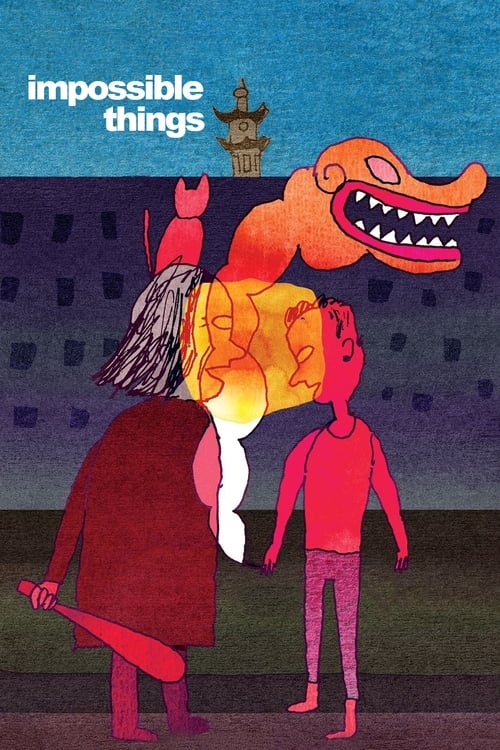
Impossible Things
A tender, melancholic drama that blooms like a resilient flower in the cracks of a concrete city, finding vibrant color in an unlikely friendship born from shared loneliness.
Impossible Things
Impossible Things

Cosas imposibles

"There are encounters that change your life"

17 June 2021 Mexico 88 min ⭐ 8.4 (414)
Director: Ernesto Contreras
Cast: Nora Velázquez, Benny Emmanuel, Luisa Huertas, Salvador Garcini, Andrés Delgado
Drama Family
Liberation from Trauma Unlikely Intergenerational Friendship Loneliness and Connection Second Chances and Self-Discovery

Impossible Things - Ending Explained

⚠️ Spoiler Analysis

"Impossible Things" follows Matilde, a widow so traumatized by her deceased husband Porfirio that she continues to see and interact with him as if he were still alive, subjecting her to constant psychological abuse. Her life is one of utter isolation until she forms an unlikely friendship with her 19-year-old neighbor, Miguel, a small-time drug dealer. Their bond is the film's central focus. Miguel brings the outside world into Matilde's cloistered apartment, introducing her to new music and marijuana, and encouraging her to venture out.

As Matilde's confidence grows, Porfirio's apparitions become more aggressive, representing her internal conflict between her old fears and her new taste of freedom. The climax of the film is not an external confrontation, but an internal one. After a series of empowering experiences with Miguel, Matilde finally finds the strength to stand up to Porfirio's memory. In a powerful scene, she verbally confronts his apparition, telling him he no longer has any power over her and effectively banishing him from her mind. The ending sees Matilde at peace in her own home, no longer haunted, ready to live the remainder of her life on her own terms. The film concludes on a note of quiet triumph and hope, showing that she has achieved the 'impossible' task of freeing herself.

Alternative Interpretations

While the dominant interpretation of the film is psychological, viewers could propose alternative readings of its central elements. One could interpret the presence of Matilde's deceased husband, Porfirio, through a supernatural lens, viewing him as a literal, tormented spirit bound to the apartment and his victim. This reading would frame the film as a ghost story where the haunting is real, and Matilde's friendship with Miguel gives her the spiritual strength to perform a kind of emotional exorcism.

However, the critical consensus and the film's grounded, realistic tone strongly support the interpretation of Porfirio as a psychological manifestation. He is a vivid embodiment of Matilde's PTSD. His appearances and dialogue are products of her traumatized mind, replaying decades of abuse. In this view, the film is not about the supernatural, but about the very real and haunting power of memory and the immense internal struggle required to overcome it. The 'impossibility' is not fighting a ghost, but breaking a psychological cycle that has defined a lifetime.