
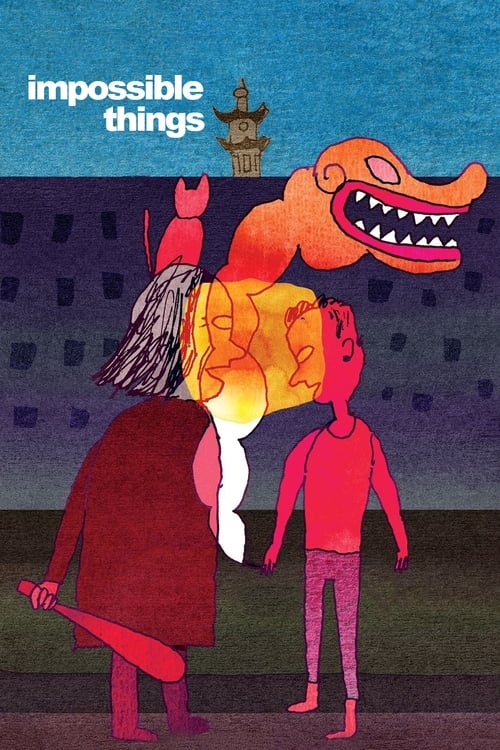
Impossible Things
A tender, melancholic drama that blooms like a resilient flower in the cracks of a concrete city, finding vibrant color in an unlikely friendship born from shared loneliness.
Impossible Things

Impossible Things

Cosas imposibles

"There are encounters that change your life"

17 June 2021 Mexico 88 min ⭐ 8.4 (414)
Director: Ernesto Contreras
Cast: Nora Velázquez, Benny Emmanuel, Luisa Huertas, Salvador Garcini, Andrés Delgado
Drama Family
Liberation from Trauma Unlikely Intergenerational Friendship Loneliness and Connection Second Chances and Self-Discovery

Overview

"Impossible Things" (Cosas imposibles) tells the story of Matilde (Nora Velázquez), a woman in her late 60s living a solitary life in a vast Mexico City housing complex. Following the recent death of her husband, Porfirio, she finds herself haunted by his abusive memory, which manifests as persistent, tormenting apparitions. Her world, confined to the four walls of her apartment, is one of fear and suffocating routine.

This fragile existence is interrupted by the arrival of Miguel (Benny Emmanuel), a troubled 19-year-old neighbor who makes a living through small-time illicit dealings. Despite their vast age difference and seemingly opposite worlds, a tentative connection forms between them, born out of mutual loneliness and a shared sense of being trapped. Their burgeoning friendship becomes a lifeline, slowly pulling Matilde out of her isolation and empowering her to confront the ghosts of her past and imagine a future she never thought possible.


Core Meaning

The core meaning of "Impossible Things" is a profound exploration of liberation and the healing power of human connection. Director Ernesto Contreras conveys that it is never too late to reclaim one's life from the grip of past trauma. The film posits that friendship can be found in the most unexpected places and that these relationships, free from societal judgment, can provide the strength needed to face deep-seated fears. It is a hopeful message that even after a lifetime of abuse and isolation, a person can find the courage to experience joy, independence, and self-worth—achieving things that once seemed impossible.

Thematic DNA

Liberation from Trauma 35%
Unlikely Intergenerational Friendship 30%
Loneliness and Connection 20%
Second Chances and Self-Discovery 15%

Liberation from Trauma

The central theme is Matilde's struggle to free herself from the psychological prison built by her deceased abusive husband, Porfirio. His constant presence as a ghost or memory is a manifestation of her deep-seated trauma and PTSD. Her journey, facilitated by her friendship with Miguel, is one of slowly dismantling this internal prison, learning to make her own choices, and finally banishing the specter of her abuser. The film meticulously portrays the difficult but ultimately achievable path toward emotional freedom.

Unlikely Intergenerational Friendship

The heart of the film is the tender, unconventional friendship between Matilde, a senior citizen, and Miguel, a teenager. Their bond transcends societal norms and expectations. They find in each other a non-judgmental confidant and a source of mutual support. Miguel introduces Matilde to new experiences, while Matilde offers Miguel a sense of stability and care he lacks. Their relationship highlights how genuine connection is not bound by age or background, but by shared emotional needs.

Loneliness and Connection

Both protagonists are profoundly lonely. Matilde is isolated by age and trauma, while Miguel is adrift, having been abandoned by his mother. The film is set primarily within a massive, anonymous housing unit, visually emphasizing their isolation amidst a crowd. Their story is a testament to how finding a single, meaningful connection can combat the deepest feelings of solitude and provide a reason to engage with the world again.

Second Chances and Self-Discovery

"Impossible Things" is a powerful narrative about second chances. Matilde, who has spent her entire adult life under the thumb of her husband, gets the opportunity to discover who she is for the first time in her late 60s. Through Miguel's encouragement, she tries marijuana, listens to new music, and ventures out into the city, slowly building a new identity independent of her past. It champions the idea that self-discovery is a lifelong process.

Character Analysis

Matilde

Nora Velázquez

Archetype: The Oppressed
Key Trait: Resilient

Motivation

Initially, her motivation is simply to survive her suffocating loneliness and fear. As her friendship with Miguel develops, her motivation shifts towards a desire to live and experience the world she has been denied. Ultimately, she is motivated by the fundamental human need for freedom and self-worth.

Character Arc

Matilde begins as a timid, fearful widow, completely dominated by the psychological ghost of her abusive husband. She is isolated and trapped in her past. Through her friendship with Miguel, she embarks on a quiet but profound journey of self-reclamation. She slowly gains confidence, experiences moments of joy, and learns to defy the voice of her internal oppressor. Her arc culminates in her finally standing up to Porfirio's memory, banishing him from her mind and stepping into a future she can define for herself.

Miguel

Benny Emmanuel

Archetype: The Catalyst / The Lost Boy
Key Trait: Empathetic

Motivation

Miguel is motivated by a deep-seated loneliness and a need for connection. He sees a kindred spirit in Matilde's isolation. His initial interactions may be transactional, but they quickly evolve into a genuine desire to help and protect her, filling a void in his own life.

Character Arc

Miguel starts as a seemingly typical disaffected youth—insecure, dealing drugs, and living a precarious day-to-day existence after being abandoned by his mother. His friendship with Matilde provides him with an anchor and a sense of purpose. In helping her, he also helps himself, finding a familial connection and a measure of stability that was missing in his life. He moves from being aimless and alone to being a supportive and crucial part of someone else's healing journey.

Porfirio

Salvador Garcini

Archetype: The Antagonist / The Ghost of the Past
Key Trait: Abusive

Motivation

As a memory, his motivation is to maintain control over Matilde, perpetuating the cycle of abuse even after death. He seeks to keep her weak, isolated, and dependent on his validation, ensuring his psychological dominance continues.

Character Arc

Porfirio's character does not have a developmental arc in the present, as he is already deceased. He exists as a static, tormenting memory. His role is to represent the trauma that Matilde must overcome. The 'arc' belongs to Matilde's perception of him, as she moves from being terrified of his memory to being able to confront and ultimately dismiss it.

Symbols & Motifs

The Ghost of Porfirio

Meaning:

Porfirio's ghost is not a literal supernatural entity but a powerful symbol of Matilde's post-traumatic stress disorder (PTSD) and the enduring psychological chains of domestic abuse. He represents her fear, her internalized feelings of worthlessness, and the ingrained habits of a lifetime of subjugation. His presence is a constant, tangible manifestation of her memory and trauma.

Context:

He appears throughout the film within Matilde's apartment, verbally abusing her and criticizing her every move, just as he did in life. He is confined to the apartment, symbolizing that the trauma is tied to that space. Her final confrontation with him is her act of reclaiming her mind and her home.

The Apartment

Meaning:

Matilde's apartment symbolizes her prison. It is both a physical and psychological space of confinement. For years, it was the primary scene of her husband's abuse, and after his death, it becomes the place where his memory continues to trap her. Her journey into the outside world with Miguel is a crucial step towards breaking free from this confinement.

Context:

The film visually contrasts the often dark, cluttered, and oppressive atmosphere of the apartment with the more open, vibrant, and sometimes overwhelming spaces of the city that she begins to explore with Miguel. Her eventual ability to be at peace within the apartment signifies her ultimate liberation.

Marijuana

Meaning:

Marijuana serves as a symbolic catalyst for change and liberation. It represents a break from a lifetime of rigid control and fear. For Matilde, trying it for the first time is not merely about getting high; it is an act of rebellion against her husband's memory and the strict, joyless life he imposed on her. It opens a door to new experiences and helps her lower her inhibitions.

Context:

Miguel, who sells marijuana, introduces it to Matilde to help her sleep and forget her troubles. Sharing a joint becomes a ritual that solidifies their bond and allows for moments of genuine, carefree laughter and connection, something long absent from Matilde's life.

Philosophical Questions

To what extent does our past define our present reality?

The film explores this question through Matilde, whose present is almost entirely consumed by the memory of her abusive husband. Her every action is dictated by the fear and routine he instilled in her. The narrative investigates whether it is possible to break free from such a deeply ingrained past. Miguel's presence suggests that new relationships and experiences can create a new present reality, one that can eventually overwrite the traumas of the past.

What constitutes a meaningful friendship?

"Impossible Things" challenges conventional definitions of friendship. The bond between Matilde and Miguel is devoid of common ground in terms of age, life experience, or social circles. The film posits that true friendship is based on a deeper level of shared emotional vulnerability and mutual empathy. It explores the idea that the most meaningful connections are those that help us become better versions of ourselves, regardless of how they appear to the outside world.

Can a person truly reinvent themselves at any age?

Matilde's journey is a case study in late-life reinvention. After living nearly seventy years in a state of oppression, she begins to explore her own identity, desires, and capacity for joy. The film philosophically argues against the notion that identity is fixed by a certain age, suggesting instead that the human capacity for growth and change is lifelong, provided the right catalyst—in this case, friendship—appears.

Alternative Interpretations

While the dominant interpretation of the film is psychological, viewers could propose alternative readings of its central elements. One could interpret the presence of Matilde's deceased husband, Porfirio, through a supernatural lens, viewing him as a literal, tormented spirit bound to the apartment and his victim. This reading would frame the film as a ghost story where the haunting is real, and Matilde's friendship with Miguel gives her the spiritual strength to perform a kind of emotional exorcism.

However, the critical consensus and the film's grounded, realistic tone strongly support the interpretation of Porfirio as a psychological manifestation. He is a vivid embodiment of Matilde's PTSD. His appearances and dialogue are products of her traumatized mind, replaying decades of abuse. In this view, the film is not about the supernatural, but about the very real and haunting power of memory and the immense internal struggle required to overcome it. The 'impossibility' is not fighting a ghost, but breaking a psychological cycle that has defined a lifetime.

Cultural Impact

"Impossible Things" was received by critics as a sensitive and well-crafted piece of contemporary Mexican cinema that prioritizes character-driven storytelling over spectacle. It stands as a significant work that tackles difficult social issues—domestic violence, trauma in old age, and urban loneliness—with honesty and hope, avoiding sensationalism. The film provided a dramatic leading role for Nora Velázquez, an actress primarily known for her comedic character "Chabelita," allowing her to showcase her significant dramatic range and earning her critical acclaim. By focusing on an intergenerational friendship, the film challenges cinematic conventions and offers a poignant commentary on the possibility of connection in an increasingly fragmented society. Its success at the Ariel Awards, with ten nominations, cemented its status as one of the most important Mexican films of its year.

Audience Reception

Audiences have generally responded very positively to "Impossible Things," praising it as a moving, heartfelt, and hopeful film. Viewers frequently highlight the powerful and touching performances of Nora Velázquez and Benny Emmanuel, noting their incredible on-screen chemistry as the heart of the movie. Many reviews from audience members express admiration for the film's sensitive and realistic handling of difficult subjects like domestic abuse and loneliness, appreciating that it does so without becoming overly bleak or depressing. The main points of praise are the emotional depth, the quality of the acting, and the optimistic message. Criticism is minimal, but some viewers have noted the pacing as slow, though many others argue this deliberate pace is necessary to fully develop the characters' relationship and internal struggles.

Interesting Facts

  • The screenplay, written by Fanie Soto, won first place at the 13th National Feature Film Screenplay Competition organized by the Matilde Landeta Cultural Association in Mexico.
  • Director Ernesto Contreras discovered the script while serving as the president of the Mexican Academy of Cinematographic Arts and Sciences. He was present at the award ceremony, was captivated by the synopsis, and sought out the writer to direct it.
  • The film was primarily shot in the Unidad Habitacional Aquiles Serdán, a large housing complex in Mexico City, whose architecture plays a significant role in establishing the atmosphere of isolation and community.
  • For her lead role as Matilde, renowned comedic actress Nora Velázquez received a nomination for the Ariel Award (Mexico's equivalent of the Oscar) for Best Actress.
  • The film received a total of 10 Ariel Award nominations, including Best Picture, Best Director, and Best Original Screenplay, ultimately winning for Best Original Score.

⚠️ Spoiler Analysis

Click to reveal detailed analysis with spoilers

Frequently Asked Questions

Explore More About This Movie

Dive deeper into specific aspects of the movie with our detailed analysis pages

Comments (0)

Leave a comment

No comments yet. Be the first to share your thoughts!