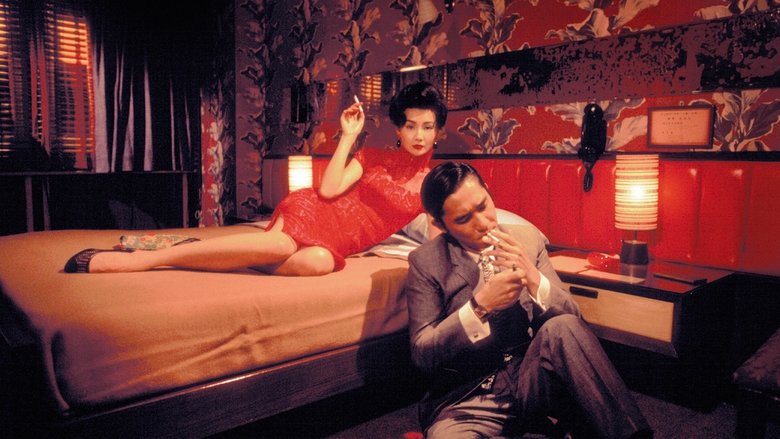

In the Mood for Love
A melancholic and visually stunning exploration of unrequited love, where unspoken emotions simmer beneath the surface like the steam from a noodle stall in 1960s Hong Kong.
In the Mood for Love

花樣年華

"Feel the heat, keep the feeling burning, let the sensation explode."

29 September 2000 Hong Kong 98 min ⭐ 8.1 (3,045)
Director: Wong Kar-Wai
Cast: Maggie Cheung, Tony Leung Chiu-wai, Rebecca Pan, Kelly Lai Chen, Siu Ping-Lam
Drama Romance
Unfulfilled Love and Longing Memory and Time Societal Norms and Repression Secrets and Betrayal
Budget: $3,000,000
Box Office: $15,867,968

In the Mood for Love - Ending Explained

⚠️ Spoiler Analysis

The plot of In the Mood for Love culminates in a series of near-misses and a final, heartbreaking acceptance of a love that can never be. After developing deep feelings for one another while collaborating on a martial arts serial in the privacy of hotel room 2046, Chow accepts a job in Singapore. He asks Su to go with him, but she arrives at the hotel room too late, after he has already left.

Years pass. Su, now with a young son, visits Singapore and calls Chow's apartment but remains silent when he answers the phone. He later realizes she was there when he finds a lipstick-stained cigarette in his ashtray. Later, back in Hong Kong, Chow returns to their old apartment building, narrowly missing Su, who now lives there with her son. He learns from the new neighbors that a woman and her son live there now but leaves without realizing it is her.

The film's final sequence takes place at the ancient temple of Angkor Wat in Cambodia. Chow, remembering a story he told about how people in the old days would unburden themselves of secrets, finds a hole in the temple wall. He whispers his unspoken feelings for Su into the cavity and seals it with mud, forever entombing his secret love. The final title card reveals that he remembers these past years as if through a dusty window—visible but untouchable. The unspoken implication is that they never meet again, their love remaining a beautiful, painful, and perfectly preserved memory.

Alternative Interpretations

While the film's central narrative is clear, its ambiguous nature, particularly the ending, invites several interpretations.

A Platonic Relationship: The most common interpretation is that Su and Chow's relationship remains platonic. They consciously choose not to consummate their feelings out of a sense of moral duty, determined not to become like their cheating spouses. Their bond is one of deep emotional intimacy and shared sorrow, but not physical infidelity. The film's power, in this reading, comes from their noble and painful restraint.

An Unseen Affair: Some critics and viewers speculate that an affair does happen, but it occurs off-screen, consistent with Wong Kar-wai's style of omitting key narrative events. The rehearsals and the intimate moments in Room 2046 could be seen as blurring the line between role-playing and reality. This interpretation suggests that their statement, "We won't be like them," is more of a hopeful denial than a statement of fact.

A Fantasy of Love: Another perspective is that the relationship is more of a shared fantasy. Traumatized by betrayal, Su and Chow create an idealized romance to cope with their pain and loneliness. They fall in love with the idea of each other and the roles they play, rather than the reality. Their inability to be together in the real world stems from the fact that their connection is rooted in a shared, imagined space, making a real-life commitment impossible.

The Ending as Metaphor: Chow's final act at Angkor Wat can be interpreted in different ways. Is he burying his love forever to move on, or is he preserving it in a sacred place, acknowledging its eternal significance? The ambiguity leaves the audience to decide whether the ending is one of tragic finality or poignant preservation.