
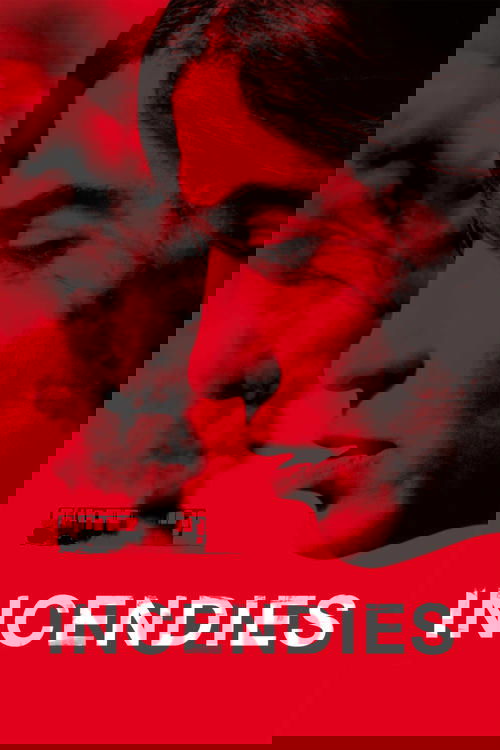
Full spoilers follow.
The setup. Nawal Marwan dies in Montréal after a period of silence. Her will, read by the notary Jean Lebel, orders that she be buried without a coffin, naked, face-down, with no headstone and no epitaph — until her twins, Jeanne and Simon, deliver two letters: one to their father, whom they believed dead, and one to a brother whose existence is news to them. Only then may a stone be placed and a name carved.
Nawal's past, reconstructed. As a young Christian woman in an unnamed Lebanon-like country, Nawal loved a refugee from the other community. Her family killed him and forced her to give up the son she bore, but not before she promised to find the boy; the child was marked so he could be identified later. Her search led her into the war — through a massacre of refugees, into militancy, and finally to the assassination of a militia leader, for which she was imprisoned for roughly fifteen years. In prison she became known as \"the woman who sings,\" and her defiance drew the attention of the facility's torturer, who raped her. The children conceived in that cell are Jeanne and Simon, saved at birth by a nurse and eventually brought to Canada.
The twist. The lost son grew up in an orphanage, was absorbed into the war as a child soldier and sniper, and was later trained by the opposing side as an interrogator — becoming the very torturer who assaulted his mother. The father and the brother are the same man. The two letters have one recipient. In mathematical terms, the equation Jeanne has been solving all film resolves to the impossible: one plus one equals one.
What the silence was. The film's opening premise is retroactively explained by a scene in a Canadian swimming pool, where Nawal sees the identifying mark on a man's body and understands everything at once. Her muteness is not illness or grief in the ordinary sense — it is the moment a mother recognises her son in her rapist. Everything the twins experience as maternal coldness was in fact the aftershock of that recognition.
The ending. With help from the warlord who once employed the boy, the twins locate him — now living in Canada — and deliver both envelopes. The letter to the father is unsparing: it names him for what he did. The letter to the son is the opposite: it tells him that nothing he became could sever the promise she made at his birth, that a mother's love is not conditional on what the world made of her child. He reads them in silence. The film closes with the burial condition satisfied and the headstone finally inscribed, restoring Nawal's name.
What only becomes clear afterwards. On a second viewing, the will is legible as a precisely engineered instrument: Nawal could simply have told her children, but a told truth would have been a fact, while a discovered one becomes an inheritance. She sends them to walk her own road so they will understand her rather than merely learn about her. The film's cross-cut structure — Villeneuve's \"building skeleton\" in which the audience fills the holes — is likewise a trap: it invites us to solve the puzzle a few beats ahead of Jeanne, so we arrive at the answer with exactly her horror. And the Greek-tragedy scaffolding declares itself fully: recognition, incest, prophecy fulfilled by the effort to escape it, and a final act of mercy that changes nothing about the past and everything about what the survivors carry forward.