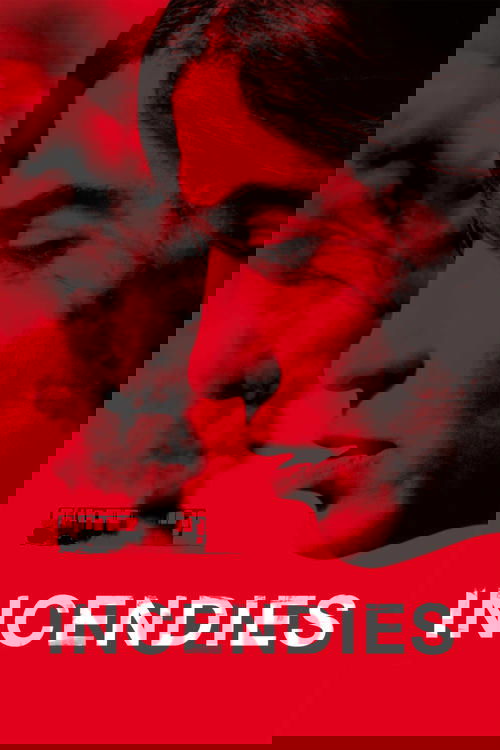
Incendies
A haunting, non-linear drama where buried family secrets ignite a journey into the scorched landscape of war-torn memory.
Incendies

Incendies

"The search began at the opening of their mother's will."

17 September 2010 Canada 131 min ⭐ 8.1 (3,022)
Director: Denis Villeneuve
Cast: Lubna Azabal, Mélissa Désormeaux-Poulin, Maxim Gaudette, Rémy Girard, Allen Altman
Drama War Mystery
The Cycle of Violence and Hatred Identity and Origins The Scars of War and Trauma Truth, Silence, and Reconciliation
Budget: $6,800,000
Box Office: $6,788,659

Overview

"Incendies" follows Canadian twins, Jeanne and Simon Marwan, who, after their mother Nawal's death, are tasked by her will to deliver two sealed letters. One is for a father they believed was dead, and the other for a brother they never knew existed. This posthumous request sends them on a gripping journey to an unnamed Middle Eastern country, heavily influenced by the Lebanese Civil War, to unravel their mother's mysterious and painful past.

As the twins delve deeper into Nawal's life, the film flashes back to her youth, revealing a harrowing story of forbidden love, political violence, and immense suffering. Jeanne, and later a reluctant Simon, piece together the puzzle of their origins, uncovering secrets that are far more shocking and interconnected than they could have ever imagined. The narrative masterfully weaves between the children's investigation in the present and their mother's tragic experiences in the past.

Core Meaning

At its heart, "Incendies" is a profound exploration of the cyclical nature of hatred and violence, and the possibility of breaking that chain through truth and reconciliation. Director Denis Villeneuve presents a story where personal trauma is inextricably linked to collective, political history. The film posits that confronting even the most horrifying truths is necessary to heal generational wounds. Nawal's final request is an act of breaking silence, forcing her children to understand the origins of their own anger and sorrow. The ultimate message is one of profound humanity: that even in the face of unspeakable atrocities, the promise of love and forgiveness can offer a path to peace.

Thematic DNA

The Cycle of Violence and Hatred 35%
Identity and Origins 30%
The Scars of War and Trauma 25%
Truth, Silence, and Reconciliation 10%

The Cycle of Violence and Hatred

This is the central theme, illustrated by the recurring violence fueled by the Christian-Muslim conflict that defines Nawal's life. The war's atrocities, such as the bus massacre, propel her to join the conflict, perpetuating the cycle. The film argues that hatred is learned and passed down through generations, a 'chain of anger' that Nawal desperately wants her children to break. The devastating final revelation underscores how violence turns victims into perpetrators, trapping everyone in its inescapable logic.

Identity and Origins

The entire plot is a quest for identity. Jeanne and Simon embark on a journey to understand their origins, which in turn reshapes their understanding of themselves. Nawal's life is a constant struggle with her identity—as a Christian who loves a Muslim, a political prisoner known as 'the woman who sings,' and a mother separated from her children. The film explores how identity is forged by history, family, and trauma, and how the truth of one's origins can be both liberating and shattering.

The Scars of War and Trauma

"Incendies" unflinchingly portrays the long-lasting impact of war, showing how trauma reverberates through generations. Nawal's experiences of loss, imprisonment, and torture leave indelible scars that affect her relationship with her children in Canada, decades later. The film visualizes this through the 'scorched' landscapes of her homeland, a metaphor for her internal state. It powerfully argues that the wounds of war do not simply disappear with time or distance.

Truth, Silence, and Reconciliation

The film is structured as a mystery where the truth is gradually unearthed. Nawal's silence throughout her life in Canada is a heavy burden, and her will is a final, desperate act to break it. The journey is painful, but it is only by confronting the horrific truth that the family can find a semblance of peace. The ending, where Nawal's rapist/son receives two letters—one of hate, one of love—suggests that reconciliation is not about forgetting, but about acknowledging the whole, terrible truth.

Character Analysis

Nawal Marwan

Lubna Azabal

Archetype: The Tragic Heroine
Key Trait: Resilient

Motivation

Initially motivated by love for her child and her lover, her primary motivation becomes vengeance after witnessing the bus massacre. After her imprisonment and the birth of the twins, her motivation shifts to survival and protecting her children from her past. Her final motivation is to force a confrontation with the truth, no matter how painful, to free her children and herself.

Character Arc

Nawal's journey is one of immense suffering and resilience. She begins as a young woman in love, is radicalized by the violence of the civil war, becomes a political assassin, and endures 15 years of torture in prison where she is known as 'The Woman Who Sings.' After immigrating to Canada, she lives in a state of silent trauma. Her arc completes posthumously, as her will forces the truth to be revealed, finally breaking the 'chain of anger' and allowing her to be buried with a name.

Jeanne Marwan

Mélissa Désormeaux-Poulin

Archetype: The Seeker
Key Trait: Methodical

Motivation

Jeanne is motivated by a deep-seated need to understand her enigmatic mother and the silence that permeated their lives. She is driven by love and a sense of duty to fulfill Nawal's last wish and uncover the truth of their origins.

Character Arc

Initially, Jeanne is a quiet academic, seemingly detached from her family's emotional turmoil. She is the first to accept her mother's quest, approaching it with methodical determination. Her journey transforms her from a passive observer of her family's history into an active participant. She confronts the brutal realities of her mother's past, which forces her to mature and understand the deep-seated pain that defined her family.

Simon Marwan

Maxim Gaudette

Archetype: The Skeptic
Key Trait: Cynical

Motivation

Simon's initial motivation is to resist what he perceives as his mother's final act of control. His motivation shifts to protecting his sister and, eventually, a need to confront the past that has haunted his family and understand the source of his own anger.

Character Arc

Simon begins as angry and cynical, holding deep resentment towards his mother for her emotional distance. He initially refuses to participate in her posthumous quest, viewing it as another one of her games. However, as Jeanne uncovers more of the story, his anger gives way to a reluctant sense of responsibility. He travels to join his sister and ultimately plays a crucial role in uncovering the final, devastating truth, transforming his anger into a profound, grieving understanding of his mother's sacrifice.

Nihad de Mai / Abou Tarek

Allen Altman

Archetype: The Monster / The Lost Son
Key Trait: Traumatized

Motivation

As a child, his motivation is survival. The war twists him, and as Abou Tarek, he is motivated by ideology and cruelty. After the war, his motivation appears to be assimilation and the suppression of his past. The final revelation obliterates any sense of a clear motivation, leaving him shattered by fate.

Character Arc

Nihad's arc is a tragic spiral from innocent victim to monstrous perpetrator. Taken from his mother at birth, he becomes a child soldier, then a notorious torturer for the nationalist militia named Abou Tarek. After the war, he is given a new life in Canada. His arc culminates in the devastating realization of his dual identity as both Nawal's son and her rapist, the brother and the father of the twins. The end shows him standing at Nawal's grave, a figure consumed by a horrifying, inescapable truth.

Symbols & Motifs

The Number One (1+1=1)

Meaning:

This mathematical equation, which Jeanne, a mathematics professor, grapples with, symbolizes the impossible and horrifying truth at the heart of the film: that two people (the father and the brother) are actually one person. It represents a logic that defies reason, much like the senselessness of the war itself.

Context:

Jeanne discusses the concept in her university lectures. The symbol's meaning becomes devastatingly clear in the final act when the twins realize their father and their long-lost brother are the same man, Nihad.

Fire

Meaning:

The title "Incendies" translates to "Fires" or "Scorched." Fire symbolizes destruction, rage, and the indelible marks of war. It represents both the literal violence, like the burning bus, and the emotional 'scorching' of Nawal's soul and her family's history. It also hints at a brutal form of purification or revelation.

Context:

The most searing use of this symbol is the massacre scene where a bus full of Muslim refugees is shot up and set on fire by Christian nationalists. This event is a turning point for Nawal, igniting her rage and driving her to political action.

Swimming Pool

Meaning:

The swimming pool represents the place of shocking revelation and the collision of past and present. It is a seemingly tranquil, ordinary Western setting where the horrific, unspoken trauma of the past erupts into the present.

Context:

The film opens with Nawal having a stroke at a public pool after seeing the three-dot tattoo on a man's heel. This is the moment she recognizes her torturer and son, Nihad. The sight triggers the final chapter of her life and sets the plot in motion.

Three Dots Tattoo

Meaning:

The three dots tattooed on the heel are a symbol of identity and destiny. Initially a mark of a mother's love to one day find her lost son, it is horrifically transformed into the identifying mark of a monster—the torturer Abou Tarek.

Context:

Nawal's mother tattoos three dots on her firstborn son's heel before he is sent to an orphanage so Nawal might one day recognize him. Decades later, this is the mark Nawal sees at the pool, and the mark the twins are told to look for to identify their brother. It is the clue that ultimately resolves the central mystery.

Memorable Quotes

La mort, c'est jamais la fin de l'histoire. Il y a toujours des traces.

— Jean Lebel

Context:

Spoken by the notary, Jean Lebel, at the beginning of the film during the reading of Nawal's will, as he explains to the bewildered twins the task their mother has left for them.

Meaning:

"Death is never the end of the story. There are always traces left behind." This quote establishes the film's central premise: that the past is never truly dead and its secrets will eventually surface. It foreshadows the journey the twins must take into their mother's history.

L'enfance est un couteau planté dans la gorge.

— Nawal Marwan (in her letter)

Context:

This is a line from one of Nawal's letters, read aloud, explaining the depth of the wound she has carried with her since her youth, a wound she can no longer bear in silence.

Meaning:

"Childhood is a knife stuck in the throat." This powerful metaphor conveys the idea that early life traumas are deeply embedded and can silence a person for their entire life. It speaks to the profound and lasting pain of Nawal's experiences.

On est tous sur le bord du chemin à insulter la vie. On ne veut plus de cette vie-là. Il faut défaire le fil de la colère.

— Nawal Marwan (in her letter)

Context:

From Nawal's final letter to her children, explaining her actions and her hope that by uncovering the truth, they can end the legacy of anger that began with her.

Meaning:

"We are all on the side of the road, insulting life. We don't want this life anymore. We must break the thread of anger." This quote articulates the film's core message about breaking the cycle of hatred that is passed down through generations. It is Nawal's ultimate plea for peace and reconciliation.

Philosophical Questions

Can the cycle of hatred and revenge ever be truly broken?

The film places this question at its center. The entire plot is a 'chain of anger' forged in a civil war where violence begets more violence. Nawal is both a victim and a perpetrator in this cycle. Her final wish for her children to deliver the letters is a desperate attempt to break this chain, not with more violence, but with a devastating truth. The ending remains ambiguous on whether the cycle is truly broken for everyone—Nihad's fate is left uncertain—but it suggests that for Jeanne and Simon, understanding the origin of their pain is the first step toward liberation.

Is it better to know a devastating truth or live in ignorance?

Nawal's life in Canada is defined by a heavy silence, a form of ignorance she imposes on her children to protect them. However, this silence breeds its own kind of poison, creating resentment and confusion. The film argues that truth, no matter how horrific, is necessary for healing and understanding. The twins' journey is a painful stripping away of ignorance, and while the truth they uncover is nearly unbearable, it ultimately allows them to understand their mother and themselves, finally granting Nawal a proper burial and a name, symbolizing peace.

How much of our identity is shaped by forces beyond our control?

"Incendies" explores the concept of identity as something inherited and forged by history, conflict, and family secrets. The twins' identities are completely upended by the revelation of their origins. Nihad's life is the most extreme example: a boy whose entire identity as a loving son was stolen from him at birth, only to be replaced by that of a killer and a torturer by the forces of war. The film leans towards a deterministic view, suggesting that individuals are often swept up in historical and familial tides that are incredibly difficult to escape.

Alternative Interpretations

While the film's narrative is quite direct, discussions among critics and viewers have centered on the interpretation of its ending and core message. One perspective sees the ending as deeply pessimistic, suggesting that trauma is an inescapable prison and that certain wounds are too deep to ever truly heal. The final, silent shot of Nihad at his mother's grave can be read as a portrait of a man utterly destroyed by the truth, with no hope for redemption. A more optimistic interpretation, however, focuses on Nawal's final act as one of ultimate grace. By sending two letters—one of condemnation to the father/rapist and one of love to the son—she acknowledges the duality of his existence. This act breaks the cycle of pure hatred. In this view, Nihad's presence at her grave is not an ending but a beginning of a long, painful reckoning, and the twins, by delivering the letters, have successfully broken the 'chain of anger,' freeing their own future even if his is shattered. This reading emphasizes the film's message about the power of truth and forgiveness, however difficult, as the only way forward.

Cultural Impact

"Incendies" was met with widespread critical acclaim upon its release, lauded as a masterpiece of Canadian cinema and one of Denis Villeneuve's finest works. It was Canada's official submission for the Best Foreign Language Film at the 83rd Academy Awards, earning a nomination and significantly raising Villeneuve's international profile, paving the way for his successful transition to Hollywood. The film's narrative, reminiscent of a Greek tragedy, resonated with audiences and critics for its powerful examination of intergenerational trauma and the consequences of war. Although Villeneuve intended the setting to be a fictional, apolitical landscape to focus on the theme of anger itself, the story's parallels to the Lebanese Civil War sparked conversations about that conflict's history and its lingering wounds. When screened in Beirut, many viewers felt it was an important film for their children to see, to understand the history they had endured. The film's shocking and meticulously constructed plot twist has become infamous among cinephiles, solidifying its place as a powerful and unforgettable piece of cinema that explores the depths of human suffering and the difficult path toward reconciliation.

Audience Reception

Audiences have generally lauded "Incendies" as a powerful, emotionally devastating, and unforgettable film. It holds a 91% positive rating on Rotten Tomatoes. Viewers frequently praise the masterful storytelling, the stunning cinematography, and the brilliant performance by Lubna Azabal as Nawal. The film's final plot twist is almost universally cited as one of the most shocking and impactful in modern cinema. The primary point of praise is its unflinching, yet sensitive, handling of difficult themes like war, trauma, and hatred. Criticism, though less common, sometimes points to the narrative's reliance on what can feel like an implausible coincidence, with some finding the third act to be overly melodramatic, bordering on a 'Latin American soap opera' rather than a Greek tragedy. A few viewers also found the pacing slow and the relentless tragedy to be emotionally exhausting, making it a difficult film to watch.

Interesting Facts

  • The film is an adaptation of a critically acclaimed play of the same name by Wajdi Mouawad.
  • While the country in the film is never named, the events are heavily inspired by the Lebanese Civil War (1975-1990).
  • The character of Nawal Marwan was partly inspired by the life of Souha Bechara, a Lebanese woman who was imprisoned for attempting to assassinate a leader of a Christian militia.
  • Director Denis Villeneuve spent five years working on the screenplay adaptation.
  • The film was shot in Montreal, Canada, and Amman, Jordan, with the Jordanian locations standing in for the war-torn Middle Eastern setting.
  • Belgian-Moroccan actress Lubna Azabal, who was 30 at the time, played Nawal across four decades of her life, from a teenager to a 60-year-old woman.
  • The film was nominated for the Academy Award for Best Foreign Language Film at the 83rd Academy Awards.
  • The use of two Radiohead songs, "You and Whose Army?" and "Like Spinning Plates," was written into the script from the beginning to establish a Western perspective on the events.

⚠️ Spoiler Analysis

Click to reveal detailed analysis with spoilers

Frequently Asked Questions

Explore More About This Movie

Dive deeper into specific aspects of the movie with our detailed analysis pages

Comments (0)

Leave a comment

No comments yet. Be the first to share your thoughts!