
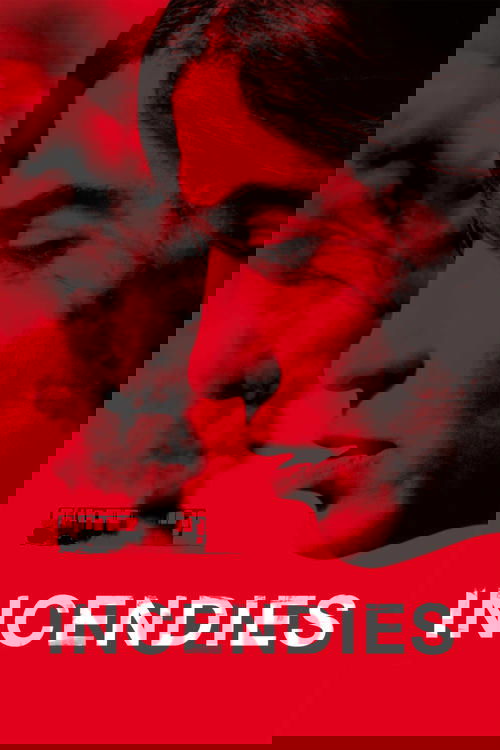
"The search began at the opening of their mother's will."
Incendies - Symbolism & Philosophy
Symbols & Motifs
The Number One (1+1=1)
This mathematical equation, which Jeanne, a mathematics professor, grapples with, symbolizes the impossible and horrifying truth at the heart of the film: that two people (the father and the brother) are actually one person. It represents a logic that defies reason, much like the senselessness of the war itself.
Jeanne discusses the concept in her university lectures. The symbol's meaning becomes devastatingly clear in the final act when the twins realize their father and their long-lost brother are the same man, Nihad.
Fire
The title "Incendies" translates to "Fires" or "Scorched." Fire symbolizes destruction, rage, and the indelible marks of war. It represents both the literal violence, like the burning bus, and the emotional 'scorching' of Nawal's soul and her family's history. It also hints at a brutal form of purification or revelation.
The most searing use of this symbol is the massacre scene where a bus full of Muslim refugees is shot up and set on fire by Christian nationalists. This event is a turning point for Nawal, igniting her rage and driving her to political action.
Swimming Pool
The swimming pool represents the place of shocking revelation and the collision of past and present. It is a seemingly tranquil, ordinary Western setting where the horrific, unspoken trauma of the past erupts into the present.
The film opens with Nawal having a stroke at a public pool after seeing the three-dot tattoo on a man's heel. This is the moment she recognizes her torturer and son, Nihad. The sight triggers the final chapter of her life and sets the plot in motion.
Three Dots Tattoo
The three dots tattooed on the heel are a symbol of identity and destiny. Initially a mark of a mother's love to one day find her lost son, it is horrifically transformed into the identifying mark of a monster—the torturer Abou Tarek.
Nawal's mother tattoos three dots on her firstborn son's heel before he is sent to an orphanage so Nawal might one day recognize him. Decades later, this is the mark Nawal sees at the pool, and the mark the twins are told to look for to identify their brother. It is the clue that ultimately resolves the central mystery.
Philosophical Questions
Can the cycle of hatred and revenge ever be truly broken?
The film places this question at its center. The entire plot is a 'chain of anger' forged in a civil war where violence begets more violence. Nawal is both a victim and a perpetrator in this cycle. Her final wish for her children to deliver the letters is a desperate attempt to break this chain, not with more violence, but with a devastating truth. The ending remains ambiguous on whether the cycle is truly broken for everyone—Nihad's fate is left uncertain—but it suggests that for Jeanne and Simon, understanding the origin of their pain is the first step toward liberation.
Is it better to know a devastating truth or live in ignorance?
Nawal's life in Canada is defined by a heavy silence, a form of ignorance she imposes on her children to protect them. However, this silence breeds its own kind of poison, creating resentment and confusion. The film argues that truth, no matter how horrific, is necessary for healing and understanding. The twins' journey is a painful stripping away of ignorance, and while the truth they uncover is nearly unbearable, it ultimately allows them to understand their mother and themselves, finally granting Nawal a proper burial and a name, symbolizing peace.
How much of our identity is shaped by forces beyond our control?
"Incendies" explores the concept of identity as something inherited and forged by history, conflict, and family secrets. The twins' identities are completely upended by the revelation of their origins. Nihad's life is the most extreme example: a boy whose entire identity as a loving son was stolen from him at birth, only to be replaced by that of a killer and a torturer by the forces of war. The film leans towards a deterministic view, suggesting that individuals are often swept up in historical and familial tides that are incredibly difficult to escape.
Core Meaning
At its heart, "Incendies" is a profound exploration of the cyclical nature of hatred and violence, and the possibility of breaking that chain through truth and reconciliation. Director Denis Villeneuve presents a story where personal trauma is inextricably linked to collective, political history. The film posits that confronting even the most horrifying truths is necessary to heal generational wounds. Nawal's final request is an act of breaking silence, forcing her children to understand the origins of their own anger and sorrow. The ultimate message is one of profound humanity: that even in the face of unspeakable atrocities, the promise of love and forgiveness can offer a path to peace.